



5 Elements (Wu Xing): The Five Elements Theory in Chinese Medicine
The 5 Elements — Wu Xing (五行) — in traditional Chinese medicine are Wood, Fire, Earth, Metal and Water: the five fundamental phases of energy that govern all natural phenomena, including the human body. This is a theory page about the classical 5 Elements (Wu Xing) framework used across Chinese medicine for over 2,000 years. Each of the 5 Elements corresponds to a pair of organs, an emotion, a season, a colour and a taste, and the elements interact through the generating cycle (sheng), in which each element nourishes the next, and the controlling cycle (ke), in which each element restrains another. Imbalances in this dynamic 5 Elements system underlie disease patterns in TCM and guide diagnosis and treatment. This page covers the theory itself. If you are looking for the modern Worsley-school treatment style, see the separate page on 5 Elements Acupuncture (Five Element acupuncture).
On this page
- What are the Five Elements?
- History of Five Element theory
- The five elements explained
- Five Element correspondences
- The generating, controlling and insulting cycles
- Five Element diagnosis
- Five Element imbalances and disease
- How TCM is used in clinical practice for Five Element imbalances
- The 5 Elements in my Wokingham fertility practice
- Commonly asked questions about the 5 Elements
1. What are the 5 Elements?
The 5 Elements — known in Chinese as wu xing (五行), which translates more precisely as "Five Phases" or "Five Movements" — is one of the most important and sophisticated theoretical frameworks in traditional Chinese medicine (TCM). Together with yin and yang theory, the 5 Elements form the theoretical bedrock upon which TCM diagnosis and treatment is built.
The 5 Elements are Wood, Fire, Earth, Metal and Water. These are not understood as literal physical substances but as archetypes of transformation — five fundamental phases or qualities of change through which all phenomena in the natural world, and in the human body, cycle. Each of the 5 Elements embodies a distinct set of characteristics, associated with specific internal organs, emotions, seasons, climates, colours, sounds, tastes, body tissues and sensory organs.
By mapping the human body onto this framework, a TCM practitioner can understand how the organ systems relate to and influence each other, identify the root cause of disease across multiple organ systems simultaneously, and select the most appropriate treatment strategy using acupuncture, Chinese herbal medicine or moxibustion to restore balance.
2. History of Five Element theory
Five Element theory is thought to have originated during the Warring States period (475–221 BCE) and was consolidated during the Han Dynasty (206 BCE–220 CE), when Chinese scholars were engaged in systematically observing nature and developing a comprehensive framework for understanding how natural processes could be mapped onto the physiology of the human body.
The theory draws on ancient Chinese cosmological thought, in which the five elements were used to classify everything in the universe — from the planets and seasons to the flavours of food and the qualities of human character. When applied to medicine, the five elements provided a way to understand not just individual organ function but the dynamic relationships between organs, explaining how disease in one part of the body could arise from or affect another seemingly unrelated part.
The medical application of Five Element theory was codified in the foundational classical text of traditional Chinese medicine, the Huángdì Nèijīng (The Yellow Emperor's Classic of Medicine), compiled around 300 BCE. It has been refined and developed by generations of physician-scholars across the dynasties and remains a living clinical tool in TCM practice today.
It is important to distinguish Five Element theory as used in TCM from Five Element acupuncture — a distinct western style of acupuncture developed in the 20th century by the Englishman JR Worsley. Five Element acupuncture does not exist in East Asia and is not recognised in China, Australia or other countries where acupuncture is regulated. The classical Five Element theory described here is the ancient East Asian framework used across all traditional styles of Chinese medicine.
3. The five elements explained
Each of the five elements represents a phase of transformation with its own distinctive quality, movement and set of associations. Understanding each element in depth is the foundation of Five Element diagnosis and treatment.
Wood 木
Wood represents the energy of growth, expansion and upward movement — like a tree pushing upward through the soil in spring. It is associated with new beginnings, vision, planning and the capacity for creative, directed action. Wood energy is dynamic and assertive; when in balance it produces clear thinking, decisiveness and the ability to move forward smoothly in life.
The primary yin organ of Wood is the Liver, and its yang organ is the Gallbladder. The Liver in TCM governs the smooth flow of qi throughout the body — ensuring that energy moves freely and without obstruction through all the organ systems. It also stores blood, governs the tendons and sinews, and opens into the eyes. The emotion associated with Wood is anger, frustration and resentment — when the Liver's qi is obstructed or its energy is excessive, these emotions arise; when Wood is deficient, a person may feel directionless, indecisive or depressed.
Common clinical presentations linked to Wood imbalance include headaches and migraines (particularly at the temples or crown), visual disturbances, tendon and sinew problems, muscle cramps, IBS and digestive disorders triggered by stress, depression, irregular menstrual cycles and premenstrual tension.
Fire 火
Fire represents the energy of warmth, radiance, maximum yang activity and connection. It is associated with summer — the height of the year's energy — with joy, laughter, passion and the capacity for intimacy and relationship. Fire energy is expansive and outward-moving; it governs the mind, consciousness and the ability to experience and express joy.
The primary yin organ of Fire is the Heart, and its yang organ is the Small Intestine. TCM also recognises two additional Fire organ pairs: the Pericardium (Heart Protector) and the Triple Burner (San Jiao). The Heart in TCM governs blood circulation and houses the shen — the mind and spirit. When the Heart is healthy, thinking is clear, sleep is sound and relationships are warm and connected. When Fire is disturbed, the mind becomes agitated and unsettled.
Common clinical presentations linked to Fire imbalance include insomnia, anxiety and palpitations, poor memory and concentration, depression and lack of joy, speech disorders, excessive or inappropriate laughter, and difficulty forming or maintaining close relationships.
Earth 土
Earth represents the energy of stability, nourishment, centredness and transformation. It is associated with late summer — the transitional season between the expansiveness of summer and the gathering inward of autumn — with the qualities of groundedness, care, nurturing and the ability to receive and process. Earth energy is steady, reliable and sustaining.
The primary yin organ of Earth is the Spleen, and its yang organ is the Stomach. In TCM, the Spleen governs digestion and the transformation of food and fluids into qi and blood — the vital substances that nourish every cell in the body. It also governs the muscles and limbs, maintains the organs in their proper positions (preventing prolapse) and is responsible for the quality of thought and concentration. The emotion associated with Earth is worry and overthinking.
Common clinical presentations linked to Earth imbalance include digestive weakness, bloating, loose stools, poor appetite, fatigue after eating, excessive worry and rumination, difficulty concentrating, chronic fatigue, fluid retention and oedema, and bruising easily. Because the Spleen produces blood, its deficiency is also a common contributor to fertility problems and menopausal symptoms.
Metal 金
Metal represents the energy of contraction, refinement, letting go and the inward movement of autumn. It is associated with precision, purity, boundaries and the ability to distinguish what is essential from what can be released. Metal energy is clear, sharp and discerning — at its best it gives a person clarity of mind, strong boundaries and the capacity to grieve and move on.
The primary yin organ of Metal is the Lung, and its yang organ is the Large Intestine. The Lung in TCM governs respiration and the circulation of wei qi (defensive energy) across the body's surface — its first line of defence against external pathogens such as wind, cold and damp. It also governs the skin and body hair and is connected to the nose and sense of smell. The emotion associated with Metal is sadness, grief and the capacity to let go.
Common clinical presentations linked to Metal imbalance include respiratory conditions including recurrent colds and infections, asthma, sinusitis and skin conditions such as acne and eczema, constipation and large intestine disorders, inability to grieve or let go of past events, low immunity, and a tendency to be overly rigid or perfectionistic.
Water 水
Water represents the energy of depth, stillness, potential, storage and the dormancy of winter. It is associated with the most yin phase of the year — when energy retreats inward and downward, conserved for the renewal of spring. Water energy is deep, still and powerful — at its best it gives a person profound reserves of willpower, courage, wisdom and the ability to endure.
The primary yin organ of Water is the Kidney, and its yang organ is the Urinary Bladder. The Kidney in TCM is considered the root of all yin and yang in the body and stores the body's fundamental essence (jing) — the constitutional vitality inherited at birth that governs development, reproduction, ageing and longevity. It governs bone, marrow and the brain, and opens into the ears. The emotion associated with Water is fear and the counterbalancing virtue of willpower and courage.
Common clinical presentations linked to Water imbalance include lower back pain and knee weakness, tinnitus and hearing loss, fertility problems including low AMH, poor egg quality and low sperm count, premature ageing, insomnia (particularly waking between 2 and 4am), urinary frequency, Raynaud's disease, excessive fear and anxiety, and burn out.
4. Five Element correspondences
Each of the five elements has a comprehensive set of correspondences that map its qualities onto every aspect of the natural world and the human body. These correspondences allow a TCM practitioner to recognise an element's influence in a patient's signs, symptoms, appearance, voice and behaviour, and to use this information in diagnosis and treatment.
| Correspondence | Wood | Fire | Earth | Metal | Water |
|---|---|---|---|---|---|
| Yin organ | Liver | Heart | Spleen | Lung | Kidney |
| Yang organ | Gallbladder | Small Intestine | Stomach | Large Intestine | Urinary Bladder |
| Season | Spring | Summer | Late summer | Autumn | Winter |
| Climate | Wind | Heat | Dampness | Dryness | Cold |
| Emotion | Anger / frustration | Joy / agitation | Worry / pensiveness | Sadness / grief | Fear / willpower |
| Colour | Green / blue-green | Red | Yellow | White | Black / dark blue |
| Taste | Sour | Bitter | Sweet | Pungent / spicy | Salty |
| Sound / voice | Shouting | Laughing | Singing | Weeping | Groaning |
| Body tissue | Tendons / sinews | Blood vessels | Muscles / flesh | Skin / body hair | Bones / marrow |
| Sense organ | Eyes | Tongue | Mouth / lips | Nose | Ears |
| Direction | East | South | Centre | West | North |
| Flavour craving | Sour | Bitter | Sweet | Pungent | Salty |
These correspondences are not merely theoretical — they have direct clinical utility. For example, a patient who craves sour foods, has red or irritated eyes, suffers from tendon problems and experiences frequent anger or frustration is showing signs that point clearly to a Wood (Liver) imbalance. A patient who is chronically fearful, has persistent lower back pain, poor hearing and fragile bones is demonstrating a Water (Kidney) pattern. By reading these signs together, a TCM practitioner can build a comprehensive picture of which element or elements are out of balance and direct treatment accordingly.
5. The generating, controlling and insulting cycles
The five elements do not exist in isolation — they are connected by dynamic relationships that describe how they support, restrain and sometimes undermine each other. There are three primary cycles: the generating cycle, the controlling cycle and the insulting cycle.
The generating cycle (Sheng cycle)
The generating cycle — also known as the mother-child cycle — describes the sequence in which each element nourishes and supports the next: Wood generates Fire; Fire generates Earth; Earth generates Metal; Metal generates Water; Water generates Wood. Each element is the "mother" of the one it generates and the "child" of the one that generates it.
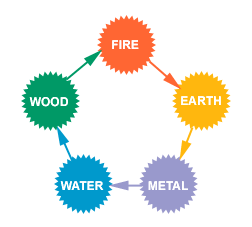
This relationship has direct clinical implications. In the generating cycle, if the mother element is deficient, the child will be insufficiently nourished and may also become deficient over time. Conversely, if the child element is chronically depleted, it may drain the mother. A practitioner can treat a deficient organ either directly or by tonifying its mother organ. For example, Kidney (Water) is the mother of Liver (Wood); treating Kidney deficiency can therefore help strengthen Liver function. Similarly, Heart (Fire) generates Spleen (Earth); chronic worry and overthinking that depletes the Spleen may be rooted in an underlying Heart imbalance.
A classic clinical example of the generating cycle in action is the relationship between the Heart (Fire) and the Spleen (Earth). When a person experiences chronic anxiety, the Heart is in a state of excess or agitation (Fire overacting), which can weaken the Spleen's (Earth) digestive and transformative function — explaining why many anxious patients also suffer from digestive problems and fatigue.
The controlling cycle (Ko cycle)
The controlling cycle — also called the restraining or checking cycle — describes the sequence in which each element keeps another in check, preventing it from becoming excessive: Wood controls Earth; Earth controls Water; Water controls Fire; Fire controls Metal; Metal controls Wood.
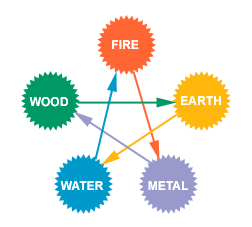
This restraining relationship is essential for maintaining balance within the system. Just as the generating cycle ensures that each element receives nourishment, the controlling cycle ensures that no element becomes excessive at the expense of others. When the controlling relationship is healthy, each element is held within its appropriate bounds. When the controlling relationship is disrupted — either because the controlling element is too weak to restrain the other, or because the controlled element has become excessively strong — imbalance and disease result.
For example, the Liver (Wood) normally controls the Spleen (Earth) — a relationship seen clinically in the way that emotional stress and Liver qi stagnation so frequently disrupts digestion. When the Liver over-controls the Spleen, patients experience digestive cramping, bloating and IBS, particularly when under emotional pressure. Another example: the Kidney (Water) controls the Heart (Fire). When Kidney yin is deficient, it fails to restrain Heart fire, producing symptoms of insomnia, palpitations and anxiety.
The insulting cycle (Wu cycle)
The insulting cycle — also called the counteracting or rebellion cycle — describes what happens when the normal controlling relationship is reversed. Instead of Wood controlling Earth, Earth insults Wood; instead of Water controlling Fire, Fire insults Water, and so on.
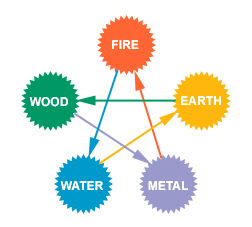
The insulting cycle occurs when an element has become so excessive that it overpowers the element that would normally control it, or when the controlling element has become so weak that it can no longer perform its restraining function. This represents a more severe disruption of balance and indicates that the condition has progressed beyond simple imbalance to a more complex and entrenched pattern. Recognising insulting relationships is an important part of advanced TCM diagnosis and helps explain why some patients present with apparently paradoxical or complex symptom pictures.
6. Five Element diagnosis
Five Element diagnosis is one of the most nuanced and holistic diagnostic tools in traditional Chinese medicine. It goes beyond identifying the organ system involved in a patient's symptoms to identify the underlying constitutional element — the element that represents the patient's fundamental nature and that, when out of balance, is the root cause of their recurring health problems.
A TCM practitioner gathers Five Element diagnostic information through four methods: questioning, observation, listening and palpation. The colour of the patient's complexion, the quality of their voice, the emotion that predominates, the odour they carry and the specific body tissues and sense organs affected all provide clues about which element is the constitutional focus of the imbalance.
For example, a greenish or blue-green tinge to the complexion around the temples and eyes, a tendency to shout or to speak with a clipped assertive tone, a predominance of anger or frustration, a craving for sour foods and a history of eye, tendon and menstrual problems would all point towards a Wood constitutional type. A patient with a yellowish tinge to their complexion, a singing quality to their voice, a tendency to worry, a craving for sweetness and a history of digestive weakness and fatigue would suggest an Earth constitutional pattern.
This constitutional diagnosis is used alongside pattern differentiation — the identification of the specific type of imbalance (excess, deficiency, heat, cold, stagnation, etc.) — to build a complete and nuanced picture of each patient's individual health presentation.
7. Five Element imbalances and disease
Five Element imbalances can arise from a wide range of causes — emotional stress, dietary habits, climatic exposure, overwork, constitutional weakness or the natural process of ageing. Because the elements are interconnected through the generating and controlling cycles, an imbalance in one element will eventually affect others, producing complex, multi-system presentations that are often difficult to address through western medicine's symptom-focused approach.
The following are some of the most clinically common Five Element imbalance patterns and their associated health conditions:
Wood (Liver and Gallbladder) imbalance
Wood imbalance is one of the most common patterns seen in modern clinical practice, driven largely by the demands of contemporary life — chronic stress, overwork, irregular eating and insufficient rest all predispose the Liver to stagnation. Associated conditions include headaches and migraines, IBS, irregular or painful periods, premenstrual tension, depression, tendon and muscle pain, and visual problems.
Fire (Heart and Small Intestine) imbalance
Fire imbalance commonly manifests as disturbances of the mind and spirit, producing insomnia, anxiety, palpitations, poor memory and concentration, and emotional instability. Heart fire excess produces restlessness and agitation; Heart qi or blood deficiency produces low mood, flat affect and difficulty finding joy.
Earth (Spleen and Stomach) imbalance
Earth imbalance produces digestive weakness and fatigue, as the Spleen's ability to transform food into qi and blood is impaired. Associated conditions include bloating, IBS, poor appetite, loose stools, chronic tiredness, chronic fatigue syndrome, fluid retention and excessive worry. Spleen deficiency is also a common contributing factor in fertility problems, as the Spleen produces the blood needed to nourish the uterine lining and sustain pregnancy.
Metal (Lung and Large Intestine) imbalance
Metal imbalance typically affects immunity and the body's defensive surface, producing recurrent colds and infections, chronic fatigue, asthma, sinusitis, skin conditions including acne and eczema, constipation and large intestine dysfunction, and difficulty processing grief and loss.
Water (Kidney and Urinary Bladder) imbalance
Water imbalance produces depletion of the body's fundamental constitutional energy, manifesting as lower back pain, knee weakness, tinnitus, urinary problems, premature ageing, fertility difficulties including low AMH and low sperm count, burn out, bone problems, menopausal symptoms and excessive fear or lack of willpower.
8. How TCM is used in clinical practice for Five Element imbalances
Treatment of Five Element imbalances in TCM is always tailored to the individual patient's specific pattern. The practitioner must first identify which element or elements are out of balance, the nature of the imbalance (excess or deficiency, heat or cold, stagnation or weakness), and which cycle relationships are disrupted, before selecting the appropriate therapeutic approach.
Acupuncture uses specific points on the meridians associated with each element to regulate qi, tonify deficiency, clear excess and restore the smooth flow of energy between the organ systems. Each meridian has five elemental points — one corresponding to each of the Five Elements — which allow the practitioner to influence the generating and controlling cycles directly through needling. For example, the Water point on the Liver meridian can be needled to nourish Liver yin (tonifying the Kidney's contribution to Liver blood); the Wood point on the Stomach meridian can help address digestive stagnation driven by Liver over-control of the Spleen.
Chinese herbal medicine uses herbs that are classified according to the Five Element framework — each herb has a taste, nature and organ affinity that determines which elements and organ systems it addresses. A sour-tasting herb enters the Liver (Wood); a bitter herb enters the Heart (Fire); a sweet herb nourishes the Spleen (Earth); a pungent herb supports the Lung (Metal); a salty herb tonifies the Kidney (Water). By combining herbs into bespoke formulas, the practitioner can nourish deficient elements, clear excess from overactive ones and restore the balance of the generating and controlling cycles.
Moxibustion is particularly valuable for treating deficiency of yang in the Earth and Water elements — conditions of cold, digestive weakness, fatigue and depleted Kidney essence respond well to the penetrating warmth of moxibustion applied to relevant acupuncture points.
Dietary therapy uses food according to the Five Element framework. Each taste corresponds to a specific element and organ system, and eating appropriate foods can support a deficient element or reduce an excess. Sweet foods in moderate quantity nourish the Spleen; sour foods in small amounts support the Liver; bitter foods clear Heart fire; pungent foods support Lung function; salty foods in moderation strengthen the Kidney.
To find out more about how 5 Elements theory applies to your own health, you can schedule a consultation at my clinic in Wokingham, Berkshire or book an online consultation.
9. The 5 Elements in my Wokingham fertility practice
Theory is one thing; what the 5 Elements actually look like in a working UK clinic is another. After twenty-five years of practising in Wokingham — with a caseload weighted heavily toward fertility, IVF preparation, menstrual disorders and the menopausal transition — certain 5 Elements patterns recur with striking regularity in the patients who come through my door. Understanding which ones, and why, helps explain how the classical theory is applied in modern western fertility practice.
The Wood/Earth axis dominates the fertility caseload. The single most common pattern I see in women trying to conceive is Liver qi stagnation (Wood) over-controlling the Spleen (Earth). The clinical picture is familiar to almost every fertility patient: a stressful job or longstanding emotional strain, premenstrual tension and irritability, bloating that worsens before the period, painful or clotty periods, irregular bowel function and a tongue with redness or purple on the sides plus tooth-marks at the front. In 5 Elements terms, the Wood element has become excessive and is rebelling against the Earth element that should be supporting digestion and the production of qi and blood. Treatment moves Liver qi (acupuncture points like LV3 and GB34, herbs such as Chai Hu and Bai Shao), strengthens Spleen function (ST36, herbs such as Bai Zhu and Huang Qi), and gently nourishes Liver blood to allow Wood to soften. This single pattern probably accounts for a third of my fertility caseload.
The Water element is the deep root of fertility. In 5 Elements theory, Water (Kidney) stores the body's essence (jing) — the constitutional vitality that determines reproductive capacity, ovarian reserve and the quality of eggs and sperm. Patients with low AMH, premature ovarian insufficiency, recurrent miscarriage and longstanding sub-fertility frequently show signs of Water depletion: lower back ache, knee weakness, dark circles under the eyes, fearful disposition, frequent night-time urination, a pale or peeled tongue and a deep, thin pulse at the rear position. Treatment focuses on tonifying Kidney yin and/or yang depending on the sub-pattern, using herbs such as Shu Di Huang, Tu Si Zi, Gou Qi Zi and Du Zhong alongside acupuncture points like KD3 and BL23. The 5 Elements generating cycle is relevant here: Metal (Lung) generates Water (Kidney), so I often add Lung-supporting elements (breathing practice, points like LU9) to feed the depleted Water from above.
The Fire/Water axis in menopause and recurrent IVF failure. Patients in their late thirties and forties — particularly those who have been through multiple IVF cycles or are entering the menopausal transition — frequently show the picture of Heart Fire flaring above a depleted Kidney Water: insomnia, night sweats, palpitations, anxiety, a red tongue tip with cracks, and the pulse-and-tongue signs of yin deficiency. This is the classical 5 Elements presentation of "Water failing to control Fire" — when the cooling Kidney yin reserves drop below the level at which they can restrain the upward-flaring Heart yang. Treatment nourishes Kidney yin (Shu Di Huang, Nu Zhen Zi, Han Lian Cao, KD3, KD6), gently sedates Heart fire (HT7), and crucially insists on restorative sleep and reduction of stimulant load. The clinical improvement, when this pattern responds, is striking: sleep returns first, then the night sweats settle, then the anxiety reduces.
The Metal element is often the missing link. Modern UK life depletes Metal (Lung) through poor air quality, chronic low-grade respiratory infection, unprocessed grief and the constant low-level pulmonary stress of long screen-time in shallow-breathing postures. In 5 Elements theory Metal generates Water; a depleted Metal element therefore fails to feed the Water reservoir, and the patient slowly empties out from above. I see this often in patients with longstanding low-grade respiratory complaints (recurrent colds, mild asthma, post-COVID lingering symptoms), unresolved bereavement, and gradually worsening reproductive parameters. Treatment supports Lung qi (Huang Qi, Bai Zhu, LU9, ST36), encourages diaphragmatic breathing practice, and addresses any unprocessed grief through both TCM and conventional psychological support where appropriate.
These four 5 Elements pictures — Wood-Earth stagnation, Water depletion, Fire-Water disharmony, and Metal-feeding-Water depletion — account for perhaps three-quarters of what I see in fertility-focused TCM practice in Wokingham. The remainder is composed of mixtures and less common variants, and the value of the 5 Elements framework is precisely that it lets the practitioner see how the elements are interacting in a particular patient and design treatment that works with that interaction rather than against it.
10. Commonly asked questions about the 5 Elements
What are the Five Elements in Chinese medicine?
The Five Elements in traditional Chinese medicine are Wood, Fire, Earth, Metal and Water. They are not understood as literal physical substances but as five fundamental phases or qualities of transformation that describe the dynamic relationships between the body's organ systems, emotions, seasons and the natural world. Each element is associated with specific organs, emotions, seasons, colours, tastes, body tissues and sense organs, and is connected to the others through the generating and controlling cycles.
What element am I in Chinese medicine?
In TCM, identifying a person's constitutional element — the element that represents their fundamental nature and that, when out of balance, is the root cause of their health problems — requires a thorough diagnostic assessment. A practitioner observes the patient's complexion colour, listens to the quality of their voice, identifies the predominant emotion, notes which body tissues and sense organs are affected, and asks about the specific pattern of symptoms and how they relate to the seasons, emotions and lifestyle. This assessment, combined with tongue examination and pulse-taking, allows the practitioner to identify the constitutional element and formulate an appropriate treatment plan.
What is the difference between Five Element theory and Five Element acupuncture?
Five Element theory as described here is the ancient classical framework from traditional Chinese medicine, used across all styles of TCM to understand the relationships between organ systems and diagnose disease. Five Element acupuncture, by contrast, is a distinct western style of acupuncture developed in the 20th century by the Englishman JR Worsley. It uses a simplified version of classical Five Element theory as its primary diagnostic and treatment framework, placing particular emphasis on the constitutional element and the emotional dimension of health. Five Element acupuncture does not exist in East Asia and is not recognised in China, Australia or other countries where acupuncture is regulated. Both use the Five Elements as a framework, but they are distinct approaches.
How does Five Element theory relate to yin and yang?
Five Element theory and yin and yang theory are the two pillars of traditional Chinese medicine theory and are deeply interconnected. Yin and yang provides the broad framework for understanding health and disease as a balance of complementary opposites — hot and cold, excess and deficiency, interior and exterior. Five Element theory adds a more specific layer, mapping the organ systems and their interrelationships onto five distinct phases of transformation. In clinical practice, a TCM practitioner uses both frameworks simultaneously — yin and yang to identify the broad nature of the imbalance, and the Five Elements to understand which organ systems are involved and how they are affecting each other.
Which element governs fertility in Chinese medicine?
Fertility in TCM is primarily governed by the Water element — specifically the Kidney, which stores the body's fundamental essence (jing) that determines reproductive vitality, egg and sperm quality, and the ability to conceive and sustain pregnancy. The Wood element (Liver) is also critically important, as it governs the smooth flow of qi and blood and regulates the menstrual cycle. The Earth element (Spleen) contributes by producing the blood that nourishes the uterine lining and sustains early pregnancy. Treatment of fertility problems in TCM therefore commonly involves supporting and balancing the Water, Wood and Earth elements simultaneously, using a combination of acupuncture, Chinese herbal medicine and dietary therapy.
Can Five Element imbalances be treated with Chinese herbs?
Yes — Chinese herbal medicine is one of the most effective tools for addressing Five Element imbalances. Herbs are classified according to the Five Element framework by their taste, nature and organ affinity, and are combined into bespoke formulas designed to nourish deficient elements, clear excess from overactive ones and restore the balance of the generating and controlling cycles. Chinese herbal treatment is commonly used in TCM practice for deep-rooted constitutional imbalances where the organ systems need not just regulation (as acupuncture provides) but genuine nourishment and replenishment of depleted substance.
References
- Huang Di Nei Jing Su Wen (The Yellow Emperor's Classic of Internal Medicine). (~300 BCE). Beijing: People's Medical Publishing House.
- Unschuld, P. U. (2003). Huang Di Nei Jing Su Wen: Nature, Knowledge, Imagery in an Ancient Chinese Medical Text. Berkeley: University of California Press.
- Maciocia, G. (2015). The Foundations of Chinese Medicine: A Comprehensive Text (3rd ed.). Edinburgh: Churchill Livingstone Elsevier.
- Kaptchuk, T. J. (2000). The Web That Has No Weaver: Understanding Chinese Medicine (2nd ed.). New York: McGraw-Hill.
- Porkert, M. (1974). The Theoretical Foundations of Chinese Medicine: Systems of Correspondence. Cambridge, MA: MIT Press.
- Wiseman, N. & Ye, F. (1998). A Practical Dictionary of Chinese Medicine (2nd ed.). Brookline: Paradigm Publications.
- Beijing University of TCM. (1998). Basic Theories of Traditional Chinese Medicine. Beijing: Academy Press.
- Wu, C. & Zhu, Z. (2002). Basic Theory of Traditional Chinese Medicine. Shanghai: Publishing House of Shanghai University of Traditional Chinese Medicine.
- Yanchi, L. (1988). The Essential Book of Traditional Chinese Medicine, Vol. 1: Theory. New York: Columbia University Press.
- Deadman, P., Al-Khafaji, M., & Baker, K. (2007). A Manual of Acupuncture (2nd ed.). Hove: Journal of Chinese Medicine Publications.
- Vickers, A. J., Vertosick, E. A., Lewith, G., MacPherson, H., Foster, N. E., Sherman, K. J., ... & Linde, K. (2018). Acupuncture for chronic pain: update of an individual patient data meta-analysis. The Journal of Pain, 19(5), 455–474. doi:10.1016/j.jpain.2017.11.005
- Smith, C. A., Armour, M., Lee, M. S., Wang, L. Q., & Hay, P. J. (2018). Acupuncture for depression. Cochrane Database of Systematic Reviews, (3), CD004046. doi:10.1002/14651858.CD004046.pub4
- Cheong, K. B., Zhang, J. P., Huang, Y., & Zhang, Z. J. (2013). The effectiveness of acupuncture in prevention and treatment of postoperative nausea and vomiting — a systematic review and meta-analysis. PLoS ONE, 8(12), e82474. doi:10.1371/journal.pone.0082474
- Xu, Y., Zhao, W., Li, T., Bu, H., Zhao, Z., Zhao, Y., & Song, S. (2017). Effects of acupoint-stimulation for the treatment of primary dysmenorrhoea compared with NSAIDs: a systematic review and meta-analysis of 19 RCTs. BMC Complementary and Alternative Medicine, 17, 436. doi:10.1186/s12906-017-1924-8
- Ried, K. & Stuart, K. (2011). Efficacy of Traditional Chinese Herbal Medicine in the management of female infertility: a systematic review. Complementary Therapies in Medicine, 19(6), 319–331. doi:10.1016/j.ctim.2011.09.003
What are the 5 elements in Chinese medicine?
The 5 elements (Wu Xing) in Chinese medicine are Wood, Fire, Earth, Metal and Water. Each element is associated with specific organ systems, seasons, emotions, colours, tastes and clinical patterns. Wood = Liver/Gallbladder, anger, spring, green, sour. Fire = Heart/Small Intestine, joy, summer, red, bitter. Earth = Spleen/Stomach, worry, late summer, yellow, sweet. Metal = Lung/Large Intestine, grief, autumn, white, pungent. Water = Kidney/Bladder, fear, winter, black/blue, salty.
How are the 5 elements used in TCM diagnosis?
The 5 elements help explain clinical patterns through their relationships (generation and control cycles). Generation cycle: Wood→Fire→Earth→Metal→Water→Wood. Control cycle: Wood controls Earth, Earth controls Water, Water controls Fire, Fire controls Metal, Metal controls Wood. Imbalances in these relationships explain clinical patterns — for example, ‘Liver invading Spleen’ (Wood over-controlling Earth) produces stress-pattern IBS.
What is 5-element acupuncture?
5-element acupuncture is a style of acupuncture that uses the 5-element theory as the primary diagnostic framework. It focuses on identifying a patient's constitutional element (typically determined by emotional tendencies, voice tone, complexion and pulse quality) and using element-balancing point combinations to support that element. It differs from TCM acupuncture, which uses meridian theory and Zang-Fu organ patterns as the primary framework. Both styles produce clinical effect; many practitioners integrate both.
How does the 5-element theory explain stress?
In 5-element theory, stress typically reflects Wood imbalance (Liver Qi stagnation). The Liver is the element of free flow and emotional regulation; when Wood is constrained, the smooth flow of Qi throughout the body becomes disrupted, producing the physical tension, irritability and digestive dysfunction characteristic of modern stress. Wood-affecting points (LV 3, GB 34, GB 41) are used alongside Earth points to break the Wood-over-Earth cycle that drives stress-pattern IBS and fatigue.
Are the 5 elements scientifically valid?
The 5 elements are a TCM theoretical framework, not a biomedical model. They describe relational patterns between organs and clinical presentations that have proved clinically useful for thousands of years. Modern research has begun to find biomedical correlates: for example, the Wood-over-Earth pattern (stress-driven IBS) maps onto the modern understanding of gut-brain axis dysregulation. But the elements are best understood as a clinical pattern-recognition framework rather than a literal physical model.
How long until 5 elements of traditional chinese medicine improves with TCM treatment?
Most patients with 5 elements of traditional chinese medicine notice meaningful improvement within 4–6 weeks of weekly acupuncture combined with Chinese herbal medicine as a complementary therapy alongside conventional care. Substantial improvement typically develops over 8–12 weeks. Always consult your doctor for any new or persistent symptoms; TCM treatment runs alongside, not instead of, your conventional medical care.















