

Xin Yi San (辛夷散) — Magnolia Flower Powder
On this page
Overview
Xin Yi San — Magnolia Flower Powder — is the classical Chinese herbal formula most specifically targeted at nasal congestion, loss of smell and sinus conditions from Wind-Cold obstructing the nasal orifices. The formula takes its name from its principal herb, Xin Yi Hua (Magnolia flower), which is the most important single herb in the entire TCM materia medica for opening the nasal orifices and dispersing Wind-Cold from the head. The formula combines multiple aromatic, Wind-expelling and channel-opening herbs that specifically ascend to the head and nasal region to disperse obstruction and restore normal nasal function. It is one of the most precise and effective formulas in Chinese herbal medicine for nasal conditions, with a long history of clinical use for allergic rhinitis, chronic sinusitis and the loss of smell associated with nasal obstruction.
TCM pattern
Prescribed for Wind-Cold obstructing the nasal orifices, characterised by: nasal congestion with watery or white nasal discharge, loss of sense of smell, headache (particularly at the forehead and sinuses), a heavy feeling in the head, sneezing, a pale tongue with white coating, and a floating or tight pulse. The formula is used for both acute and chronic nasal conditions where Wind-Cold obstruction is the primary pattern.
Key herbs
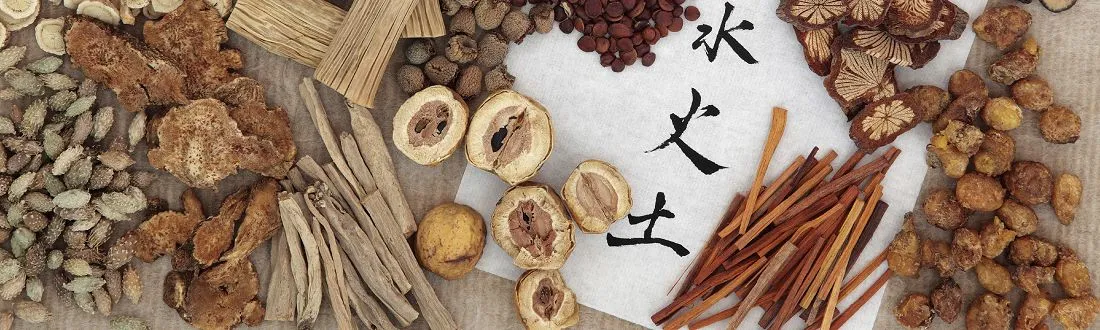
- Xin Yi Hua (Magnolia biondii flower bud) — the principal herb; the most important herb in TCM for opening the nasal orifices; disperses Wind-Cold, unblocks the nose and restores the sense of smell
- Xi Xin (Asarum sieboldii herb, 3-9g) — warms the channels, disperses Cold and strongly opens the orifices; commonly used in TCM practice for deep-seated Cold obstruction in the sinuses
- Mu Tong (Akebia quinata stem, 3-9g) — opens the channels and orifices; promotes the flow of Qi through the nasal passages
- Fang Feng (Saposhnikovia divaricata root, 3-10g) — expels Wind and releases the exterior; disperses Wind-Cold from the head
- Bai Zhi (Angelica dahurica root, 3-10g) — disperses Wind-Cold, opens the nasal orifices and alleviates sinus headache; commonly used in TCM practice for frontal sinus pain
- Gao Ben (Ligusticum sinense rhizome, 3-9g) — expels Wind-Cold and alleviates headache at the vertex and occiput
- Sheng Ma (Cimicifuga heracleifolia rhizome, 3-9g) — disperses Wind-Heat and guides the formula upward to the head and nasal orifices
- Cang Er Zi (Xanthium sibiricum fruit) — disperses Wind-Cold-Damp and opens the nasal orifices; specifically treats nasal conditions with thick discharge
- Gan Cao (Glycyrrhiza uralensis root, 3-9g) — harmonises the formula and moderates the acrid herbs
Formula actions
- Disperses Wind-Cold
- Opens nasal passages
- Alleviates pain
Conditions treated
- Allergic rhinitis (hay fever) with nasal congestion, watery discharge and sneezing — often combined with Yu Ping Feng San for a combined preventive and symptomatic approach
- Chronic sinusitis with nasal congestion and loss of smell from Wind-Cold obstruction
- Loss of sense of smell (anosmia) from nasal obstruction — including post-viral anosmia
- Acute and chronic nasal congestion with watery or white discharge
- Sinus headache from Wind-Cold obstructing the nasal and sinus channels
- Perennial allergic rhinitis with year-round nasal congestion from Wind-Cold pattern
Cautions
Always consult a qualified Chinese herbalist registered with the Register of Chinese Herbal Medicine (RCHM). Online herbal consultations are available. See the prices page for costs.
Prefer to be treated from home? Chinese herbal medicine online consultations are available throughout the UK and worldwide. After a full video consultation, Dr (TCM) Attilio D'Alberto formulates a bespoke herbal prescription and posts your Chinese herbs directly to your door.















