


Acupuncture and Chinese Herbs for PMS
By Dr (TCM) Attilio D'Alberto | Traditional Chinese Medicine Practitioner, Wokingham
Premenstrual syndrome (PMS) — also known as premenstrual tension (PMT) — affects up to 75% of women of reproductive age. For most women it is a monthly source of significant physical discomfort and emotional disruption. Acupuncture and Chinese herbal medicine are among the most effective drug-free treatments available, addressing the root hormonal and emotional imbalances that drive PMS rather than simply masking the symptoms.
What is PMS?
PMS encompasses a broad range of physical and psychological symptoms that arise in the luteal phase (the two weeks before menstruation) and resolve within a few days of the period starting. Common symptoms include mood swings, irritability, anxiety, low mood, breast tenderness and swelling, bloating, headaches, fatigue, food cravings, skin breakouts and sleep disturbance. In its severe form — premenstrual dysphoric disorder (PMDD) — the emotional symptoms are disabling and can significantly impair relationships and daily functioning.
Premenstrual tension in TCM
In traditional Chinese medicine, PMS arises primarily from Liver Qi stagnation — a failure of the Liver’s function of ensuring the smooth, unobstructed flow of Qi and Blood through the body and, crucially, through the emotional realm. The Liver is the organ most affected by emotional stress in TCM, and the accumulation of unexpressed emotions, overwork and chronic tension creates a stagnant Liver that cannot perform its regulatory function in the premenstrual phase. The specific symptoms depend on which secondary patterns are present:
- Liver Qi stagnation — the core pattern; irritability, frustration, mood swings, breast distension and tenderness, hypochondriac tightness, bloating; a wiry pulse and a slightly red tongue
- Liver Qi stagnation transforming to Heat — when stagnation becomes intense and generates Heat; agitation, anger, headaches, hot flushes, acne flares, a bitter taste, insomnia; red tongue edges, rapid wiry pulse; this corresponds to PMDD presentations and responds to the formula Jia Wei Xiao Yao San
- Liver Blood deficiency — insufficient Blood to nourish the Liver and uterus; mild premenstrual anxiety, poor sleep, emotional sensitivity, pale scanty blood, dizziness; the deficiency leaves the channels easily disturbed; responds to Blood nourishment alongside Qi regulation
- Heart and Spleen Qi and Blood deficiency — worry, overthinking and poor diet deplete Heart and Spleen; premenstrual anxiety with palpitations, poor sleep, fatigue, poor appetite, sweet cravings; responds to Gui Pi Tang modifications
- Kidney Yin deficiency with Empty Heat — depleted Kidney Yin fails to cool and anchor the rising Heat of the luteal phase; night sweats, heat sensations, restlessness, dry skin; more common in women in their late 30s and 40s approaching perimenopause
Acupuncture for PMS
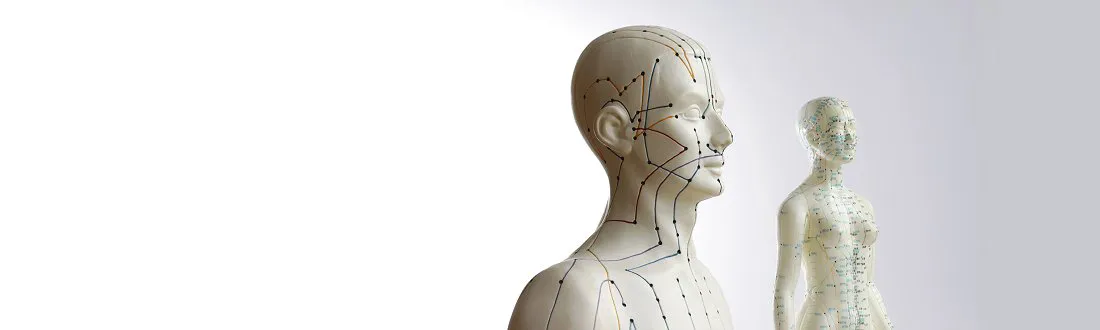
Acupuncture is used as a complementary therapy for PMS through several mechanisms that directly address its hormonal and neurological drivers. It regulates the hypothalamic-pituitary-ovarian (HPO) axis, normalising the oestrogen-progesterone relationship that determines luteal phase symptom severity. It reduces sympathetic nervous system hyperactivity and raises endorphin and serotonin levels, directly addressing the mood symptoms. A systematic review of 8 RCTs found acupuncture significantly more effective than sham acupuncture and conventional treatment for reducing PMS symptom scores. Treatment is most effective when delivered consistently over two to three cycles, with sessions in both the follicular and luteal phases.
Key acupuncture points for PMS include LV 3 (Taichong) to spread Liver Qi, PC 6 (Neiguan) to calm the Heart-Mind, SP 6 (Sanyinjiao) to nourish Liver Blood and regulate the cycle, and LV 14 (Qimen) for the Liver channel breast symptoms.
Chinese herbal medicine for PMS
Chinese herbal medicine is commonly used in TCM practice for PMS because it can be taken daily throughout the cycle, addressing the Liver Qi stagnation and Blood deficiency at their root rather than only treating symptoms when they arise. The most important formulas are:
- Xiao Yao San (Free and Easy Wanderer) — the foundational formula for Liver Qi stagnation with Blood and Spleen deficiency; the single most widely prescribed Chinese herbal formula in the world; treats PMS mood swings, breast tenderness, bloating and cycle irregularity
- Jia Wei Xiao Yao San (Augmented Free and Easy Wanderer) — the modification for Liver Heat; adds Mu Dan Pi and Zhi Zi to clear the Heat generated by stagnation; specifically indicated for PMS with irritability, anger, heat sensations and insomnia
- Gui Pi Tang (Restore the Spleen Decoction) — for PMS with Heart and Spleen deficiency; anxiety, palpitations, poor sleep, sweet cravings and fatigue
Herbs are prescribed as pharmaceutical-grade granules from Sun Ten (Taiwan), taken daily in warm water. An online herbal consultation is available for those who cannot attend in person.
Frequently asked questions
How does acupuncture help PMS?
Acupuncture regulates the hypothalamic-pituitary-ovarian axis, normalising the oestrogen-progesterone balance that determines luteal phase symptom severity. It also reduces sympathetic nervous system hyperactivity, raises endorphin and serotonin levels, and addresses the Liver qi stagnation that underlies most PMS in TCM terms.
How many acupuncture sessions are needed for PMS?
Treatment is most effective when delivered weekly across 2–3 menstrual cycles, with sessions ideally falling in both the follicular and luteal phases. Most patients see meaningful improvement by cycle 3, with continued improvement through cycle 6.
What is the best Chinese herbal formula for PMS?
Xiao Yao San (Free and Easy Wanderer) is the most widely used formula for PMS — for Liver qi stagnation with Spleen and blood deficiency. Its variant Jia Wei Xiao Yao San adds heat-clearing herbs for women with more pronounced irritability or heat symptoms.
Can acupuncture replace medication for PMS?
For mild-to-moderate PMS, acupuncture combined with diet, supplements and Chinese herbal medicine is often sufficient as a primary treatment. For severe PMS or PMDD, the combined natural approach works well alongside conventional medical care.
What is Liver qi stagnation?
In TCM, Liver qi stagnation is a pattern in which the smooth flow of qi (energy) through the body becomes blocked, typically by chronic stress and unexpressed emotions. It produces irritability, breast distension, bloating, headaches, mood swings and disrupted cycle regularity. It is the most common pattern in PMS.
Should I try supplements before acupuncture?
The two work well together. Calcium, magnesium, B6 and vitex (see PMS supplements) are inexpensive and widely effective; acupuncture and herbal medicine address the underlying TCM pattern at a deeper level. Combining both gives the strongest result.
See also: natural remedies for PMS, PMS supplements, natural PMDD treatment.
To discuss PMS treatment at my clinic in Wokingham, contact me or book a consultation.















