



Meridians and the channel system
Meridians — also called channels — are the network of pathways through which qi and Blood circulate throughout the body in traditional Chinese medicine. They connect the internal organs to the surface of the body, link every part to every other, and carry the acupuncture points through which that flow can be accessed and regulated. The meridian system is the framework on which acupuncture, moxibustion and tui na all rest.
On this page
- What are meridians?
- The twelve primary meridians
- The eight extraordinary vessels
- Meridians and acupuncture points
- The Chinese body clock
- Meridians in diagnosis and treatment
- The Six Stages of channel theory
- Frequently asked questions
- A modern perspective
1. What are meridians?
In traditional Chinese medicine (TCM), the body is animated and sustained by qi. Qi does not move at random — it flows along a defined system of channels known as the jingluo, usually translated as meridians. The larger, deeper pathways are the jing (channels); the finer branches that net outwards from them are the luo (collaterals). Together they form a continuous, interconnected web reaching every tissue of the body.
Health, in this model, depends on qi and Blood flowing smoothly and abundantly through the meridians. When the flow becomes deficient, stagnant, blocked or misdirected — through injury, illness, emotional strain, poor diet or external factors such as Cold or Damp — pain and disease result. The aim of acupuncture, moxibustion and related therapies is to restore that smooth flow.
The earliest comprehensive description of the meridian system appears in the Huang Di Nei Jing (Yellow Emperor’s Inner Classic), compiled between roughly 300 BCE and 100 CE. The two-thousand-year refinement of this framework has produced one of the most enduring clinical models in medicine.
2. The twelve primary meridians
The core of the system is the twelve primary meridians. Each is paired with one of the internal organs, runs on both the left and right sides of the body, and is classified as either yin or yang. The six yin meridians are associated with the solid (zang) organs and run on the inner, more protected surfaces of the body; the six yang meridians are associated with the hollow (fu) organs and run on the outer surfaces.
Qi flows through the twelve in a fixed daily sequence, passing from one meridian to the next in an unbroken 24-hour circuit — from the Lung through to the Liver, and then back to the Lung to begin again. The elemental pairings (Lung-Large Intestine, Stomach-Spleen and so on) link the meridian system directly to Five Element theory.
Lung meridian (LU) — the Metal yin channel
The Lung meridian begins in the chest at the lateral aspect of the upper torso, runs down the inner front of the arm and ends at the radial corner of the thumbnail. It has 11 points. Clinically the Lung governs respiration, the skin, body hair and the immune defence at the body surface. Key indications along the channel include cough, asthma, sore throat, allergic rhinitis, eczema and grief. Important points include LU 1 (Zhongfu), LU 7 (Lieque) and LU 9 (Taiyuan).
Large Intestine meridian (LI) — the Metal yang channel
The Large Intestine meridian begins at the radial corner of the index fingernail, runs up the back of the arm, over the front of the shoulder, up the neck and onto the face, ending beside the nose. It has 20 points. Clinically the meridian treats facial paralysis (Bell’s palsy), toothache, sinusitis, sore throat and shoulder pain. The famous point LI 4 (Hegu) on the hand is the command point for the face and an indispensable analgesic. Other key points include LI 11 (Quchi) and LI 20 (Yingxiang).
Stomach meridian (ST) — the Earth yang channel
The Stomach meridian is the longest of the twelve. It begins below the eye, runs down the face and front of the neck, across the chest and abdomen, down the front of the leg and ends at the second toe. It has 45 points. The Stomach governs digestion, the receiving and rotting of food, and the descent of food into the intestines. Clinically the Stomach meridian treats acid reflux, nausea, abdominal pain, leg pain, knee pain and facial conditions including Bell’s palsy and sinusitis. Pivotal points include ST 6 (Jiache) for TMJ and jaw, ST 25 (Tianshu) for the bowels and ST 36 (Zusanli) — the most powerful general tonifying point in the body.
Spleen meridian (SP) — the Earth yin channel
The Spleen meridian begins on the medial side of the big toenail, runs up the inner leg, across the lower abdomen and up to the chest, ending in the side of the rib cage. It has 21 points. The Spleen in TCM is the central organ of digestion, transformation and the production of qi and Blood; it also holds Blood within the vessels and governs the muscles. Clinically the meridian treats fatigue, bloating, loose stools, easy bruising, irregular menstruation, miscarriage prevention and oedema. SP 6 (Sanyinjiao) is the most important point in gynaecology and fertility; SP 9 (Yinlingquan) and SP 10 (Xuehai) are also pivotal.
Heart meridian (HT) — the Fire yin channel
The Heart meridian begins in the chest, emerges in the axilla and runs down the inner aspect of the arm to the radial side of the little finger. It has 9 points. The Heart circulates Blood and houses the Shen (mind and spirit), making it the “emperor” of organs in TCM. Clinically the Heart meridian treats palpitations, insomnia, anxiety, brain fog, mouth ulcers and elbow pain. The most useful point is HT 7 (Shenmen), the principal Shen-anchoring point in all of acupuncture.
Small Intestine meridian (SI) — the Fire yang channel
The Small Intestine meridian begins at the ulnar corner of the little fingernail, runs up the back of the arm, across the scapula, up the side of the neck and ends in front of the ear. It has 19 points. Clinically it is used for stiff and painful neck and shoulder (the classical “wry neck”), shoulder blade pain, jaw conditions, tinnitus, deafness and trigeminal neuralgia affecting the cheek. Key points include SI 3 (Houxi) for stiff neck, SI 11 (Tianzong) for the rotator cuff and SI 19 (Tinggong) for the ear.
Bladder meridian (UB / BL) — the Water yang channel
The Bladder meridian is the longest channel on the back. It begins at the inner corner of the eye, runs over the crown of the head, down the back in two parallel lines either side of the spine, down the back of the leg and ends at the lateral corner of the little toenail. It has 67 points. Along its first line on the back lie the Back-Shu points — one for each of the major internal organs — including BL 13 (Feishu, Lung Shu), BL 20 (Pishu, Spleen Shu) and BL 23 (Shenshu, Kidney Shu). The meridian treats back pain, sciatica, headache, eye conditions and urinary disorders. BL 40 (Weizhong) behind the knee is the command point for the back, and BL 67 (Zhiyin) at the foot is famously used to turn a breech baby with moxibustion.
Kidney meridian (KD) — the Water yin channel
The Kidney meridian begins on the sole of the foot, runs up the inner leg, across the lower abdomen and up the front of the torso, ending below the collarbone. It has 27 points. The Kidneys are the “root of life” in TCM, storing the inherited essence (Jing) and governing growth, reproduction and longevity. Clinically the meridian treats infertility, low back pain, menopausal symptoms, urinary problems, tinnitus and chronic fatigue. KD 3 (Taixi) is the principal Kidney-tonifying point; KD 6 (Zhaohai) nourishes Kidney Yin and is invaluable in menopause.
Pericardium meridian (PC) — the second Fire yin channel
The Pericardium meridian begins in the chest, emerges from the axilla and runs down the centre of the inner arm to the middle finger. It has 9 points. The Pericardium is the protective sheath around the Heart and in clinical practice it shares much of the Heart’s territory — calming the mind, regulating emotions and easing chest tightness. The most-used point in all of acupuncture for nausea, motion sickness and chemotherapy-induced sickness is PC 6 (Neiguan). PC 7 (Daling) is also used for carpal tunnel.
San Jiao meridian (TB / SJ) — the second Fire yang channel
The San Jiao (Triple Burner) meridian begins at the ulnar corner of the ring fingernail, runs up the back of the arm, around the shoulder, around the ear and ends at the lateral end of the eyebrow. It has 23 points. The San Jiao has no Western anatomical equivalent but functions as the system that coordinates water, qi and heat metabolism throughout the upper, middle and lower regions of the body. Clinically the meridian treats lateral headache, ear conditions, frozen shoulder and Wei Qi (immune) deficiency. TB 5 (Waiguan) is the master point of the Yang Wei Mai and a powerful exterior-releasing point.
Gallbladder meridian (GB) — the Wood yang channel
The Gallbladder meridian is the most laterally placed of all twelve channels. It begins at the outer corner of the eye, runs across the side of the head, down the lateral aspect of the neck, torso and leg, and ends on the lateral side of the fourth toenail. It has 44 points. Clinically it treats migraine and lateral headache, hip pain, sciatica down the lateral leg, shingles in this distribution, decisiveness and emotional courage. GB 20 (Fengchi) is the single most-used point for headaches; GB 21 (Jianjing) for shoulder and neck tension; GB 30 (Huantiao) and GB 34 (Yanglingquan) for the lower limb.
Liver meridian (LV) — the Wood yin channel
The Liver meridian begins on the dorsum of the great toe, runs up the inner leg, through the genital region, up the side of the abdomen and ends below the nipple. It has 14 points. The Liver ensures the smooth flow of qi throughout the body and stores Blood. It is one of the busiest organs in modern TCM clinical practice because of its association with stress and emotion. Clinically the meridian treats depression, premenstrual tension, migraine, irritable bowel syndrome with stress, plantar fasciitis and gynaecological conditions. LIV 3 (Taichong) is the principal point for moving stuck Liver Qi; LIV 14 (Qimen) is its closing front point.
3. The eight extraordinary vessels
Beyond the twelve primary meridians lie the eight extraordinary vessels (qi jing ba mai). Rather than being tied to a single organ, these act as deep reservoirs that store and regulate qi and Blood, absorbing any surplus and releasing it when the primary meridians run low. They are particularly active in constitutional health, fertility, menstruation and the deeper Yuan Qi.
The eight are: Du Mai (Governing Vessel), Ren Mai (Conception Vessel), Chong Mai (Penetrating Vessel), Dai Mai (Girdling Vessel), Yin Wei Mai (Yin Linking Vessel), Yang Wei Mai (Yang Linking Vessel), Yin Qiao Mai (Yin Heel Vessel) and Yang Qiao Mai (Yang Heel Vessel).
- Du Mai (Governing Vessel) — runs up the spine and over the head; governs all the yang meridians. Contains points such as GV 4 (Mingmen) and GV 20 (Baihui). One of the two extraordinary vessels with its own points.
- Ren Mai (Conception Vessel) — runs up the midline of the front of the body; governs the yin meridians and is the “sea of yin”. Pivotal in fertility, pregnancy and gynaecology. Contains CV 4 (Guanyuan) and CV 17 (Tanzhong).
- Chong Mai (Penetrating Vessel) — the “Sea of Blood” and “Sea of the 12 Channels”. Critical in menstruation, fertility and recurrent miscarriage. Activated via SP 4 (Gongsun).
- Dai Mai (Girdling Vessel) — the only horizontal channel, encircling the waist like a belt. Important in vaginal discharge, central obesity and lower-back-into-leg patterns. Activated via GB 41 (Zulinqi).
- Yin Wei Mai (Yin Linking Vessel) — links the yin channels. Used in chronic chest oppression and emotional sensitivity. Activated via PC 6 (Neiguan).
- Yang Wei Mai (Yang Linking Vessel) — links the yang channels. Used in alternating chills and fever and in conditions affecting the lateral side of the body. Activated via TB 5 (Waiguan).
- Yin Qiao Mai (Yin Heel Vessel) — runs from the inner ankle up to the eye. Important in insomnia (cannot stay asleep) and in eye conditions. Activated via KD 6 (Zhaohai).
- Yang Qiao Mai (Yang Heel Vessel) — runs from the outer ankle up to the eye. Important in insomnia (cannot fall asleep) and in muscular tension across the back of the body. Activated via BL 62 (Shenmai).
4. Meridians and acupuncture points
Distributed along the meridians are the acupuncture points (acupoints) — specific, named locations where the qi of the channel comes close to the surface and can be accessed. There are 361 classical points on the twelve primary meridians and the Du and Ren vessels, plus several dozen extra (EX) points that lie outside the main channels.
Each point has its own actions and indications, and stimulating a point with a needle, with heat or with pressure influences the flow of qi along the whole meridian — which is why a point on the foot can affect the head, or a point on the hand can ease the gut. Points have been classified over the centuries into clinically meaningful groups:
- Five Shu (Transporting) points — five points on each channel below the elbow or knee that correspond to the Five Elements (Well, Spring, Stream, River, Sea)
- Yuan-Source points — the “source” of qi for each organ, used to tonify the channel
- Luo-Connecting points — link a yin-yang pair of channels
- Xi-Cleft points — where qi gathers deeply; used in acute and painful presentations
- Back-Shu points — on the back, one per organ, used to tonify or regulate that organ
- Front-Mu points — on the front of the torso, the “alarm” points that often become tender when their organ is diseased
- Confluent points of the Eight Extraordinary Vessels — the eight points (one per vessel) used to access the extraordinary system
- Influential points — eight points that influence a specific body tissue (e.g. Bone, Marrow, Sinews, Blood)
Detailed profiles of the most important points are in the acupuncture points directory.
5. The Chinese body clock
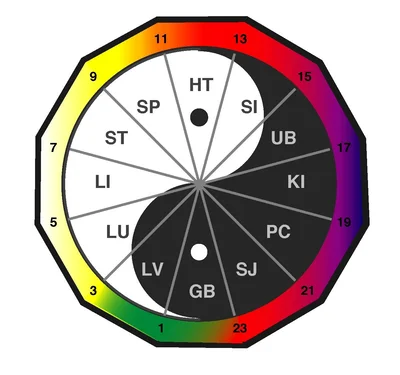
Because qi flows through the twelve primary meridians in a set sequence, each meridian has a two-hour window in the 24-hour day when its qi is at its peak — and the opposite two-hour window when its qi is at its lowest. The system is known as the Chinese body clock or organ clock and is one of the most useful diagnostic clues a practitioner has. Symptoms that reliably occur at the same time each day — waking at the same hour each night, for instance — can point directly to which organ and meridian are involved.
| Time | Meridian | What it governs |
|---|---|---|
| 3am – 5am | Lung | Respiration, immune defence, grief; waking with cough or sadness |
| 5am – 7am | Large Intestine | Elimination and bowel movement; the natural time for the morning stool |
| 7am – 9am | Stomach | Receiving food; the time when breakfast is best digested |
| 9am – 11am | Spleen | Transformation and transportation of food essences; the peak energy of the morning |
| 11am – 1pm | Heart | Circulation of Blood and Shen; midday peak of mental clarity |
| 1pm – 3pm | Small Intestine | Separating pure from impure; the afternoon dip and the absorption phase of digestion |
| 3pm – 5pm | Bladder | Fluid metabolism and storage; afternoon urination |
| 5pm – 7pm | Kidney | Storage of essence; the body’s deep reserves |
| 7pm – 9pm | Pericardium | Protection of the Heart; the time of intimacy and connection |
| 9pm – 11pm | San Jiao | Distribution of qi and heat for the night; the natural time to wind down |
| 11pm – 1am | Gallbladder | Decisions and storage of bile; waking at this hour often indicates Gallbladder/Liver issues |
| 1am – 3am | Liver | Storage and detoxification of Blood; waking 1–3am is the classical sign of Liver imbalance |
The body clock is a quick way of beginning a TCM diagnosis. Someone who consistently wakes at 3am with the mind racing has, in TCM, a Liver pattern; someone who wakes coughing at 4am has a Lung pattern; someone with persistent 3pm headaches likely has a Bladder-channel problem. These are not absolute rules but reliable clinical pointers.
6. Meridians in diagnosis and treatment
The meridian system is not just a treatment map — it is a diagnostic one. The path a symptom follows often reveals the channel involved: sciatic pain travelling down the back of the leg follows the Bladder meridian, while pain down the side of the leg follows the Gallbladder meridian. Sciatica is therefore not one diagnosis in TCM but several, each with different treatment.
Other channel signs include:
- Tenderness on palpation along the channel
- Temperature differences (a hot or cold patch over the meridian)
- Discolouration (purple, dusky, pale) over a segment of channel
- Sensory changes (numbness, hypersensitivity, pins and needles) tracking the channel
- Distinctive symptom triggers (eating, emotion, time of day) pointing to an organ-channel relationship
Treatment then selects points on the affected meridian, on its paired meridian, or on a meridian linked through the Five Elements, to draw the system back into balance. This is why two patients with the same Western diagnosis may receive quite different acupuncture prescriptions.
7. The Six Stages of channel theory
One of the most influential developments in meridian theory came from Zhang Zhongjing’s Shang Han Lun (Treatise on Cold Damage, c. 220 CE). He grouped the twelve primary meridians into six stages (liu jing), each pair sharing a common nature. The Six Stages describe how an external cold pathogen penetrates the body progressively through these layers — from the outermost defensive layer down to the deepest interior — and the framework still guides treatment of acute illness, autoimmune flare patterns, chronic pain and many other conditions today.
- Tai Yang (Greater Yang) — Bladder and Small Intestine. The exterior. Symptoms: chills, stiff neck, headache, no sweating, floating tight pulse. Treated by formulas such as Ma Huang Tang and Gui Zhi Tang.
- Yang Ming (Yang Brightness) — Stomach and Large Intestine. Interior Heat. Symptoms: high fever, profuse sweating, intense thirst, constipation, full deep pulse. Treated by Bai Hu Tang and Da Cheng Qi Tang.
- Shao Yang (Lesser Yang) — Gallbladder and San Jiao. Half-exterior, half-interior. Symptoms: alternating chills and fever, bitter taste, flank pain, wiry pulse. Treated by Xiao Chai Hu Tang.
- Tai Yin (Greater Yin) — Spleen and Lung. Interior Cold with Spleen deficiency. Symptoms: fatigue, loose stools, abdominal fullness, poor appetite, pale tongue. Treated by Li Zhong Wan.
- Shao Yin (Lesser Yin) — Heart and Kidney. Deep deficiency of Heart and Kidney. Symptoms: severe fatigue, cold extremities, marked weakness, faint pulse. Treated by Ma Huang Fu Zi Xi Xin Tang and other Yang-rescuing formulas.
- Jue Yin (Terminal Yin) — Liver and Pericardium. The terminal stage. Symptoms: mixed Heat above and Cold below, severe upper-abdominal pain, exhaustion. Treated by complex formulas such as Wu Mei Wan.
The Six Stages framework gives the practitioner a way of understanding any illness as a movement along a path — and points to the formula or point combination most likely to halt that movement and return the patient to health.
8. Frequently asked questions
Are meridians real?
The meridians have not yet been mapped by Western anatomy as familiar structures — they are not nerves, blood vessels or lymphatic channels — but modern research is converging on their physical existence through different means. Thermal imagery work by Schlebusch, Maric-Oehler and Popp (2005) demonstrated that when moxibustion is applied at a single acupuncture point, heat travels along the entire length of the meridian, and the paired meridian is stimulated at the same time, exactly as the classical Nei Jing texts predict (see my article on thermal imagery and the Jinglou). Earlier electrophysiology work characterised the meridian network as a DC electrical conduction system, and recent histology has identified threadlike vessels that may be the anatomical Jinglou itself. The meridian system also corresponds closely to planes of connective tissue and fascia, to neurovascular bundles and to lines of referred sensation. Far from being metaphorical, the meridian map — refined over more than two thousand years of clinical observation — is increasingly being validated by modern imaging and electrophysiology, and its clinical predictions are reliably borne out in practice.
How many meridians are there?
There are twelve primary meridians (one for each major organ system) and eight extraordinary vessels, making 20 in all. In addition, each primary meridian has a Luo-Connecting branch and a Divergent branch, plus 12 Tendino-Muscular Meridians and 12 Cutaneous Regions — bringing the full total in the classical literature to around 70 named channels of varying depth and function.
Can I feel my own meridians?
Practitioners of qi gong and tai chi sometimes describe sensing the flow of qi along the channels — usually as warmth, tingling or a feeling of energy moving. This is not necessary for treatment to work, but it is a familiar experience to many long-term practitioners. The acupuncture sensation of de qi (a dull, heavy or radiating feeling around a needled point) is the closest most patients come to experiencing the channels directly.
Do meridians have anything to do with the nervous system?
There is overlap but they are not the same. Meridian pathways run along defined anatomical lines that often (but not always) follow neurovascular planes. Modern research using fMRI, microcirculatory imaging and connective-tissue mapping shows that needling acupoints produces measurable changes in brain activity, blood flow and fascia, and that these effects often track along the classical meridian pathway. The meridian framework predates these findings by two millennia but increasingly converges with them.
Which meridian is most important?
None can be called the most important — each meridian has a unique role. In modern practice the meridians most frequently treated are the Liver (because of the impact of stress on health), the Spleen (because of dietary and digestive disturbances), the Kidney (because of fertility, menopausal and constitutional conditions) and the Bladder (because the Back-Shu points access every organ).
9. A modern perspective
Whatever its physical basis, the meridian system remains a remarkably effective clinical framework — the foundation on which the points, channels and treatment strategies of acupuncture are built. Two thousand years of refinement have produced a system that allows a practitioner to predict, with surprising accuracy, where a symptom will spread, when it will be worst, and which point combinations will dissolve it.
If you would like to experience how the meridian framework is used in practice, you can book a consultation at my clinic in Wokingham, Berkshire. To explore the wider system, read about acupuncture and traditional Chinese medicine, or related theory in yin and yang and the Five Elements.















