



Tongue diagnosis in Chinese medicine
On this page
- What is tongue diagnosis?
- The tongue map — organ zones
- Tongue body colour
- Tongue body shape and size
- Tongue coating
- Tongue moisture
- Tongue movement
- Sublingual veins
- The three tongues I see most often in my Wokingham fertility practice
- Common tongue patterns and what they mean
- Tongue diagnosis in my practice
- Commonly asked questions about tongue diagnosis
1. What is tongue diagnosis?
The first thing I do after a new patient sits down in my Wokingham clinic, often before I have asked them a single question, is look at their tongue. Twenty-five years of clinical practice have taught me that the tongue tells a story the patient often cannot put into words — about the state of their digestion, their hormonal balance, their stress load, their sleep, their fluid metabolism and the underlying constitutional terrain on which all of this is sitting. Together with pulse diagnosis, tongue examination is the part of the traditional Chinese medicine (TCM) consultation that most distinguishes it from a Western medical consultation, and the part that most often surprises new patients.
The reason the tongue is so diagnostically useful is anatomical. It is one of the most densely vascularised structures in the body, fed by a network of small arteries that respond rapidly to changes in circulation, hydration, organ function and inflammatory state. The tongue body shows you the patient's current state of qi, blood and yin; the coating shows you what is happening in the digestive tract and where any pathogenic factor — cold, heat, damp, phlegm — has reached; the moisture and movement show you fluid balance and the state of the nervous system. Symptoms can mislead. The tongue is harder to fake, because it reflects what the body is doing rather than what the patient thinks the body is doing.
Tongue diagnosis was systematised in China across roughly two thousand years, with the most influential codification occurring in the Song, Ming and Qing dynasties. By the late Qing, dedicated tongue atlases had documented hundreds of distinct presentations and their corresponding internal patterns. I studied this system in detail at Beijing University of Chinese Medicine during my five-year Bachelor of Medicine degree and have since applied it to thousands of patient consultations in the UK. Every tongue I see in clinic adds to that internal reference library; over time, recognition of common patterns becomes a near-instant clinical reflex.
Where Western medicine examines the tongue mainly to rule out infection (oral thrush) or nutritional deficiency (glossitis, atrophic glossitis from B12 deficiency), TCM tongue examination is a multi-parameter clinical reading. In a single look I am assessing tongue body colour, body shape and size, the nature and distribution of the coating, the moisture level, any cracks, ulcers or red points, the sublingual veins on the underside, and how the tongue moves when extended. Each of these features carries distinct diagnostic weight, and the diagnostic picture is built from their interaction rather than any single feature in isolation.
2. The tongue map — organ zones
One of the foundational principles of TCM tongue diagnosis is that different areas of the tongue correspond to different internal organ systems. This mapping allows the practitioner to localise patterns of disharmony to specific organs by observing where on the tongue particular features — such as changes in colour, coating thickness or surface markings — are concentrated.
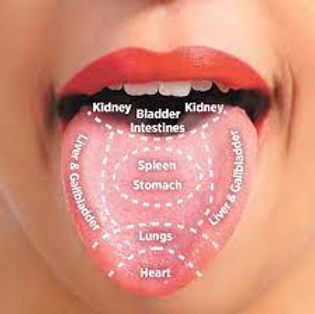
The conventional TCM tongue map divides the tongue into five primary zones:
- Tip of the tongue — reflects the state of the Heart and, to a lesser extent, the Lungs. Redness at the tip is one of the most commonly observed findings in clinical practice and typically indicates Heart fire or Liver fire rising, often associated with anxiety, insomnia or emotional disturbance.
- Front third (behind the tip) — corresponds to the Lungs. Pale or white discolouration in this zone, or the presence of a thick white coating, can indicate Lung qi deficiency or the presence of cold or phlegm in the Lungs.
- Centre of the tongue — reflects the state of the Spleen and Stomach, the central organs of digestion and transformation in TCM. A thick, greasy coating concentrated in the centre is a common indicator of Spleen dampness or Stomach phlegm. Cracks in the centre of the tongue often indicate Stomach yin deficiency.
- Sides of the tongue — correspond to the Liver and Gallbladder. Redness, swelling or purple discolouration on the sides of the tongue may indicate Liver qi stagnation, Liver fire or Liver blood stasis — conditions that are frequently associated with chronic stress, emotional suppression and hormonal imbalance.
- Root of the tongue — reflects the state of the Kidneys and Bladder, and to some extent the lower Jiao (lower body). A particularly thick or absent coating at the root can indicate Kidney yin deficiency or accumulation of dampness in the lower body.
These zone correspondences are not rigid boundaries but overlapping regions of clinical emphasis. The tongue is examined as a whole, and the pattern that emerges from considering all zones together — alongside all other tongue features — is what informs the TCM diagnosis.
A practical clinical example from my own caseload: a fertility patient with longstanding period pain, a history of failed IVF and significant pre-menstrual irritability will very often present with a tongue showing redness or purple discolouration along the sides (Liver pattern), tooth-marks at the front-centre (Spleen qi deficiency) and a thicker coating at the root (lower-Jiao damp accumulation) — three findings that together name the underlying pattern within seconds, before I have asked a single question. The accuracy of this correlation, repeated in thousands of consultations, is what gives experienced practitioners such confidence in the technique.
3. Tongue body colour
The colour of the tongue body — the muscular tissue of the tongue itself, as distinct from its coating — is one of the most important parameters in tongue diagnosis. It reflects the state of qi, blood and yin in the body.
- Pale pink — the normal, healthy tongue colour. Indicates a balanced state of qi and blood with no significant internal disharmony.
- Pale or white tongue body — indicates deficiency of qi, yang or blood. A pale tongue is commonly seen in patients with fatigue, coldness, poor circulation, anaemia or constitutional weakness. Yang deficiency — often accompanied by cold extremities and low energy — typically produces a very pale, moist tongue.
- Red tongue body — indicates heat in the body. This may be full heat (excess fire from an external pathogen or emotional excess) or empty heat (deficiency heat arising from yin deficiency, where the cooling, moistening yin is insufficient to control the body's yang). A red tongue with a yellow coating suggests full heat; a red tongue without coating, or with a very thin coating, suggests yin deficiency heat.
- Crimson or deep red tongue body — indicates a more severe degree of heat, particularly heat that has penetrated deeply into the blood level or ying level. This is seen in febrile illness, severe yin deficiency or blood-level heat.
- Purple tongue body — indicates blood stasis — poor circulation and blood that is not moving freely through the vessels. A purple tongue may be bluish-purple (cold stagnation) or reddish-purple (heat stagnation). Blood stasis of the tongue is frequently associated with chronic pain, cardiovascular conditions, gynaecological problems including painful periods, endometriosis and fibroid formation, and prolonged emotional suppression.
- Blue tongue body — a relatively rare finding indicating severe cold constriction of the vessels or profound blood stasis with cold.
4. Tongue body shape and size
The shape and size of the tongue body provide additional diagnostic information about the underlying state of the body's fluids, qi and organ systems.
- Normal size and shape — a tongue of moderate size, neither swollen nor shrunken, that fits comfortably within the mouth without being pressed against the teeth.
- Swollen or enlarged tongue — indicates the presence of dampness, phlegm or fluid accumulation in the body. Dampness in TCM arises from impaired Spleen function and manifests as sluggishness, heaviness, digestive bloating, excess mucus and fatigue. A swollen tongue that leaves tooth marks on its sides (a scalloped edge) is one of the most common clinical findings and is a reliable indicator of Spleen qi deficiency with dampness.
- Thin or shrunken tongue — indicates deficiency of yin, blood or body fluids. A thin, dry tongue that appears shrunken or contracted suggests significant yin or blood deficiency.
- Stiff or rigid tongue — may indicate wind invasion, liver wind or phlegm obstructing the heart orifices, and may be associated with difficulty speaking clearly.
- Flaccid or soft tongue — a tongue that appears soft and lacking tone indicates severe qi, blood or yin deficiency.
- Cracked tongue — cracks in the tongue surface indicate deficiency of fluids or yin. Long central cracks are associated with Heart or Stomach issues; cracks across the tongue may indicate chronic Stomach yin deficiency. It is worth noting that some cracks are constitutional and present throughout life without pathological significance; the key is to assess changes over time.
- Scalloped edges (tooth marks) — indentations along the sides of the tongue created by the teeth are a very common finding and reliably indicate Spleen qi deficiency with dampness. This pattern is associated with fatigue, digestive weakness, bloating and a tendency to retain fluid.
5. Tongue coating
If the tongue body tells you about the patient's constitutional terrain, the coating tells you what is currently happening in the digestive tract and what pathogenic factor — heat, cold, dampness, phlegm — is currently dominant. Classical TCM teaches that the coating is generated by the Stomach qi rising upward; modern observation suggests it largely reflects the keratinised epithelium and the oral and gut microbiome on top of it. Either way, its thickness, colour, distribution and texture are some of the most diagnostically dense information a TCM practitioner has access to.
- Normal coating — a thin, white, evenly distributed coating that is slightly moist. This indicates a healthy Stomach and the absence of significant pathogenic factors.
- Thin white coating — normal or may indicate the early stage of an external cold invasion.
- Thick white coating — indicates the presence of cold, dampness or phlegm in the interior. Commonly seen in patients with digestive sluggishness, excess mucus, sinus congestion or respiratory phlegm.
- Thick yellow coating — indicates interior heat. A yellow coating results from heat transforming the coating from white to yellow. A thick, greasy yellow coating indicates damp-heat, a common pattern in inflammatory digestive conditions, skin disorders and gynaecological infections.
- Grey or black coating — indicates extreme interior cold (grey-black moist coating) or extreme interior heat (grey-black dry coating). These are relatively uncommon findings in modern clinical practice.
- Greasy or sticky coating — indicates the presence of phlegm or dampness regardless of colour. A greasy coating is one of the key diagnostic indicators of a damp or phlegm pattern.
- Dry coating — indicates deficiency of body fluids or yin, or the presence of heat consuming fluids.
- Peeled coating (geographic tongue) — areas where the coating is absent or has peeled away indicate deficiency of Stomach yin. A completely coating-free, shiny tongue (mirror tongue) indicates severe yin deficiency.
- Rootless coating — a coating that can be scraped off easily and appears to be sitting on the surface of the tongue rather than growing from it indicates that stomach qi is becoming deficient.
6. Tongue moisture
The degree of moisture on the tongue reflects the state of the body's fluids and the balance between yin (cooling, moistening) and yang (warming, drying) forces.
- Normal moisture — the tongue is slightly moist but not excessively wet.
- Wet or dripping tongue — indicates yang deficiency or cold, where the yang is insufficient to metabolise and transform fluids. Excess fluid accumulates and manifests as a wet tongue.
- Dry tongue — indicates yin deficiency, heat consuming fluids, or insufficient production of body fluids. A dry tongue is often seen in patients with chronic illness, post-menopausal heat symptoms or prolonged use of diuretics.
7. Tongue movement
Observation of how the tongue moves when it is extended can provide additional diagnostic information, particularly in relation to internal wind and the nervous system.
- Normal movement — the tongue extends smoothly in the midline without deviation or trembling.
- Trembling or quivering tongue — indicates Liver wind, qi or blood deficiency, or, if accompanied by red colour, Liver fire generating wind.
- Deviation to one side — indicates internal wind or phlegm obstructing the channels and may be associated with neurological conditions.
- Tongue rolling inward — indicates extreme heat consuming fluids or Liver wind in acute febrile conditions.
8. Sublingual veins
Examination of the underside of the tongue — specifically the two sublingual veins that run beneath the tongue on either side of the frenulum — provides important information about blood circulation. Normally these veins are barely visible or a light blue-green colour. Prominent, dark purple, distended or tortuous sublingual veins are a reliable indicator of blood stasis, particularly in the chest or lower abdomen. This finding is clinically significant in patients with cardiovascular conditions, chronic pain, gynaecological disorders and conditions involving poor peripheral circulation.
9. The three tongues I see most often in my Wokingham fertility practice
Because my clinical practice is heavily weighted toward fertility, IVF preparation, menstrual disorders and menopause-related complaints, certain tongue patterns recur with striking regularity. These are not the textbook patterns of a general TCM practice in Beijing or Hong Kong — they are the patterns of UK women in their thirties and forties trying to conceive, navigating perimenopause, or recovering from miscarriage and failed IVF cycles. Three patterns dominate.
Pattern one — pale, swollen, scalloped, with a thin damp coating. This is the tongue I see most often in patients struggling with low AMH, poor egg quality, persistent fatigue, mid-cycle bleeding and unexplained sub-fertility. It indicates Spleen qi deficiency with dampness: the digestive and metabolic engine of the body is underpowered, fluid handling is poor, and the constitutional reserves of qi and blood that the ovary needs are running thin. These patients almost always benefit from a long preparation window with warming, Spleen-strengthening Chinese herbs and a diet shift toward cooked, warm, easily-digestible food. Many have spent years eating cold salads, raw juices and yoghurt in the belief that this is healthy — in TCM terms this is the dietary equivalent of pouring cold water on a low flame.
Pattern two — red body with redder sides, often purple in the centre-front and sides, dry coating. This is the pattern I see most often in patients with endometriosis, fibroids, painful periods, recurrent implantation failure and longstanding emotional strain. It reads as Liver qi stagnation transforming into Liver fire and blood stasis, with secondary yin depletion. Treatment focuses on moving Liver qi, breaking up blood stasis, cooling Liver fire and replenishing yin — usually a combination of acupuncture, blood-moving Chinese herbs and a deliberate reduction in nervous-system load (sleep, screens, caffeine, late-night work). The tongue change you see when this pattern responds — the sides becoming less swollen and red, the purple receding, the coating returning — is one of the most clinically satisfying I see in practice.
Pattern three — red body, no coating or a peeled coating, with a deep central crack reaching the tip. This is the menopausal and peri-menopausal pattern, but I also see it in younger women who have run themselves into the ground through chronic overwork, insufficient sleep, repeated IVF cycles or long-term breastfeeding without adequate nutritional support. It indicates Kidney and Heart yin deficiency with empty heat — the cooling, moistening reserves of the body have depleted faster than the body can replace them, and what looks like “menopause” or “burn-out” is really a fluid-and-substance bankruptcy. Treatment is yin-nourishing herbs, gentle Heart-calming acupuncture, and absolute prioritisation of restorative sleep. The crack does not fully heal, but its surrounding tissue rebuilds and the empty heat recedes.
These three tongues account for perhaps two-thirds of what I see in fertility-focused practice. The remaining third is composed of mixtures and less-common patterns — pure Kidney yang deficiency (very pale, very wet), blood deficiency (thin, dry, pale), pure Phlegm-damp (thick greasy coating, swollen body) — and they shape the herbal prescription and the acupuncture point selection accordingly.
10. Common tongue patterns and what they mean
In clinical practice, tongue features are never assessed in isolation — they are interpreted as part of a combined picture alongside the patient's symptoms and the findings of pulse diagnosis. The following are some of the most commonly encountered tongue patterns in TCM practice.
- Pale, slightly swollen, with scalloped edges and thin white coating — indicates Spleen qi deficiency with dampness. This is the single most commonly seen tongue pattern in clinical practice in the UK. It is associated with fatigue, digestive weakness, loose stools or bloating, cold extremities, and a tendency to gain weight or retain fluid.
- Red tip with normal body — indicates Heart fire or Liver fire rising. This very common finding is associated with anxiety, palpitations, insomnia and emotional agitation.
- Red body, thin or no coating — indicates yin deficiency with empty heat. Common in menopausal patients, those with chronic fatigue, or anyone who has depleted their yin through overwork, insufficient sleep or chronic stress.
- Red body with thick yellow greasy coating — indicates damp-heat. Associated with inflammatory digestive conditions, skin disorders such as acne, pelvic infections, and conditions such as IBS with inflammatory features.
- Purple body with or without dark coating — indicates blood stasis. Associated with chronic pain, cardiovascular disease, gynaecological conditions including painful periods, endometriosis and fibroids, and longstanding emotional suppression.
- Pale body, dry, thin — indicates blood deficiency. Common in women with heavy or prolonged periods, post-partum patients, or those with nutritional deficiency.
- Central crack reaching the tip — indicates Heart yin deficiency or a constitutional weakness of the Heart, often associated with anxiety, restless sleep and emotional sensitivity.
11. Tongue diagnosis in my practice
Every consultation in my Wokingham clinic begins with a tongue examination. At your first appointment I will ask you to extend your tongue while I look at it from a few angles — no longer than five or six seconds in total, which is enough for a trained eye to register colour, body shape, coating, moisture and the underside veins. Follow-up appointments include a fresh tongue inspection because, as I explain to patients, the tongue is one of the few diagnostic tools that updates in real time as treatment takes effect.
I actively encourage patients to look at their own tongue in the mirror between visits. A useful habit is to photograph it once a week in similar lighting (natural daylight at the bathroom mirror, no flash, no lipstick) and keep the photos in a dated folder on the phone. Over the course of a 12-week IVF preparation or a course of treatment for a chronic condition, the changes you see in those photos — a thick coating clearing, a swollen body shrinking, a pale tongue regaining colour, a red tip calming down — are often more reassuring than the symptom diary. They are the body's own progress report.
A few practical points patients regularly ask about. Coffee, black tea, blackcurrant cordial, beetroot juice and certain sweets will stain the coating temporarily and can mask the true colour of the body. Broad-spectrum antibiotics often strip the coating and produce a transient red, peeled appearance that is not necessarily a sign of yin deficiency. Lipstick is best removed before the examination. I always ask what a patient has eaten and drunk in the previous hour, and I cross-check tongue findings against pulse findings, symptoms and history rather than relying on the tongue alone.
Tongue diagnosis sits inside the broader four-pillar TCM consultation: looking, listening/smelling, asking, and pulse-taking. None of these is decisive on its own. The diagnostic confidence comes from the consistency — when the tongue, the pulse, the symptoms and the history all point to the same pattern, the treatment plan more or less writes itself. When they diverge, the divergence itself is a clinical clue worth investigating.
12. Commonly asked questions about tongue diagnosis
Can I self-diagnose from my own tongue?
You can learn to observe basic tongue features — such as scalloped edges, a very red tip or a thick coating — and these observations can give you useful general information about your health. However, accurate TCM tongue diagnosis requires training and experience, and must always be interpreted in the context of the full clinical picture including symptoms, history and pulse findings. Self-observation is a useful adjunct to, not a substitute for, professional assessment.
Does my tongue change from day to day?
Yes — the tongue changes continuously in response to your health, diet, emotional state, sleep quality and treatment. This is precisely what makes it such a valuable diagnostic tool: it provides a real-time window into the body's current state. Changes in the tongue over the course of a treatment programme are one of the ways I assess whether treatment is having its intended effect.
Why does my practitioner need to see my tongue at every appointment?
Because the tongue reflects the current state of your internal organs and body fluids, it changes as your health changes. Tracking how your tongue evolves over the course of treatment — for example, whether a thick coating is clearing, whether redness is reducing, or whether a very pale tongue is returning to a healthier colour — is one of the most reliable ways to assess progress and refine the treatment plan accordingly.
Does wearing lipstick or eating affect my tongue examination?
Yes. I always ask patients to remove lipstick before examination and to avoid eating strongly coloured foods immediately before their appointment where possible. Coffee, tea, coloured sweets and some medications can all temporarily stain the coating and affect the colour of the tongue body. If there is any uncertainty about whether a finding is genuine or due to external staining, I will take this into account in my assessment.
Can a TCM practitioner tell I am pregnant from my tongue?
The tongue does change in pregnancy — it tends to become slightly more swollen and the coating slightly thicker, reflecting the increased fluid handling and the rising progesterone state. An experienced practitioner can sometimes suspect early pregnancy from the tongue and pulse together, particularly in a patient they have seen many times before, but tongue diagnosis is not a substitute for a beta-hCG blood test or a urine pregnancy test, and I never use it as the primary basis for confirming pregnancy. Where tongue diagnosis is genuinely useful in fertility is in the months before conception: it shows me the constitutional terrain we are working on improving, and it shows me clearly when the terrain has shifted — for example when a longstanding cold-damp pattern has cleared, which often precedes a successful conception by several cycles.
Is tongue diagnosis the same in all traditions of Chinese medicine?
The core principles of tongue diagnosis are shared across the major traditions of East Asian medicine — including Chinese, Japanese and Korean styles. Some schools place greater emphasis on tongue diagnosis relative to pulse diagnosis, and there are some differences in the interpretation of specific findings between schools. The system described on this page reflects mainstream TCM tongue diagnosis as taught and practised in China and in UK TCM institutions.
References
- Maciocia, G. (1995). Tongue Diagnosis in Chinese Medicine (revised ed.). Seattle: Eastland Press.
- Maciocia, G. (2015). The Foundations of Chinese Medicine (3rd ed.). Edinburgh: Churchill Livingstone.
- Huang Di Nei Jing Su Wen (The Yellow Emperor's Classic of Internal Medicine). (~300 BCE). Beijing: People's Medical Publishing House.
- Wang, S. (1341). Ao Shi Shang Han Jin Jing Lu (The Golden Mirror of Cold Damage). Translated and discussed in Maciocia (1995).
- Porkert, M. (1974). The Theoretical Foundations of Chinese Medicine. Cambridge, MA: MIT Press.
- Scheid, V., Bensky, D., Ellis, A., & Barolet, R. (2009). Chinese Herbal Medicine: Formulas and Strategies (2nd ed.). Seattle: Eastland Press.















