

Ayahuasca and Ibogaine: What the Plant Medicine Research Shows
By Dr (TCM) Attilio D'Alberto | Traditional Chinese Medicine Practitioner, Wokingham
Alongside psilocybin, two other traditional plant medicines — ayahuasca from the Amazon and iboga (ibogaine) from West Africa — are being studied for depression, addiction and trauma. This is an educational overview of that research. It is not medical advice and it is not an endorsement. Ayahuasca contains DMT, a Class A controlled drug in the UK; ibogaine is not an approved medicine and carries serious, sometimes fatal, heart risks. I do not offer, prescribe, supply or recommend ayahuasca, iboga or ibogaine in any form, and nothing here should be read as encouragement to seek them out. This article is a companion to my overview of psilocybin research.
Important legal and safety notice
Ayahuasca contains DMT (dimethyltryptamine), which is a Class A drug under the Misuse of Drugs Act 1971 and a Schedule 1 substance — illegal to produce, possess or supply in the UK. Ibogaine (from the iboga root) is not an approved medicine in the UK; its supply and import are restricted under the Psychoactive Substances Act 2016, and it is dangerous to the heart — it can cause fatal cardiac arrhythmias and has been linked to deaths. Neither is available as a treatment here, and the studies below were all carried out in research settings or overseas clinics with medical screening and supervision.
Taking either substance outside such a setting can be life-threatening. Ayahuasca is itself a strong MAOI and can cause dangerous reactions with many medicines (especially antidepressants) and foods; both can be hazardous for anyone with a personal or family history of psychosis or bipolar disorder, and ibogaine requires cardiac monitoring. If you are struggling with depression, trauma or addiction, please speak to your doctor — and in a crisis in the UK, contact your GP, NHS 111, the Samaritans on 116 123, or for addiction support, FRANK on 0300 123 6600.
On this page
- What ayahuasca and ibogaine are
- The research on ayahuasca
- The research on ibogaine
- How they are thought to work
- A Chinese medicine reflection — reading plants by how they grow
- The risks
- Do I offer this?
- Frequently asked questions
- References
1. What ayahuasca and ibogaine are
Ayahuasca is a bitter brew from the Amazon basin, traditionally used by Indigenous peoples in ceremony. It is made from two plants together: the Banisteriopsis caapi vine and the leaf of Psychotria viridis (chacruna). The leaf provides DMT; the vine provides compounds (beta-carbolines) that act as monoamine oxidase inhibitors (MAOIs) and allow the DMT to become orally active. Neither plant does much alone — the effect comes from the pairing.
Iboga is a shrub from West Africa (notably Gabon), where the root bark has long been used in Bwiti initiation ceremonies. Ibogaine is its principal active compound. Unlike the classic serotonergic psychedelics, ibogaine produces a long (24–36 hour), dream-like, introspective state, and it has attracted research interest mainly for addiction and, more recently, trauma.
Both are powerful, traditional "plant medicines" from outside the Chinese tradition, and both sit at the edge of what is legal and safe — so the research needs to be read with that firmly in mind.
2. The research on ayahuasca
The most cited clinical study is a randomised, double-blind, placebo-controlled trial by Palhano-Fontes and colleagues in Brazil, published in Psychological Medicine in 2019. In around 29 people with treatment-resistant depression, a single dose of ayahuasca produced significantly greater reductions in depression scores than placebo, with a large effect at day seven and a response rate of 64% versus 27% for placebo. A secondary analysis explored a possible reduction in suicidality.
This is a landmark result, but the usual cautions apply with force: it is a single, small trial; the vivid effects of ayahuasca make genuine blinding very difficult; and it was conducted in a carefully screened, supervised research setting. Beyond this, most of the evidence is observational (surveys of ceremony participants), which cannot establish cause and effect. Ayahuasca is not an approved or available treatment.
3. The research on ibogaine
Ibogaine has been explored for decades, largely outside mainstream medicine, as a possible interrupter of opioid and other substance dependence — users report a marked reduction in withdrawal and craving. However, this evidence is mostly anecdotal or observational from private clinics, and ibogaine's cardiac risks have limited formal trials.
The most prominent recent study is a 2024 report in Nature Medicine by a Stanford group (Cherian, Williams and colleagues). It followed 30 US special-operations veterans with traumatic brain injury who travelled to a clinic in Mexico for ibogaine given together with magnesium (to reduce the heart risk). One month later the group reported large average reductions in PTSD, depression and anxiety symptoms, and a fall in suicidal thinking. These are striking figures — but this was an observational study with no control group, so it cannot prove the treatment caused the change, and the authors themselves called for controlled trials.
4. How they are thought to work
The mechanisms are only partly understood. Ayahuasca's DMT acts on serotonin (5-HT2A) receptors like other classic psychedelics, while the vine's MAOIs prolong its action; research points to effects on brain connectivity, emotional processing and neuroplasticity. Ibogaine is pharmacologically unusual, acting on several receptor systems at once (including serotonin, NMDA, opioid and nicotinic receptors), and is thought to promote neuroplasticity — but it also affects the heart's electrical rhythm, which is the source of its danger. As with all of this field, the science is still developing and the strong subjective experience may itself be part of any benefit.
5. A Chinese medicine reflection — reading plants by how they grow
As with my psilocybin article, I want to offer a reflection rather than a claim, and to be clear at the outset: neither ayahuasca nor iboga is part of Chinese herbal medicine. They are an Amazonian brew and a West African root; they have no place in the Chinese materia medica and are not mentioned in any of the classical Chinese medical texts such as the Shen Nong Ben Cao Jing or the Ben Cao Gang Mu. I do not prescribe them, and this section is not a treatment recommendation.
That said, every traditional system — Chinese medicine included — has read a plant's character from how it lives in Nature. It is a poetic, observational lens (the old doctrine of signatures), not a scientific mechanism, and should be taken in that spirit.
Seen that way, ayahuasca is a study in connection: a vine that climbs and winds its way up from the forest floor toward the canopy light, brewed together with a leaf — two plants that are inert alone and only come alive when joined. A traditional observer might read it as a medicine of binding and union, of one thing unlocking another. Iboga is the opposite gesture: not a climbing vine but a root, reaching down into the dark earth. Traditionally it is taken to go to the root of a person's story — to dig down to the origin of a sorrow or a dependence. Root medicine, for getting to the root of things.
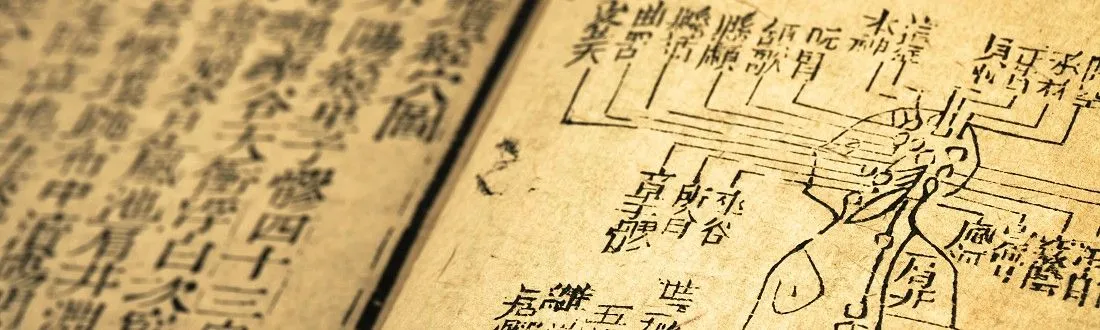
There is one more thread worth drawing. Ayahuasca has always been given by a shaman or curandero — a trained guide who prepares the brew, sings the icaros and holds the ceremony. Chinese medicine, for all its later sophistication, shares that ancestry. Its earliest practitioners were the wu (巫) — shaman-healers who worked with spirits, ritual and plants — and the very character for medicine, 醫 (yī), was in its archaic form written with the radical for shaman (巫) at its foot, in place of the usual lower component for fermented medicinal liquid. Only gradually, across the Zhou and Han dynasties, did Chinese medicine separate from shamanic practice into the naturalistic, pattern-based system recorded in the Huangdi Neijing. Seen from a distance, both traditions grow from the same root: an older world in which healing, plants and spirit were inseparable, and a knowledgeable guide held the space in which medicine was given.
I share this only as a way of thinking about how traditional medicine has always tried to understand the natural world by watching it — not as an explanation of how these substances work, and emphatically not as a suggestion that anyone should seek them out.
6. The risks
- Dangerous drug and food interactions (ayahuasca). Ayahuasca is a strong MAOI. Combined with antidepressants (SSRIs, SNRIs), other MAOIs, certain other medicines, or tyramine-rich foods, it can cause serotonin syndrome or a dangerous rise in blood pressure — both potentially fatal.
- Heart risk and death (ibogaine). Ibogaine can cause fatal heart-rhythm disturbances. Deaths have occurred, which is precisely why research protocols add magnesium and continuous cardiac monitoring — conditions absent from unregulated use.
- Serious psychological risk. Both can produce overwhelming, frightening experiences, and both are strongly contraindicated for anyone with a personal or family history of psychosis or bipolar disorder.
- Unregulated settings. Overseas "retreats" vary enormously in medical screening and safety; there have been serious harms and deaths at some.
- Legal consequences. Ayahuasca (as DMT) is a Class A drug in the UK; supplying or importing ibogaine is restricted under the Psychoactive Substances Act 2016.
7. Do I offer this?
No. To be completely unambiguous: I do not offer, provide, prescribe, supply, source or recommend ayahuasca, iboga, ibogaine or any psychedelic, and I cannot help anyone obtain them or find a retreat. My clinical work is acupuncture and Chinese herbal medicine, used as a complementary therapy alongside conventional care. This article exists only to give an accurate, responsible summary of research that patients increasingly ask about.
If you are dealing with depression, anxiety, trauma or addiction, the right first step is a conversation with your doctor about evidence-based options. Acupuncture and Chinese herbal medicine may be used supportively alongside that care.
8. Frequently asked questions
Are ayahuasca and ibogaine legal in the UK?
Ayahuasca contains DMT, which is a Class A drug under the Misuse of Drugs Act 1971 — illegal to produce, possess or supply. Ibogaine is not an approved medicine, and its supply and import are restricted under the Psychoactive Substances Act 2016. Neither is available as a treatment.
Can ayahuasca or ibogaine treat depression, trauma or addiction?
They are not approved or available treatments. Early research — a small controlled trial of ayahuasca for depression, and an observational study of ibogaine in veterans with brain injury — is promising but preliminary, conducted under medical supervision, and far from establishing safety or benefit for general use.
Do you offer ayahuasca or ibogaine?
No. I do not offer, prescribe, supply or recommend them in any form, and I cannot help anyone obtain them or find a retreat. My practice is acupuncture and Chinese herbal medicine.
Is it safe to do an ayahuasca or ibogaine retreat?
Both carry serious risks. Ayahuasca can interact dangerously with antidepressants and other medicines and foods; ibogaine can cause fatal heart-rhythm problems. Overseas retreats vary widely in medical safety and there have been deaths. If you are struggling, please speak to your doctor first.
Are ayahuasca or ibogaine part of Chinese herbal medicine?
No. They are Amazonian and West African plant medicines with no place in the Chinese materia medica, and they are not mentioned in any classical Chinese medical text. The reflection in this article is a philosophical way of thinking about plants in Nature, not a TCM treatment or a claim of effectiveness.
9. References
This article is for general information only. It is not medical, psychological or legal advice, and it is not a recommendation to use any controlled or psychoactive substance. Always consult your doctor about treatment for depression, trauma or addiction.