

Bai He Di Huang Tang (百合地黄汤) — Lily Bulb & Rehmannia Decoction
On this page
Overview
Bai He Di Huang Tang — the “Lily Bulb and Rehmannia Decoction” — is from Zhang Zhongjing’s Jin Gui Yao Lue and is the principal formula for the classical syndrome known as Bai He Bing (Lily Bulb Disease): a post-febrile state of mild but persistent disquiet of mind characterised by absent-minded restlessness, vague malaise, mild depression[1], sleep disturbance, lack of appetite and a hard-to-pin-down feeling of being unwell. The pattern is interpreted in TCM as residual Heat lingering after a febrile illness, damaging Heart and Lung Yin and unsettling the Shen.
I prescribe Bai He Di Huang Tang as part of bespoke herbal formulas from pharmaceutical-grade granules sourced from Sun Ten in Taiwan.
TCM pattern
Bai He Di Huang Tang is prescribed for Lily Bulb Disease — Heart-Lung Yin deficiency with residual Heat after febrile illness:
- Restless mind, absent-minded — "the patient wants to walk but cannot, wants to eat but cannot"
- Mild low mood, vague unwellness
- Sleep disturbance with vivid dreams
- Bitter taste, dry mouth, mild thirst
- History of recent febrile illness (or chronic stress in modern interpretation)
- Tongue — red, scant or peeled coat
- Pulse — rapid, thin
Key herbs
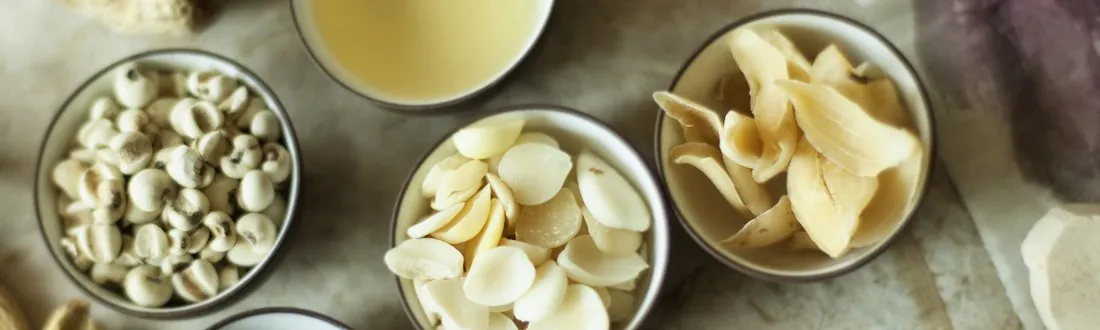
- Bai He (Bb. Lilii, 30–60g) — chief; nourishes Lung and Heart Yin; calms Shen; resolves residual Heat
- Sheng Di Huang (Rx. Rehmanniae, 15–30g) — nourishes Yin and clears Heat from the Blood
- Sheng Di Huang Zhi (rehmannia juice, traditional) — intensifies the cooling Yin-nourishing action
Formula actions
- Nourishes Heart and Lung Yin
- Clears residual Heat after febrile illness
- Calms the Shen
Conditions treated
- Post-viral fatigue[9] syndrome with Yin-deficient restlessness
- Long COVID with restless fatigue and low mood
- Post-influenza convalescence with residual Heat
- Mild depression with restlessness in Yin-deficient constitution
- Menopausal restlessness with Yin deficiency
- Chronic anxiety[4] disorder in Yin-deficient pattern
Cautions
Not appropriate for cold-deficient patterns — the cold nourishing herbs aggravate cold.
Persistent depression or anxiety needs mental health support alongside herbal treatment.
Always consult a qualified Chinese herbalist registered with the RCHM.
Prefer to be treated from home? Chinese herbal medicine online consultations are available throughout the UK and worldwide.
References
[1] Butler L, Pilkington K. Chinese herbal medicine and depression: the research evidence. Evid Based Complement Alternat Med. 2013;2013:739716. https://doi.org/10.1155/2013/739716. PMID: 23476690.
[4] Lin Y, Cai S, Wang T, Zhuang T, Huang T, Yu X, et al. Evaluation of the Safety and Efficacy of Xiao Yao San as a Treatment for Anxiety: A Systematic Review and Meta-Analysis. Evid Based Complement Alternat Med. 2022;2022:1319592. https://doi.org/10.1155/2022/1319592. PMID: 35432568.
[9] Wang YY, Li XX, Liu JP, Luo H, Ma LX, Alraek T. Traditional Chinese medicine for chronic fatigue syndrome: a systematic review of randomized clinical trials. Complement Ther Med. 2014 Aug;22(4):826-33. https://doi.org/10.1016/j.ctim.2014.06.004. PMID: 25146086.