



Wei Jing Tang (苇茎汤) — Reed Decoction
On this page
Overview
Wei Jing Tang — the Reed Decoction — is from Zhang Zhongjing’s Jin Gui Yao Lue. It is the classical formula for Lung abscess (fei yong) — chronic suppurative chest infection with thick, foul, yellow-green sputum, sometimes blood-streaked. The formula combines just four herbs in an elegant pattern: Lu Gen (or Wei Jing) cools Lung Heat, Yi Yi Ren drains Damp downward, Dong Gua Ren resolves Phlegm-Heat, and Tao Ren breaks Blood stasis.
In modern terms the formula is used for lung abscess (now uncommon thanks to antibiotics), bronchiectasis with infective exacerbations, severe pneumonia and chronic suppurative lung disease — always alongside conventional antibiotic care.
I prescribe Wei Jing Tang as part of bespoke herbal formulas from pharmaceutical-grade granules sourced from Sun Ten in Taiwan.
TCM pattern
Wei Jing Tang is prescribed for Phlegm-Heat with Blood stasis in the Lung:
- Cough with thick yellow-green or rust-coloured sputum
- Foul-smelling sputum
- Mild blood-streaking in sputum in some cases
- Chest pain — particularly with deep breath or cough[10]
- Fever (low-grade or moderate)
- Dry mouth, thirst
- Tongue — red, yellow greasy coat
- Pulse — slippery, rapid
Key herbs
- Lu Gen (Rz. Phragmitis, 10-60g) or Wei Jing (reed root) — chief; cools Lung Heat and generates fluids
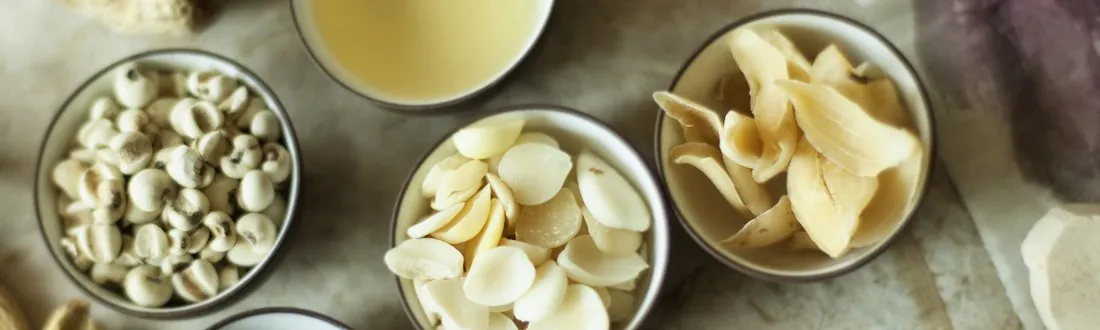
- Yi Yi Ren (coix seed, 10-30g) — drains Damp downward and resolves pus
- Dong Gua Ren (winter melon seed) — clears Lung Heat and resolves pus
- Tao Ren (peach kernel, 5-10g) — breaks Blood stasis and lubricates intestines
Formula actions
- Clears Lung Heat
- Transforms Phlegm-Heat
- Resolves pus
- Breaks Blood stasis in the chest
Conditions treated
- Lung abscess (alongside antibiotic treatment)
- Bronchiectasis — particularly with infective exacerbations
- Severe pneumonia recovery
- Empyema (alongside surgical and antibiotic care)
- Chronic suppurative bronchitis
- Cystic fibrosis with chronic chest infection (alongside conventional care)
- Lung cancer with infection (alongside oncology care)
Cautions
Lung abscess and serious chest infection require antibiotics, imaging, often hospital care and sometimes drainage. This formula is an adjunct, not a substitute.
Haemoptysis (coughing up blood) needs urgent medical assessment.
Strictly contraindicated in pregnancy (contains Tao Ren).
Not appropriate for cold-pattern cough or Lung Yin deficiency cough.
Always consult a qualified Chinese herbalist registered with the RCHM.
Prefer to be treated from home? Chinese herbal medicine online consultations are available throughout the UK and worldwide.
References
[10] Lee B, Kwon CY, Suh HW, Kim YJ, Kim KI, Lee BJ, Lee JH. Herbal medicine for the treatment of chronic cough: a systematic review and meta-analysis. Front Pharmacol. 2023 Oct 17;14:1230604. https://doi.org/10.3389/fphar.2023.1230604. PMID: 37920213.















