

Wen Pi Tang (温脾汤) — Warm the Spleen Decoction
On this page
- Overview
- TCM pattern
- Key herbs
- Formula actions
- Conditions treated
- Comparisons with related formulas
- Modifications
- Cautions
Overview
Wen Pi Tang — “Warm the Spleen Decoction” — is a Tang-dynasty formula from Sun Simiao’s Bei Ji Qian Jin Yao Fang (Essential Formulas Worth a Thousand Gold Pieces, c. 652 CE). It addresses the unusual but important pattern of Cold accumulation in the intestines with Yang deficiency — chronic constipation[11] that does not respond to standard purgatives because the underlying problem is Cold and Yang deficiency, not Heat.
The formula is a clever combination of opposites: it uses Da Huang (a strongly cold purgative) alongside Fu Zi (a powerfully warming Yang tonic), Gan Jiang (warming Spleen) and Ren Shen (Qi tonic). The Da Huang clears the cold-stuck accumulation downward; the warming herbs prevent Da Huang from damaging Yang. This principle — combining drainage with warming — is one of the most sophisticated techniques in classical formula construction.
I prescribe Wen Pi Tang as part of bespoke herbal formulas from pharmaceutical-grade granules sourced from Sun Ten in Taiwan.
TCM pattern
Wen Pi Tang is prescribed for Cold accumulation in the intestines with Yang deficiency:
- Chronic constipation — often despite normal diet, fibre and water
- Stools may be difficult to pass even when soft (in deficiency-Cold pattern)
- Cold lower abdomen
- Lower abdominal pain — relieved by warmth and pressure
- Cold extremities
- Aversion to cold, preference for warm foods
- Fatigue, lassitude
- Pale complexion
- Tongue — pale, possibly swollen, white moist coat
- Pulse — deep, slow, possibly wiry
The pattern is common in older adults with constipation, in patients on long-term opioids who have developed cold constipation, in chronic illness, after abdominal surgery, in scleroderma and in those with hypothyroidism.
Key herbs
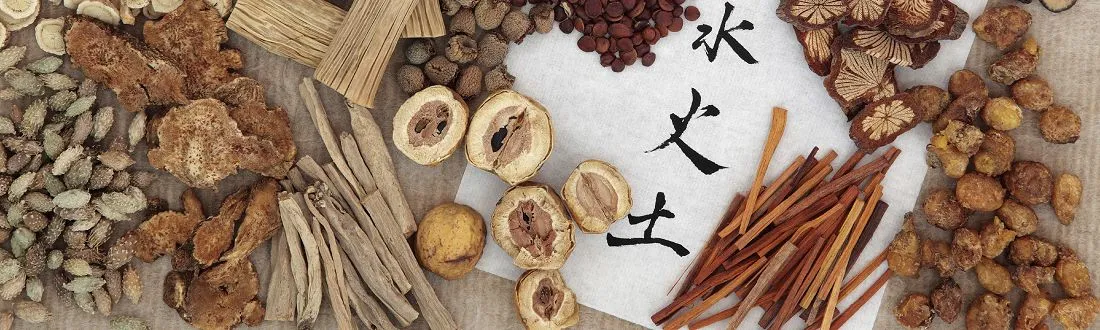
- Da Huang (Rheum palmatum, 10-12g) — purgative; clears stuck accumulation
- Fu Zi (prepared aconite, 9-12g) — warms Kidney Yang and Spleen Yang
- Gan Jiang (dried ginger, 3-9g) — warms the middle
- Ren Shen (Rx. Ginseng, 6-12g) — tonifies Qi
- Gan Cao (Rx. Glycyrrhizae Preparata, 3-9g) — harmonises
Formula actions
- Warms the Spleen and Kidney Yang
- Purges Cold accumulation downward
- Tonifies Qi
- Resolves chronic Cold constipation
Conditions treated
- Chronic constipation from Cold and Yang deficiency — the primary indication; see also Chinese medicine for constipation
- Opioid-induced constipation (alongside conventional management)
- Constipation in older adults with Yang deficiency picture
- Constipation after abdominal surgery with Cold pattern
- Constipation in hypothyroidism — see hypothyroidism
- Cold abdominal pain with constipation
- Chronic mesenteric ischaemia presentations (alongside vascular care)
- Severe Cold-deficiency constipation in chronic illness
Comparisons with related formulas
- Da Cheng Qi Tang — for Heat-pattern constipation with high fever and excess Yang Ming Heat; opposite indication.
- Ma Zi Ren Wan — for dry constipation from Yin deficiency.
- Ji Chuan Jian — for Kidney Yang deficiency constipation in elderly; gentler than Wen Pi Tang.
- San Wu Bei Ji Wan — for acute Cold accumulation; a heroic emergency formula.
- Wu Ren Wan — for dry constipation from Blood and fluid deficiency; gentler.
Modifications
- For prominent cold and Kidney Yang deficiency, increase Fu Zi and add Rou Gui
- For prominent fatigue[9], increase Ren Shen and add Huang Qi
- For prominent abdominal pain, add Bai Shao and Gan Cao
- For very stuck stool, increase Da Huang or add Mang Xiao (with caution)
- For chronic use, reduce Da Huang and consider combining with Ji Chuan Jian
Cautions
This formula contains Fu Zi (prepared aconite) and should only be prescribed by a qualified Chinese herbalist with experience in toxic herbs.
Not appropriate for Heat-pattern constipation, Yin-deficient constipation or Qi-stagnation constipation. Wrong-pattern use can cause significant adverse effects.
Not appropriate in pregnancy — contains Da Huang and Fu Zi, both contraindicated.
Use cautiously in patients on multiple medications — Da Huang can affect drug absorption; Fu Zi has potential cardiac effects.
Persistent constipation needs medical assessment to exclude bowel obstruction, colorectal pathology and serious underlying disease.
Always consult a qualified Chinese herbalist registered with the RCHM.
Prefer to be treated from home? Chinese herbal medicine online consultations are available throughout the UK and worldwide.
References
[9] Wang YY, Li XX, Liu JP, Luo H, Ma LX, Alraek T. Traditional Chinese medicine for chronic fatigue syndrome: a systematic review of randomized clinical trials. Complement Ther Med. 2014 Aug;22(4):826-33. https://doi.org/10.1016/j.ctim.2014.06.004. PMID: 25146086.
[11] Lyu Z, Fan Y, Bai Y, Liu T, Zhong LL, Liang HF. Outcome of the efficacy of Chinese herbal medicine for functional constipation: A systematic review and meta-analysis. World J Clin Cases. 2022 May 26;10(15):4856-4877. https://doi.org/10.12998/wjcc.v10.i15.4856. PMID: 35801027.















