



Lián Zǐ (莲子) — Lotus Seed
On this page
- Overview
- Properties
- Actions and indications
- Modern research
- Incompatibilities
- Cautions and contraindications
- Treatment at my clinic
1. Overview
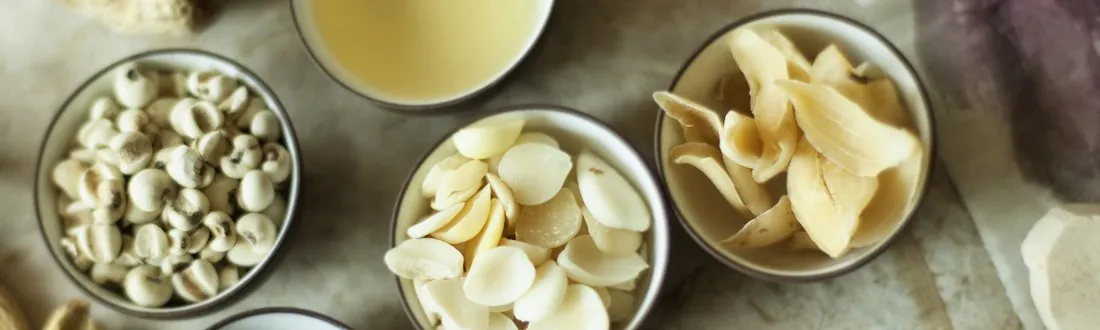
Lián Zǐ (莲子) is the dried ripe seed of Nelumbo nucifera, the sacred lotus, known in English as lotus seed. It belongs to the category of Herbs that stabilise and bind in the Chinese Materia Medica and is widely used in Chinese herbal medicine for Spleen deficiency with chronic loose stools, Heart-Kidney non-interaction presenting with palpitations and insomnia, and seminal emission from Kidney deficiency. It is also an everyday food in East Asia.
I prescribe Lián Zǐ as part of bespoke herbal formulas from pharmaceutical-grade granules sourced from Sun Ten in Taiwan.
2. Properties
| Pinyin name | Lián Zǐ |
|---|---|
| Chinese characters | 莲子 |
| Latin name | Nelumbo nucifera (seed) |
| English name | Lotus seed |
| Nature | Neutral |
| Flavour | Sweet, astringent |
| Channels entered | Spleen, Kidney, Heart |
| Category | Herbs that stabilise and bind (astringents) |
3. Actions and indications
Principal actions
- Tonifies Spleen Qi and stops chronic diarrhoea
- Tonifies Kidney Qi and stabilises essence
- Nourishes the Heart and calms the Spirit
Indications
- Chronic loose stools and diarrhoea from Spleen deficiency
- Spermatorrhoea and frequent urination from Kidney Qi deficiency
- Palpitations, anxiety and insomnia from Heart-Kidney disharmony with Spleen depletion
- Pale, weak, post-illness convalescents needing gentle restorative food-grade herbs
4. Modern research
Lotus seed contains starch, high-quality protein, alkaloids (neferine, liensinine, isoliensinine — concentrated in the green embryo Lián Zǐ Xīn, which is sometimes removed in food use), flavonoids and minerals. Studies report antihypertensive, antiarrhythmic, anti-inflammatory and mild anxiolytic activity. The embryo (Lián Zǐ Xīn) is used separately as a stronger Heart-Heat-clearing herb. Generally considered very safe.
5. Incompatibilities
Lián Zǐ (莲子) Lotus Seed is not listed in either of the two classical incompatibility texts — Shi Ba Fan (Eighteen Antagonisms) or Shi Jiu Wei (Nineteen Mutual Inhibitions). As with every Chinese herb it should be prescribed only as part of a balanced formula by a registered Chinese herbalist (RCHM), who will check for interactions with any other herbs and prescription medications you are taking.
6. Cautions and contraindications
Use with caution in patients with constipation from heat or dryness, where the astringent action would aggravate the picture. No significant drug interactions documented at culinary or standard herbal doses.
Pattern contraindications
Contraindicated in Excess patterns with retained pathogens — astringing while a pathogen is still active can lock it in. Use only once the active pathogen has been cleared and the residual deficiency is the dominant pattern.
Modern drug interactions
Wu Wei Zi is a notable CYP3A4 inhibitor — it can raise levels of statins, ciclosporin, tacrolimus and many other drugs. Tell your doctor if you take prescription medication before starting a formula containing Wu Wei Zi.
Important: Chinese herbs should always be prescribed by a fully qualified herbalist who is a member of the Register of Chinese Herbal Medicine (RCHM).
7. Treatment at my clinic
I prescribe Lián Zǐ as part of tailored herbal formulas for chronic loose stools, anxiety with insomnia and palpitations from Heart-Kidney disharmony, and gentle restorative tonification in post-illness recovery. Every prescription is individually formulated following a full TCM assessment.
Online Chinese herbal medicine consultations are available.
Return to the Chinese herb directory or the Chinese herbal medicine main page.
Prefer to be treated from home? Chinese herbal medicine online consultations are available throughout the UK and worldwide.















