



Five-colour eating
By Dr (TCM) Attilio D’Alberto — registered Traditional Chinese Medicine practitioner (BAcC, RCHM) with over 25 years’ clinical experience.
On this page
- What is five-colour eating?
- Green foods — Liver
- Red foods — Heart
- Yellow and orange foods — Spleen
- White foods — Lung
- Black and dark foods — Kidney
- Putting it into practice
- Related pages
1. What is five-colour eating?
The five-colour principle is one of the most accessible expressions of Chinese food therapy. Each of the five colours corresponds to one of the five elements, one organ system, one flavour and one season. By making sure that all five colours appear regularly — either across a single plate, a single meal, or across the days of the week — you naturally nourish all five organ systems and stay close to constitutional balance. It is a simple, visual, intuitive way to bring TCM principles into daily eating.
| Colour | Element | Organ | Flavour | Season |
|---|---|---|---|---|
| Green | Wood | Liver / Gallbladder | Sour | Spring |
| Red | Fire | Heart / Small Intestine | Bitter | Summer |
| Yellow | Earth | Spleen / Stomach | Sweet | Late summer |
| White | Metal | Lung / Large Intestine | Pungent | Autumn |
| Black | Water | Kidney / Bladder | Salty | Winter |
2. Green foods — Liver
Green foods enter the wood element and support the Liver and Gallbladder. They tend to be light, fresh, slightly sour or bitter, and many have a gentle qi-moving effect. Eating plenty of greens helps to relieve Liver qi stagnation, the most common pattern in modern stressed populations.
- Spinach, kale, watercress, rocket, romaine lettuce, pak choi
- Broccoli, Brussels sprouts, asparagus, green beans
- Courgette, cucumber, celery, leek
- Sprouts: alfalfa, mung bean, broccoli, sunflower
- Green herbs: parsley, basil, mint, coriander, dill
- Green tea, matcha
- Avocado (in moderation), kiwi, green grapes, lime
3. Red foods — Heart
Red foods enter the fire element and support the Heart and Small Intestine. They tend to nourish blood, support circulation, and many have warming or qi-supportive effects.
- Tomato, red pepper, beetroot, radish, red cabbage
- Strawberry, raspberry, cherry, watermelon, pomegranate, red grape
- Goji berries, hawthorn, jujube (red dates), cranberry
- Red kidney bean, adzuki bean, red lentil
- Beef and lamb (red meats — in moderation)
- Rooibos, hibiscus tea, red wine (1 small glass)
- Saffron, paprika, chilli (in moderation)
4. Yellow and orange foods — Spleen
Yellow and orange foods enter the earth element and support the Spleen and Stomach — the central digestive system that produces qi and blood from food. These foods are typically sweet, naturally tonifying and easy to digest.
- Sweet potato, pumpkin, butternut squash, carrot, swede
- Yellow corn, polenta, millet
- Yellow soya bean, chickpea, butter bean, lentil
- Banana, mango, pineapple, peach, apricot, papaya, orange
- Egg yolk, honey, ginger, turmeric, fennel, cumin
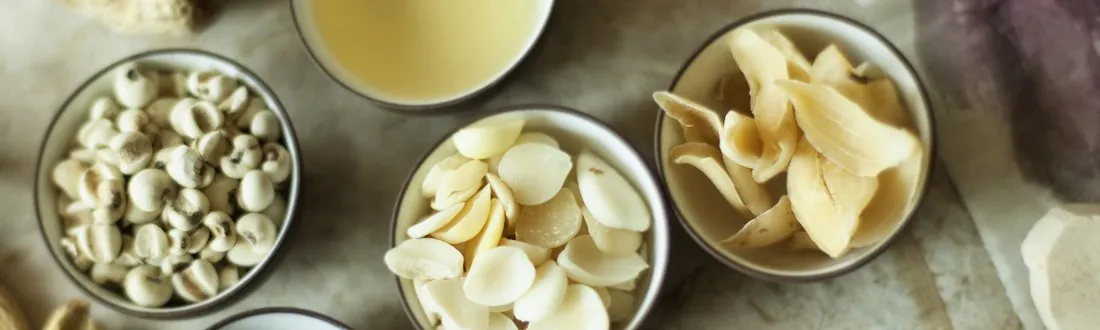
- Chinese yam (shan yao), lotus seeds
- Yellow rock sugar, brown sugar (small amounts)
5. White foods — Lung
White foods enter the metal element and support the Lung and Large Intestine. They tend to moisten and protect the Lungs, and are particularly important in autumn when the dry climate energy depletes Lung yin.
- White cabbage, cauliflower, white radish, daikon, mooli, parsnip, turnip
- Pear, apple, banana (white inside), white grape, lychee
- Pine nut, almond (sweet), white sesame
- White fungus (yin er, silver tree fungus), button mushrooms, oyster mushrooms
- Lotus root, lotus seed, lily bulb, water chestnut
- Tofu, soya milk, white fish, scallop, white beans
- Garlic, white onion, ginger, white pepper
- White rice, oats, barley
6. Black and dark foods — Kidney
Black and dark foods enter the water element and support the Kidney and Bladder — the storehouse of essence (jing) and the foundation of constitutional vitality. Eating black foods regularly is one of the most direct ways to support fertility, longevity and vital essence in TCM.
- Black beans, kidney beans (dark), black soya beans
- Black sesame seeds, black walnuts
- Black rice (forbidden rice), black quinoa, black wild rice
- Black mushroom (wood ear), shiitake (when dark)
- Seaweed: kombu, hijiki, nori, wakame
- Blackberry, blueberry, blackcurrant, mulberry, black grape, prune
- Cuttlefish, eel, oysters, mussels (dark seafood)
- Black tea, pu-erh tea
- Cocoa, dark chocolate (small amounts)
7. Putting it into practice
You do not need every colour at every meal. Aim for:
- Daily: at least three colours on your main plate (lunch or dinner). Add a colour you are missing as a side or garnish.
- Weekly: all five colours appearing regularly across the week. Black foods are the most often missed in modern diets — build a small habit (a sprinkle of black sesame on porridge, a handful of black beans in soup, a square of dark chocolate after dinner).
- Seasonally: emphasise the colour of the current season — green in spring, red in summer, yellow/orange in late summer, white in autumn, black in winter.















