


Chinese yam (shan yao)
By Dr (TCM) Attilio D’Alberto — registered Traditional Chinese Medicine practitioner (BAcC, RCHM) with over 25 years’ clinical experience.
On this page
- About Chinese yam
- Origin and tradition
- TCM properties
- Modern nutritional profile
- Health benefits
- How to use
- Recipes and pairings
- When to use it
- Cautions and contraindications
- Frequently asked questions
- Related pages
1. About Chinese yam
Chinese yam — shan yao (山药), literally "mountain medicine" — is the rhizome of Dioscorea opposita (also classified as D. polystachya), a climbing perennial vine native to East Asia. Despite the name, it is not a true yam (genus Ioscorea is shared but different species) and not at all related to sweet potato or American yams. It is one of the most universally tolerated and clinically useful tonic foods in TCM, with the unusual feature of tonifying three different organ systems simultaneously: Spleen, Lung and Kidney.
Chinese yam is mild, sweet and slightly slippery. Its gentleness and broad action make it suitable for all ages from infancy to old age, including pregnancy, postpartum, convalescence and chronic illness. Few other TCM tonics carry this universal indication. The classical text Bencao Gangmu (Compendium of Materia Medica, 1596) classifies Chinese yam as one of the most reliable everyday tonics for "boys, girls, men, women, the old and the young."
2. Origin and tradition
Chinese yam has been cultivated in China for over 4,000 years and is recorded in the Shennong Bencao Jing (c. 200 BCE) in the highest "superior" category. The most prized cultivation regions are Henan (the famous "huai shan yao" from Huaiqing district), Shanxi and Hebei provinces. Henan huai shan yao is the protected designation of origin variety with the highest concentration of active compounds.
It appears in many of the most important classical Chinese herbal formulas: Liu Wei Di Huang Wan (Six Flavour Rehmannia Pill, the foundational Kidney yin tonic), Shen Ling Bai Zhu San (Ginseng-Poria-Atractylodes Powder, for Spleen weakness with damp), Jin Gui Shen Qi Wan (Kidney Qi Pill, for Kidney yang deficiency), and many others. It is one of the most commonly prescribed Chinese herbs in modern clinical practice.
3. TCM properties
- Thermal nature: Neutral
- Flavour: Sweet
- Channels entered: Spleen, Lung, Kidney
- Actions: Tonify Spleen and Stomach qi; nourish Lung yin; tonify Kidney qi and essence; bind and astringe (anti-leakage)
The simultaneous action on three organ systems is unusual and clinically valuable: a tired person whose deficiency spans Spleen, Lung and Kidney can address all three with one substance. The neutral thermal nature ensures Chinese yam is safe across constitutions including yin- and yang-deficient patterns.
4. Modern nutritional profile
Per 100 g of fresh Chinese yam:
- Calories: ~118 kcal
- Carbohydrates: 27 g (mostly resistant starch and inulin)
- Protein: 1.5 g
- Fibre: 4 g (high)
- Vitamin C: 17 mg
- Potassium: 816 mg (very high)
- Manganese: 0.4 mg
- Allantoin: a soothing and reparative compound also found in comfrey
- Diosgenin: a steroidal saponin precursor with documented hormonal-balancing effects, particularly in perimenopausal women
- Mucilaginous polysaccharides: the slippery texture comes from mucilage with documented prebiotic and gut-soothing effects
5. Health benefits
Spleen qi support and digestive recovery
Chinese yam is one of the most reliable foods for everyday Spleen qi deficiency and chronic loose stools. Particularly useful in convalescence, post-antibiotic recovery and elderly digestion. The mucilage soothes the gut lining; the resistant starch supports beneficial gut flora.
Diabetes and blood sugar regulation
Chinese yam has been studied extensively for its blood-sugar-modulating effects. The combination of resistant starch, inulin and bioactive compounds slows glucose absorption and modestly improves insulin sensitivity. Multiple Chinese clinical trials support its use as an adjunct in type 2 diabetes management. Useful in PCOS with insulin resistance.
Lung qi and chronic respiratory conditions
The Lung-yin nourishing action makes Chinese yam useful in chronic cough, asthma and post-viral fatigue with Lung weakness. Particularly good in older adults with chronic dry cough, where its moistening action complements the warming nature of walnuts and ginger.
Kidney qi and reproductive support
Chinese yam tonifies Kidney qi and essence, supporting fertility, lower back strength and frequency of urination. It is one of the gentlest Kidney tonics — suitable where stronger Kidney tonics (like prepared rehmannia) would be too rich or warming.
Postpartum recovery and pregnancy support
The combination of Spleen-strengthening, Lung-moistening and Kidney-supporting actions makes Chinese yam ideal for pregnancy and postpartum recovery. Daily Chinese yam congee supports milk supply, replenishes qi and supports the digestive recovery of the mother.
Vaginal discharge and reproductive consolidation
The astringent and Spleen-tonifying effect addresses excessive vaginal discharge from Spleen-Kidney deficiency — a common complaint in tired women with weak digestion.
Children's nutrition and weak appetite
Chinese yam is one of the safest and most useful foods for children with weak appetite, slow growth, recurrent infections and poor digestion. Daily Chinese yam congee is a classical Chinese paediatric tonic.
6. How to use
- Fresh: peel (wear gloves — the raw skin can cause itching), then steam, stir-fry or add to soups. Fresh Chinese yam has a slightly slippery, mild flavour.
- Dried slices (most common Chinese herbal pharmacy form): rehydrate by soaking 30 minutes, then add to soups or congees.
- Powder: stir 1 tablespoon into hot water, oats or smoothies for a quick daily Spleen tonic.
- Add to congee: 30 g dried slices simmered with rice. The classical paediatric tonic.
- Add to soups and stews: 30–60 g per pot, simmered for 30–60 minutes.
- In Chinese herbal formulas: classical use is 15–30 g per dose.
- Itchy hands when peeling: wear gloves, peel under cold running water, or briefly steam first to deactivate the irritant compounds.
Daily dose: 30–60 g fresh, or 15–30 g dried slices, or 1–2 tablespoons of powder.
7. Recipes and pairings
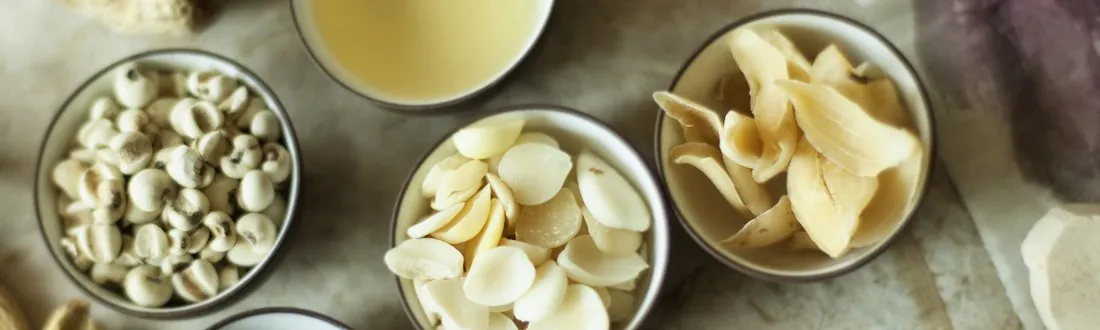
- Chinese yam and lotus seed congee: deeply Spleen-supportive; ideal for chronic fatigue or paediatric weakness.
- Chinese yam and chicken soup: a gentle daily qi tonic; add astragalus and red dates for stronger effect.
- Chinese yam and red bean dessert: a vegetarian Spleen-supporting sweet soup.
- Chinese yam and pork rib soup: a Cantonese family classic for general nourishment.
- Four Things Soup with Chinese yam: add 30 g dried Chinese yam to the classical formula for women's recovery.
- Pairings: Chinese yam + lotus seed (calming + Spleen); + red date (qi and blood); + chicken (qi tonic); + walnut (Kidney essence); + astragalus (immune support).
8. When to use it
- Chronic loose stools, weak appetite, post-antibiotic digestive recovery
- Chronic dry cough, post-viral fatigue (Lung qi/yin deficiency)
- Diabetes and metabolic syndrome (blood sugar support)
- PCOS with insulin resistance
- Lower back weakness, frequent urination (Kidney qi deficiency)
- Vaginal discharge from Spleen-Kidney deficiency
- Pregnancy and postpartum recovery
- Paediatric weakness, slow growth, recurrent infections
- Convalescence in elderly adults
- Daily preventive tonic for almost any constitution
9. Cautions and contraindications
- Marked damp-heat patterns: the slightly mucilaginous nature can mildly aggravate damp-heat. Reduce in oily skin, bitter taste, yellow tongue coating.
- Constipation with strong heat signs: the astringent action can worsen constipation. Pause until heat is cleared.
- Itchy hands when peeling fresh yam: wear gloves or peel under running water; the irritant is deactivated by cooking.
- Mucilage texture: some people dislike the slippery texture; opt for dried slices or powder forms.
- Hormone-sensitive conditions: the diosgenin content has mild oestrogen-modulating effects. Generally safe in normal food doses; discuss with practitioner if you have hormone-receptor-positive conditions and want to use therapeutic doses.
10. Frequently asked questions
Is Chinese yam the same as Western yam or sweet potato?
No. Western "yams" sold in supermarkets are usually sweet potatoes (Ipomoea batatas) or African yams (Dioscorea cayennensis) — different species with different actions. Chinese yam is specifically Dioscorea opposita. Look for "shan yao" or "Chinese yam" or "huai shan yao" specifically.
Where can I buy Chinese yam?
Fresh Chinese yam is available in Chinese supermarkets (look for long, slender, light-brown rhizomes). Dried slices are sold in Chinese herbal pharmacies and online. Powder form is the most convenient for daily use.
Is Chinese yam safe in pregnancy?
Yes. It is one of the safest tonic foods for pregnancy, suitable from first trimester onwards. Daily Chinese yam congee is a traditional pregnancy nutrient.
Can I take Chinese yam if I'm diabetic?
Yes — in fact it is one of the most recommended foods for diabetes in TCM and is supported by modern research. The resistant starch and inulin slow glucose absorption. Use whole forms (fresh or dried slices) rather than powdered for the best blood-sugar profile.
How long should I take Chinese yam for?
Daily long-term use is fine. The "superior" category in the Shennong Bencao Jing means safe for indefinite consumption. For specific patterns, take continuously for the duration plus 2–4 weeks consolidation.















