


Qi deficient constitution (Qi Xu)
By Dr (TCM) Attilio D’Alberto — registered Traditional Chinese Medicine practitioner (BAcC, RCHM) with over 25 years’ clinical experience.
On this page
- Overview
- How qi deficiency develops
- Recognising the pattern
- Tongue and pulse
- Common health conditions
- Dietary approach
- Foods to favour
- Foods to limit
- Sample day's eating
- Cooking methods
- Lifestyle
- Common mistakes
- Risks if uncorrected
- Frequently asked questions
- Related pages
1. Overview
Qi deficiency (Qi Xu) is the most common of the nine TCM constitutional patterns and the everyday picture of low functional energy. Qi is the body's ability to do work — to digest, breathe, move, think, hold organs in place, hold the blood in the vessels, defend against pathogens, and warm the surface. When qi is insufficient, all these functions become slow, weak or unreliable. The two organs most often involved are the Spleen, which makes qi from food, and the Lung, which extracts qi from air; sometimes also the Kidneys, which house the original constitutional qi.
Qi-deficient people feel persistently tired even after sleep, become breathless on stairs, talk softly, sweat without exertion, catch every cold going round and recover slowly. Unlike yang deficiency, they are not necessarily very cold — only slightly cool, often pale, and depleted rather than chilled. Unlike qi stagnation, where qi is present but blocked, qi deficiency is a true shortage that no amount of "moving" can fix.
This is the single constitution most responsive to Chinese food therapy. Because qi is made directly from food and air, dietary correction can rebuild it within weeks if the patient eats consistently — warmly, regularly and slowly — and rests appropriately. The classical formulae Bu Zhong Yi Qi Tang and Si Jun Zi Tang are the herbal counterparts.
2. How qi deficiency develops
- Chronic overwork and inadequate rest — the modern epidemic cause
- Dieting, food restriction, eating disorders, weight-loss diets, intermittent fasting taken too far
- Long-term raw and cold eating — salads, smoothies, juices in excess
- Skipping breakfast and eating most calories late at night
- Long-term illness, surgery, antibiotics, chemotherapy
- Repeated childbirth without recovery; long breastfeeding
- Excessive talking and emotional output (a classical TCM cause — teachers, presenters, therapists)
- Excessive exercise without commensurate eating
- Chronic worry and rumination, which directly drain Spleen qi
- Aging — particularly after 50
3. Recognising the pattern
- Tiredness, especially after activity, talking or eating; better with rest
- Breathlessness on mild exertion (a flight of stairs, light hill)
- Soft, low voice; reluctant to speak; voice fades by end of day
- Pale, lustreless complexion; pale lips and nails
- Spontaneous sweating during the day, particularly on the head, chest or back
- Loose stools, sluggish digestion, abdominal bloating after eating
- Frequent colds and slow recovery; colds linger for weeks
- Easy bruising or prolonged bleeding (qi fails to hold blood)
- Prolapse symptoms over years (bladder, uterus, haemorrhoids)
- Poor concentration, mental fog after lunch
- Heavy menstrual bleeding with watery, pale blood; long cycles
- Cold limbs, but not extreme; mild aversion to cold
4. Tongue and pulse
Tongue: pale, swollen, with teeth-marks (scallops) at the edges; coating thin, white, sometimes peeling in patches.
Pulse: weak, soft, especially at the right wrist (Spleen and Lung positions); short of breath quality; sometimes empty on deep pressure.
5. Common health conditions
- Chronic fatigue syndrome (ME/CFS); post-viral fatigue; long Covid
- Recurrent infections — respiratory, urinary, vaginal
- IBS-D, leaky gut, food intolerances, malabsorption
- Iron-deficiency anaemia and B12 deficiency
- Postnatal depletion (after birth and breastfeeding)
- Mild prolapse: bladder, uterus, rectum, haemorrhoids, varicose veins
- Heavy or prolonged menstrual bleeding (menorrhagia)
- Allergic rhinitis with chronic clear nasal discharge
- Fertility difficulties with thin endometrial lining; recurrent implantation failure
- Functional hypoglycaemia, "hangry" episodes between meals
6. Dietary approach
The qi-deficient diet is warm, cooked, regular and easily digestible. Eating raw, cold or skipping meals worsens qi deficiency rapidly. The principles:
- Eat regularly. Three meals a day at predictable times. No skipped breakfasts. Modest snack between meals if needed.
- Mostly cooked, mostly warm. Cold food is harder for a weakened Spleen to break down.
- Mildly sweet, neutral or slightly warm thermal nature. Sweet (in the TCM sense) is the flavour that tonifies the Spleen.
- Easily digestible textures. Soups, stews, congees, soft-cooked vegetables — not raw fibre and roughage.
- Modest portion size, eaten slowly. Large meals overwhelm a weak Spleen and cause bloating.
- Moderate protein at each meal. Not vast amounts; consistent moderate amounts.
7. Foods to favour
Grains and starches:
- White rice, brown rice, glutinous rice, congee
- Oats — cooked porridge, particularly with cinnamon
- Millet, quinoa, sweet potato, pumpkin, butternut squash
- Sourdough bread (better tolerated than industrial white bread)
Classical Chinese qi tonics:
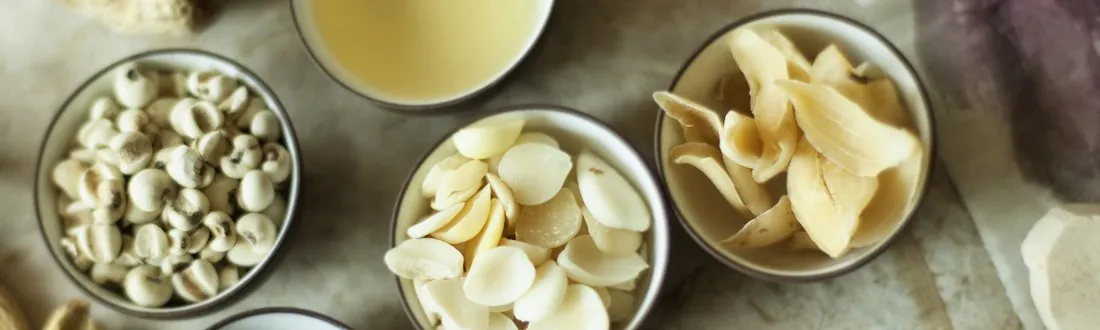
- Chinese yam (shan yao) — the cornerstone Spleen-qi food
- Lotus seeds (lian zi)
- Red dates / jujube (da zao)
- Goji berries (gou qi zi) — tonify Liver-Kidney yin and blood as well
- Longan fruit (long yan rou)
- Astragalus (huang qi) — in soup or congee
Vegetables (cooked):
- Pumpkin, carrot, squash, sweet potato, parsnip
- Leek, onion, spring onion, fennel
- Mushrooms: shiitake, white button, oyster, maitake
- Lightly steamed greens: kale, chard, spring greens
Animal proteins:
- Chicken (especially black chicken in soup), turkey
- Beef, lamb — slow cooked in stews
- Eggs (soft-cooked, scrambled, egg-drop soup)
- Bone broth and slow-cooked soups (the foundational qi food)
- White fish: cod, hake, sea bass
Aromatics and seasonings:
- Fresh ginger, dried ginger, cinnamon, cardamom
- Black pepper, white pepper, fennel seed
- Small amounts of natural sweetener: honey, maple syrup, dates
8. Foods to limit
- Raw vegetables and salads as a daily staple, particularly in winter
- Cold drinks, smoothies, iced food, ice cream straight from the freezer
- Excess raw fruit, particularly tropical (banana, mango, pineapple)
- Refined sugar, sweets, white-flour pastries
- Industrially processed snack foods
- Excess wheat, particularly cold sandwiches
- Excess dairy, especially cold milk and yoghurt straight from the fridge
- Excess coffee on an empty stomach (borrows qi rather than building it)
- Skipping breakfast; eating most calories after 8pm
- Eating while distracted, rushed or working
9. Sample day's eating
On waking: warm water with a slice of fresh ginger; or a small mug of tea.
Breakfast: oat porridge cooked with water and milk, topped with cooked apple, walnuts, a few red dates, a pinch of cinnamon. Or a congee of rice cooked with a piece of chicken, ginger and Chinese yam.
Mid-morning: a small handful of nuts and a couple of dates; warm herbal tea.
Lunch: chicken soup with rice or noodles and lightly cooked greens; or a beef and root vegetable stew. Eaten slowly, not while working.
Afternoon: one or two oatcakes with nut butter; a warm cup of ginger tea.
Dinner: baked white fish with steamed greens, mashed sweet potato; or vegetable and lentil dahl with rice. Modest portion, before 8pm.
Evening: a small mug of warm milk with cinnamon if hungry late.
10. Cooking methods
- Soups, stews and broths — the most digestible meal for weak qi
- Congee (rice porridge) — the single most therapeutic food for the Spleen
- Slow cooking and pressure cooking — concentrates flavour, breaks down fibre
- Steaming — gentle and easy on digestion
- Light stir-frying — with ginger and a little oil
11. Lifestyle
Regular sleep before 11pm, ideally 7–8 hours, with the same bedtime each night. Gentle daily exercise — walking, t'ai chi, qigong, yin yoga — not exhausting HIIT workouts which deplete qi further. Avoid chronic overwork; take proper lunch breaks; restrict screen time before bed. Treat worry, rumination and emotional overload as physical health issues — they directly drain Spleen qi. Modest sun exposure each day. Acupuncture with moxibustion on Stomach-36 (Zusanli) and Spleen-6 (Sanyinjiao) is the classical treatment.
12. Common mistakes
- Overexercising to "boost energy". Strenuous exercise drains qi when reserves are low; gentle daily movement builds it.
- Daily smoothies for breakfast. Cold blended fruit on an empty stomach is one of the most effective ways to deepen qi deficiency.
- Heavy reliance on coffee and stimulants. They borrow energy from already-empty reserves.
- Skipping breakfast or eating only fruit. Removes the most important qi-building meal.
- Eating while working. Splits attention from digestion and weakens the Spleen.
- Strict raw vegan diet. Cold raw food in large quantities damages a vulnerable Spleen.
- Pushing through fatigue. Repeated overdrawing of qi reserves slows recovery for years.
13. Risks if uncorrected
Untreated qi deficiency tends to deepen into more serious patterns: yang deficiency (cold body, fluid retention), phlegm-damp (weight gain, sluggish metabolism, foggy thinking), or blood deficiency (anaemia, dizziness, insomnia). It also predisposes to chronic infection, autoimmune flare, postnatal depletion that lasts years, and slow recovery from any illness or surgery. Early dietary correction is highly effective; later it becomes harder to fully restore.
14. Frequently asked questions
How is qi deficiency different from chronic fatigue syndrome?
Most people diagnosed with chronic fatigue syndrome (ME/CFS) or post-viral fatigue have a strong qi-deficient component, often with additional patterns (yang deficiency, blood deficiency, phlegm). TCM dietary, herbal and acupuncture treatment commonly produces meaningful improvement when applied consistently over months alongside whatever conventional treatment is in place.
Can I do intermittent fasting if I'm qi deficient?
For most strongly qi-deficient patients, intermittent fasting and very low-calorie eating tend to deepen the depletion. Three regular meals at predictable times suit qi-deficient digestion best. If fasting is desired for other reasons, a 12-hour overnight fast (e.g. 7pm to 7am) is generally tolerated.
How quickly will I notice changes?
Most patients notice meaningful improvement in fatigue and digestion within 4–8 weeks of consistent dietary change. Full restoration of qi takes 3–6 months in straightforward cases, longer in cases of long-standing depletion or postnatal exhaustion. The diet works best alongside acupuncture and where indicated, Chinese herbal formulas.
Do I need to give up coffee entirely?
Not necessarily. One good-quality coffee mid-morning, eaten with food, is generally tolerated. Multiple coffees a day on an empty stomach, especially as a fatigue substitute, are best replaced with rooibos, Chinese qi tonic teas (astragalus, red date, longan) or genmaicha.
Is qi deficiency the same as low iron or low B12?
They overlap clinically — fatigue, breathlessness, pallor, poor concentration are common to both. A nutritional deficiency can sit on top of a qi-deficient constitution and the two should be addressed together: correct the bloodwork with appropriate supplementation, and rebuild qi with diet, lifestyle and where appropriate, herbs and acupuncture.















