



Late summer eating — Spleen season
By Dr (TCM) Attilio D’Alberto — registered Traditional Chinese Medicine practitioner (BAcC, RCHM) with over 25 years’ clinical experience.
On this page
- When late summer begins and ends
- Overview
- Climate energy: dampness
- Five-element correspondences
- Common late summer patterns
- Dietary principles
- Foods to favour
- Foods to limit
- Cooking methods for late summer
- Traditional late summer dishes
- Lifestyle in late summer
- Frequently asked questions
- Related pages
1. When late summer begins and ends
Late summer is the most ambiguous of the five seasons. There are two main interpretations:
- Modern simplified TCM: a single block running from Da Shu (Greater Heat, ~23 July) to Bai Lu (White Dew, ~7 September) — the humid harvest weeks. This is the most practical interpretation for everyday seasonal eating.
- Classical "earthen seam" interpretation: the last 18 days of each of the four main seasons belong to the earth element — so there are four short late-summer periods, totalling 72 days, distributed through the year. This interpretation is mainly used in clinical practice for understanding the transitional vulnerability between seasons.
| Solar term | Meaning | Approximate dates |
|---|---|---|
| Da Shu (大暑) | Greater Heat (transitional from full summer) | ~23 July–6 August |
| Li Qiu (立秋) | Beginning of Autumn (calendar) | ~7–22 August |
| Chu Shu (处暑) | End of Heat | ~23 August–6 September |
The transition between Li Qiu (calendar autumn) and the actual climatic shift to autumn often takes another 4–6 weeks in modern UK climate, which is why most practitioners treat the period through to early September as late summer for dietary purposes.
2. Overview
Late summer is the humid, harvest weeks at the turn of the year. In the five elements, late summer corresponds to the earth element, the Spleen and Stomach, the yellow and orange colours, and the sweet flavour (the natural sweetness of grains and root vegetables, not refined sugar). It is the season of harmonising and grounding, when the dominant climate energy is dampness and the digestive system is most easily disturbed.
This is the central season — the pivot — in five-element theory. Just as the earth element grounds the other four elements, late summer grounds the year. The dietary task of late summer is to strengthen the Spleen with naturally sweet, grounding, easy-to-digest foods, and to reduce the damp-promoting foods that worsen the natural humidity of the season.
3. Climate energy: dampness
Late summer’s pathogenic factor is dampness (shi). Damp in TCM is a heavy, sticky, descending pathology that accumulates in the lower body, slows movement and digestion, weighs on thinking and adds physical heaviness. Late summer humidity (especially in the UK’s muggy August) brings out latent damp patterns: bloating, fluid retention, oily skin, fungal infections, vaginal discharge, joint heaviness, brain fog and sluggish digestion.
Practical implications: keep the Spleen warm and dry, avoid raw cold food, eat warm cooked meals, reduce damp-promoting foods (dairy, sugar, refined flour, alcohol), get regular gentle movement to disperse damp, and dry the body thoroughly after sweating or swimming.
4. Five-element correspondences
- Element: Earth
- Yin organ: Spleen
- Yang organ: Stomach
- Tissue: Muscle
- Sense organ: Mouth
- Colour: Yellow / orange
- Flavour: Sweet (natural)
- Emotion: Worry / over-thinking (in excess); steadiness, sympathy (in balance)
- Climate energy: Dampness
- Direction: Centre
- Time of day: 7–11am (Stomach and Spleen hours; Stomach at 7–9, Spleen at 9–11)
5. Common late summer patterns
- Spleen damp accumulation: bloating, distension, loose stools, heaviness, brain fog, fatigue worse after meals.
- Damp-heat in the lower burner: urinary infections, vaginal infections, oily skin, acne flares, prickly heat that won’t resolve.
- Spleen qi deficiency exposed by humidity: tiredness after meals, sallow complexion, undigested food in stools, lassitude.
- Joint heaviness from damp obstruction: aching, fixed, dull joints especially in humid weather; arthritis flares.
- Worry, over-thinking, mental heaviness: the Spleen-emotion in late summer.
- Athletes’ foot, ringworm, fungal nail infections: damp-heat external presentations.
6. Dietary principles
- Strengthen the Spleen with natural sweet foods. Yellow and orange foods, easy-to-digest grains, root vegetables.
- Eat cooked, warm meals predominantly. Even in summer humidity, cooked food supports the Spleen.
- Reduce damp-promoting foods aggressively: dairy, sugar, refined flour, alcohol, fried food, excess fruit juice.
- Add light warming spices to disperse damp: ginger, cardamom, fennel, cumin, turmeric, bay leaf.
- Eat smaller, more frequent meals. The Spleen handles small amounts better than large; overeating is particularly damaging in late summer.
- Reduce raw and cold food — though summer salads were appropriate, late summer needs cooked foods again.
- Eat to 70–80% full — not to satiety. The Chinese saying chi qi fen bao ("eat seven parts full") is most important in late summer.
7. Foods to favour
| Group | Examples |
|---|---|
| Sweet grains | Millet (the classical late-summer grain), rice, oats, corn, polenta, sticky rice (in moderation) |
| Yellow and orange root vegetables | Sweet potato, pumpkin, butternut squash, carrot, swede, parsnip |
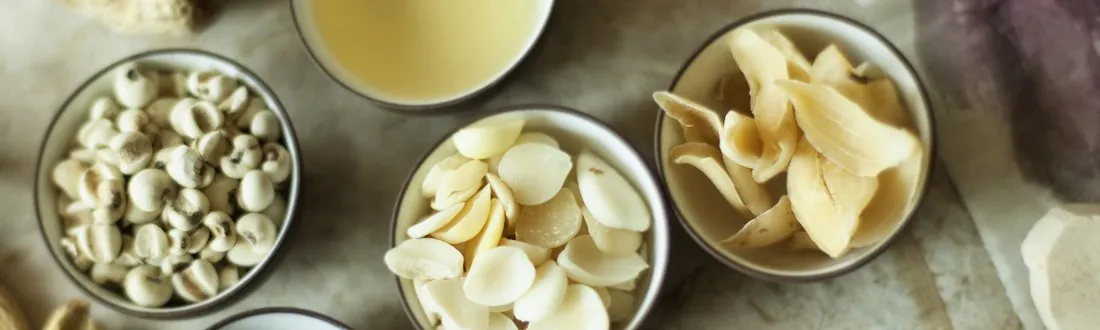
| Spleen-tonifying superfoods | Chinese yam (shan yao), lotus seeds (lian zi), jujube (red dates) |
| Damp-clearing seeds | Job’s tears (yi yi ren), adzuki beans, mung beans, barley |
| Beans and pulses | Yellow soya bean, chickpea, butter bean, lentil, black bean |
| Mushrooms | Shiitake, button, oyster, wood ear — gentle Spleen support |
| Cooked seasonal fruit | Cooked apple, baked pear, peach, apricot (modest amounts) |
| Warming spices | Fresh and dried ginger, cardamom, fennel, cumin, turmeric, bay leaf, white pepper |
| Lean meats in stew or soup form | Chicken, white fish, lean pork — long-cooked rather than grilled |
8. Foods to limit
- Dairy products — especially cheese, cream, ice cream, milky drinks. Very damp-forming.
- Refined sugar, sweets and pastries — weaken the Spleen and create damp.
- Cold, raw, iced food — chills the Spleen; reduce sharply from late summer onwards.
- Greasy, fried, takeaway food — damp-and-heat-producing.
- Alcohol in excess — particularly beer (very damp).
- Excess raw fruit and fruit juice — cooling and damp-forming.
- Bananas in excess — cooling and damp-forming.
- Late and large meals — the Spleen suffers most.
9. Cooking methods for late summer
- Slow-simmering / soup-making — the most Spleen-supportive method. Long-cooked rice congee, soups and stews.
- Steaming — preserves nutrients and is easy on digestion.
- Light stir-frying — with warming spices.
- Baking and roasting root vegetables — concentrates natural sweetness.
- Pressure cooking — modern adaptation of long-cooking; particularly good for beans and grains.
- Avoid: deep-frying, grilling, raw preparations, very cold foods.
10. Traditional late summer dishes
- Plain rice congee — the most Spleen-supportive dish in Chinese cookery. Eat for breakfast through late summer.
- Red bean and barley soup — the classical Chinese damp-clearing soup. Adzuki beans plus Job’s tears, simmered until tender.
- Chinese yam and lotus seed congee — deeply Spleen-tonifying; ideal for chronic fatigue or convalescence.
- Steamed sweet potato and pumpkin — simple, sweet, deeply grounding.
- Millet and squash porridge — alkaline, easily digestible.
- Chicken and Chinese yam soup — gentle qi-tonifying tonic.
- Adzuki bean and lotus seed dessert soup — sweetened only with rock sugar; clears damp.
11. Lifestyle in late summer
- Sleep: aim for 11pm bedtime. The Stomach and Spleen are most active 7–11am, so eating breakfast at 7–9am is particularly important.
- Movement: moderate daily exercise to disperse damp through sweat. Walking, swimming, yoga, qi gong all suit late summer. Avoid prolonged sitting (which traps damp in the lower body).
- Mind: the late-summer emotion is worry / over-thinking. Practise mental quieting — meditation, mindfulness, journalling. The Spleen suffers under chronic worry.
- Climate: avoid sitting on cold or damp surfaces; dry the body thoroughly after rain or swimming; keep the abdomen warm even in humid weather.
- Acupuncture: a session at the start of late summer (late July to early August) supports the Spleen and prevents the typical late-summer flares.
12. Frequently asked questions
I never feel late summer in the UK — we just have summer then autumn.
The UK’s mild damp August and the gradual transition into September is exactly the climatic feel of TCM late summer. Even if it feels like a continuation of summer rather than a separate season, the Spleen-supporting dietary shift is appropriate from late July onwards.
Why does my IBS always get worse in August?
August humidity worsens the Spleen damp pattern that underlies most IBS in TCM. The combination of high humidity and the cumulative effect of summer-long cold drinks and salads typically peaks in August. Switch to warm cooked food, congee for breakfast, reduce dairy and sugar, and improvement is usually rapid.
Can I still eat fruit in late summer?
Yes, but cooked is preferred over raw. Stewed apple, baked pear with cinnamon, gently poached peach are all suitable. Fresh fruit in moderation is fine if your Spleen is strong; reduce or eliminate if you have signs of damp (bloating, loose stools, brain fog).
What’s the difference between damp and damp-heat?
Damp is the underlying heaviness, sluggishness and accumulation. Damp-heat adds inflammation: redness, oily skin and acne, urinary or vaginal infections, foul-smelling discharge, dark concentrated urine. In late summer humidity, damp easily transforms into damp-heat. The dietary approach is similar (avoid damp-promoting foods) but with more cooling foods (mung bean, barley, dandelion) added for damp-heat.















