


Job's tears / Chinese pearl barley (yi yi ren)
By Dr (TCM) Attilio D’Alberto — registered Traditional Chinese Medicine practitioner (BAcC, RCHM) with over 25 years’ clinical experience.
On this page
- About Job's tears
- Origin and tradition
- TCM properties
- Modern nutritional profile
- Health benefits
- How to use
- Recipes and pairings
- When to use it
- Cautions and contraindications
- Frequently asked questions
- Related pages
1. About Job's tears
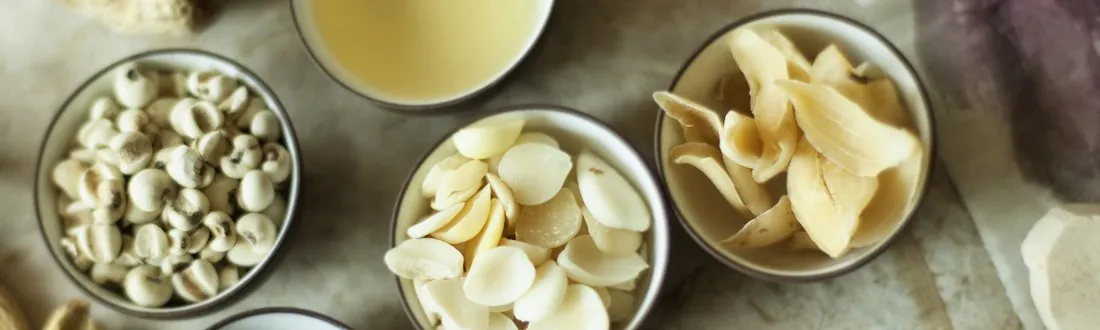
Job's tears — yi yi ren (袀艮仁) in Chinese, sometimes called Chinese pearl barley or coix — are the dried seeds of Coix lacryma-jobi var. ma-yuen, a tall grass cultivated across East and Southeast Asia. Despite the common English name "Chinese pearl barley," they are not actually barley but a related cereal in the grass family with a distinctive pearl-white, oval shape.
In TCM, Job's tears are one of the most important damp-resolving foods, useful for puffiness, oedema, sluggishness, oily skin, joint stiffness and weight retention. Modern research supports a range of effects including anti-inflammatory, anti-tumour and skin-clearing actions through the unique compound coixenolide. Job's tears are gentle enough for daily long-term use and are a staple of Chinese, Japanese and Korean cooking traditions.
2. Origin and tradition
Job's tears are native to Southeast Asia, with cultivation in China dating back at least 4,000 years. The seeds appear in the Shennong Bencao Jing (c. 200 BCE) and feature in many classical Chinese herbal formulas, particularly those for damp-bi (joint stiffness from damp accumulation) and damp-related skin conditions.
The name "Job's tears" comes from the tear-shaped form of the wild seeds, used as prayer beads in some traditions. The Chinese name yi yi ren contains the character ren (kernel/seed). In Korea and Japan, Job's tears are widely consumed as a rice substitute or porridge ingredient. Job's tears tea (yi mi cha) is a popular daily damp-clearing drink in Asia.
3. TCM properties
- Thermal nature: Cool
- Flavour: Sweet, slightly bland
- Channels entered: Spleen, Stomach, Lung
- Actions: Drain damp through urination; clear damp-heat; relieve joint stiffness; clear the skin; gently support the Spleen
The cool thermal nature distinguishes Job's tears from most damp-resolving herbs (which tend to be warming). This makes them particularly useful in damp-heat patterns — oily skin, urinary tract irritation, hot achy joints — where warming damp-resolving herbs would aggravate the heat.
4. Modern nutritional profile
Per 50 g (about 1/4 cup) of dried Job's tears:
- Calories: ~190 kcal
- Protein: 7 g (high for a grain)
- Carbohydrates: 35 g (mostly slow-release starch)
- Fibre: 1.5 g
- Iron: 0.7 mg
- Magnesium: 80 mg
- B vitamins: notable thiamin and niacin content
- Coixenolide: a unique fatty acid ester with documented anti-inflammatory, anti-tumour and skin-clearing effects in cell and animal studies
- Coixol: a related compound with mild muscle-relaxant and anti-inflammatory action
5. Health benefits
Damp accumulation, oedema and weight retention
Job's tears are the classical TCM food for damp accumulation in the body — puffiness, fluid retention, weight gain (particularly central), heaviness in the limbs and brain fog. Daily consumption (50 g cooked into porridge or soup) over 4–8 weeks gradually reduces damp accumulation. Particularly useful in PCOS with damp-phlegm pattern and metabolic syndrome.
Skin clearing — warts, acne, eczema
One of the most distinctive uses of Job's tears is their effect on certain skin conditions. The compound coixenolide has been shown in clinical studies to support clearance of common warts (verruca vulgaris) and certain types of acne, with the traditional Chinese remedy being daily Job's tears porridge for 6–12 weeks. Particularly useful in damp-heat skin conditions.
Joint stiffness and damp-bi
Job's tears address the TCM pattern of damp-bi — joint stiffness, fixed dull aches, swelling that worsens in humid weather. Combined with mulberry twig (sang zhi) or other anti-rheumatic herbs, daily Job's tears support gradual relief of chronic joint complaints.
Diabetes and metabolic support
The slow-release carbohydrate profile and unique active compounds make Job's tears modestly supportive of glycaemic control. Some clinical evidence in type 2 diabetes shows improvements in fasting glucose and HbA1c with daily Job's tears consumption. Useful as a rice substitute (cooked 1:2 with white rice) for those wishing to lower glycaemic load.
Lung-clearing in damp-related cough
Job's tears mildly clear damp from the Lungs — useful in productive cough with white phlegm, particularly in damp-prone people. Combined with almonds (xing ren) for traditional Lung-clearing soups.
Beauty and skin texture
Job's tears are widely associated in Asian cultures with clear, smooth skin. Daily Job's tears consumption is a long-standing component of Chinese, Japanese and Korean beauty traditions. The mechanism is the combination of damp-clearing action (reducing oily skin and acne) with the antioxidant content.
6. How to use
- Soak: Job's tears benefit from 2–4 hours of pre-soaking before cooking. Without soaking, expect 60–90 minutes of cooking; with soaking, 30–45 minutes.
- Mix with rice: cook 1 part Job's tears with 2 parts white or brown rice for a daily damp-clearing staple.
- Add to soups: 30–50 g per pot of vegetable, chicken or pork-rib soup.
- Make porridge: simmer 50 g with 500 ml water for an hour until soft and slightly creamy. Sweeten gently with rock sugar if desired.
- Job's tears tea (yi mi cha): roast Job's tears in a dry pan until lightly browned, then steep 1 tbsp in 250 ml hot water for 10 minutes. A classical damp-clearing daily tea.
- Powder: grind cooked and dried Job's tears into a fine powder; stir 1 tablespoon into hot water as a quick daily preparation.
- In Chinese herbal formulas: classical use is 9–30 g per dose.
Daily dose: 30–60 g of dried Job's tears (after soaking and cooking).
7. Recipes and pairings
- Red bean and barley soup (chi xiao dou yi mi tang): the classical damp-clearing dessert soup, perfect for puffiness, weight gain and PCOS.
- Job's tears and white fungus dessert: a beauty-supportive light sweet soup.
- Chicken and Job's tears soup: general damp-clearing daily soup.
- Roasted Job's tears tea: caffeine-free everyday damp-clearing drink.
- Job's tears congee: 50 g Job's tears + 100 g rice + ginger for damp-cold patterns.
- Pairings: Job's tears + adzuki bean (classic damp-resolving pair); + lotus seed (Spleen support); + Chinese yam (gentler digestive support); + mung bean (cooling for damp-heat); + astragalus (immune support with damp).
8. When to use it
- Oedema, puffiness and water retention
- PCOS, metabolic syndrome and damp-phlegm constitution
- Oily skin, acne, eczema (damp-heat skin patterns)
- Common warts (verruca vulgaris)
- Joint stiffness in humid weather (damp-bi)
- Diabetes and pre-diabetes (as part of overall diet)
- Damp-related productive cough
- Daily Asian beauty / skin-clearing tradition
- Late summer humidity (the natural seasonal damp peak)
- Vaginal discharge in damp patterns
9. Cautions and contraindications
- Pregnancy: avoid Job's tears in pregnancy. The traditional teaching is that they are mildly purgative and may stimulate uterine contractions. While the modern evidence is limited, the traditional caution should be respected.
- Cold-deficient digestion: the cool nature can be too draining for cold-pattern weak digestion. Balance with ginger or use less.
- Dry constitutions: the damp-draining action can worsen dryness. Reduce or pair with moistening foods (lily bulb, white fungus) if dry-skinned or constipated.
- Severe weight loss or convalescence: the cool, draining nature is not suitable when the body needs deep building. Switch to warmer tonics (Chinese yam, red dates).
- Quality and identity: "Chinese pearl barley" sometimes refers to actual pearled barley, not Job's tears. Look for the round-pearl shape and "yi yi ren" in the name.
10. Frequently asked questions
Are Job's tears the same as pearl barley?
No. Pearl barley is the polished grain of Hordeum vulgare; Job's tears are the seed of Coix lacryma-jobi. They look similar (round, white, slightly slippery) but are different species with different TCM actions. Look for "Job's tears," "yi yi ren" or "coix" specifically.
Why should they be avoided in pregnancy?
The traditional Chinese teaching is that Job's tears are mildly purgative and may stimulate the uterus. Modern evidence is limited but the historical caution is consistent enough across the literature that practitioners universally advise avoidance during pregnancy.
How long does it take to see skin-clearing effects?
For acne and oily skin: 4–8 weeks of daily consumption. For warts: 6–12 weeks of daily porridge. The effect is gradual and depends on consistent daily intake.
Can I eat Job's tears every day?
Yes — daily long-term use is the classical pattern outside of pregnancy. The "superior" category in the Shennong Bencao Jing means safe for daily indefinite use.
Where can I buy Job's tears?
Chinese, Korean and Japanese supermarkets; some health-food shops; online specialist retailers. Look for clean, uniform white-pearl seeds without dust or insect damage. Roasted Job's tears (for tea) are also widely available pre-packaged.















