


Hawthorn tea
By Dr (TCM) Attilio D’Alberto — registered Traditional Chinese Medicine practitioner (BAcC, RCHM) with over 25 years’ clinical experience.
On this page
- About this tea
- Origin and tradition
- TCM properties
- Traditional uses
- Ingredients
- Method
- Variations and pairings
- When to drink it
- Cautions and contraindications
- Frequently asked questions
- Related pages
1. About this tea
Hawthorn tea — shan zha cha (山楚茶) — is made from the dried sliced fruit of Chinese hawthorn, Crataegus pinnatifida. The slices are rust-red and leathery, and they give a tea that is properly sour: bright, fruity and astringent, closer to a rosehip or sour cherry infusion than to anything you would call tea. It is caffeine-free.
Its role in Chinese kitchens is specific and unglamorous — it is what you drink after eating too much. Where pu-erh is the after-dinner tea for greasiness in general, hawthorn is aimed squarely at heavy, meaty, fatty meals sitting undigested. Chinese children are given hawthorn in sweets and fruit rolls for the same reason, and the candied hawthorn skewer (tanghulu) sold on winter streets is the same fruit.
2. Origin and tradition
Hawthorn was in use as a food long before it was formalised as a medicine, and it enters the materia medica properly in the Tang dynasty, with its digestive role fully described by the Ming dynasty Bencao Gangmu. It is the principal herb of Bao He Wan ("Preserve Harmony Pill"), the classical formula for food stagnation, which remains one of the most commonly used Chinese patent remedies for overeating.
Chinese and European traditions arrived at hawthorn from different directions and reached overlapping conclusions. European herbal medicine has long used hawthorn leaf and flower for the heart, while Chinese medicine used the fruit for digestion and blood stasis — and modern cardiovascular research on the genus has since given both traditions something to point at.
3. TCM properties
This page covers hawthorn as a home-brewed tea. Hawthorn fruit is also a prescribed herb in Chinese herbal medicine, where it is combined with other herbs and dosed to a diagnosed pattern — a different thing from a kitchen infusion. For the clinical profile, actions in formula and drug interactions, see the shan zha herb page.
Hawthorn fruit (shan zha)
- Thermal nature: Slightly warm
- Flavour: Sour, sweet
- Channels entered: Spleen, Stomach, Liver
- Actions: Reduces food stagnation, particularly from meat and fatty food; invigorates blood and disperses stasis
Hawthorn is unusual among digestive herbs in being specific about what it digests. Classical sources are explicit that it targets meat and fat rather than starch — germinated barley and radish seed were used for grain and starch stagnation instead. That specificity holds up well in practice: hawthorn is the tea for after a roast, a barbecue or a rich restaurant meal, and less useful after a large bowl of rice.
4. Traditional uses
Heaviness after a rich or meaty meal
The core traditional use. A full, distended, uncomfortable feeling in the upper abdomen after a heavy meal, with belching, reflux or a sense that the food is simply sitting there, is food stagnation in TCM. Hawthorn tea drunk after the meal is the standard kitchen response, and it is one of the more immediately noticeable food-therapy measures.
Sluggish appetite in children
Chinese paediatrics uses hawthorn widely for children who eat poorly, have a distended tummy and sour breath after meals. Hawthorn sweets and fruit rolls exist for exactly this reason. Weak diluted tea is the domestic version, though persistent poor appetite or weight loss in a child needs medical assessment.
Blood stasis patterns
Beyond digestion, hawthorn invigorates blood and disperses stasis in TCM — the pattern behind fixed, stabbing pain, dark clotted menstrual blood and a purplish tongue. It appears in traditional approaches to period pain of this type and to postpartum abdominal pain.
Cardiovascular support in TCM terms
Hawthorn is among the better-researched plants in both Chinese and Western herbal traditions, with work focusing on lipids and cardiac function. In TCM terms it is used where phlegm and blood stasis obstruct the vessels. It is a complementary therapy alongside conventional care, never a substitute for prescribed cardiac or lipid-lowering treatment — and see the cautions below, as the interactions here are real.
5. Ingredients
- 5–8 dried hawthorn slices, about 10g
- 400ml water
- Optional: 1 tsp rock sugar or honey — the tea is genuinely sour without it
- Optional: a few red dates to soften the sourness and support the Spleen
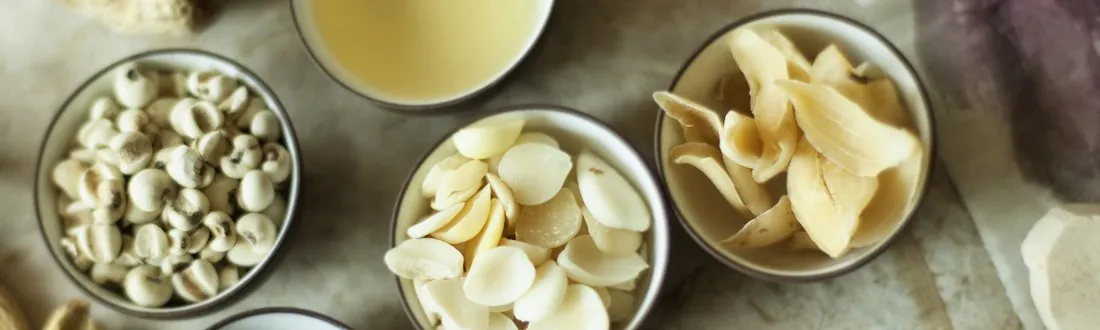
Dried hawthorn slices are sold in every Chinese supermarket, usually labelled shan zha or "hawthorn slices". Choose slices that are deep rust-red and still slightly pliable rather than grey, dusty or crumbling. Avoid the sugared and candied versions for tea — they are a confection and mostly sugar. Chinese hawthorn fruit is a larger, sourer fruit than the European hedgerow hawthorn, and it is what these preparations use.
6. Method
- Rinse the slices briefly.
- Simmer in 400ml water for 15–20 minutes — hawthorn is a dense dried fruit and needs simmering, not steeping.
- Add red dates, if using, for the last 10 minutes.
- Sweeten to taste while still hot if using rock sugar.
- Strain and drink warm, after eating rather than before.
A quicker daily version is to pour boiling water over 4–5 slices in a flask and leave 20 minutes, which gives a lighter but perfectly usable cup. The simmered version is stronger and better after a genuinely heavy meal.
7. Variations and pairings
- With red dates: softens the sourness and offsets hawthorn's tendency to irritate an empty or acidic stomach.
- With chrysanthemum: a common pairing where there is both rich food and heat — after a heavy meal with alcohol.
- With dried tangerine peel (chen pi): the classical digestive pairing, adding a qi-moving, aromatic dimension for bloating.
- With pu-erh: combine with a strong pu-erh after a very rich meal — the two work on greasiness from different angles.
- Chilled as a summer drink: brewed strong, sweetened and chilled, this is a popular Chinese soft drink in its own right.
8. When to drink it
- After a heavy, meaty or fatty meal
- Bloating, belching and upper abdominal fullness from overeating
- Over festive periods and holidays
- Sluggish appetite with a distended abdomen
- Period pain of a fixed, stabbing, clotted character
Drink it after meals, not before — and not on an empty stomach, where its sourness can cause discomfort. One to two cups a day around heavy eating is plenty. It is not a tea to sip continuously all day.
9. Cautions and contraindications
- Acid reflux, heartburn and ulcers: hawthorn is sour and can clearly aggravate gastric hyperacidity, reflux and peptic ulcers. Avoid if you have any of these.
- Empty stomach: do not drink it before eating; the sourness is uncomfortable and can provoke reflux.
- Heart and blood pressure medication: hawthorn has documented cardiovascular activity and may add to the effect of antihypertensives, digoxin and related drugs. Speak to your doctor before drinking it regularly if you take any cardiac medication.
- Statins and lipid-lowering drugs: potentially additive effects — tell your prescriber.
- Pregnancy: avoid. Hawthorn invigorates blood and has a traditional caution in pregnancy; it has also been used traditionally to promote uterine contraction.
- Heavy menstrual bleeding: avoid during heavy flow, as the blood-invigorating action may increase bleeding.
- Weak digestion without food stagnation: prolonged use where there is no stagnation is said to injure Spleen qi. Use it for the situation, not as a permanent habit.
- Tooth enamel: it is acidic; rinse with water afterwards if you drink it often.
10. Frequently asked questions
Is Chinese hawthorn the same as the hedgerow hawthorn in Britain?
They are related but not identical. Chinese hawthorn (Crataegus pinnatifida) has a much larger, sourer fruit, and it is that fruit which is dried and sold for tea. European herbal tradition has tended to use the leaf and flower of native species rather than the fruit.
Will hawthorn tea help me lose weight?
Not directly, and it should not be sold to you that way. It helps with the discomfort of a heavy meal and has some research interest around blood lipids, but it does not cause fat loss. See the wider TCM approach on the Chinese medicine for weight loss page linked below.
Can I drink it every day?
Occasional daily use around a period of rich eating is fine. Long-term daily use is not traditional — hawthorn is a corrective for a specific situation, and classical sources warn that prolonged use without food stagnation weakens the digestion.
Why does it taste so sour?
Because it genuinely is. Chinese hawthorn is one of the sourest fruits used in the kitchen, and the sour flavour is considered part of its action. Rock sugar or a couple of red dates make it much more drinkable without changing what it does.
Can children drink it?
Weak, well-diluted hawthorn is widely given to children in China for poor appetite and bloating, and hawthorn sweets are a childhood staple there. Keep it weak and occasional, and see a doctor for persistent appetite or weight problems.















