



Bai He Gu Jin Tang (百合固金汤) — Lily Bulb Decoction to Strengthen Metal
Bai He Gu Jin Tang is a classical Chinese herbal formula used primarily for chronic dry cough[10] — particularly post-viral, post-covid, or in the elderly. It is prescribed for Lung and Kidney Yin deficiency with Heat from deficiency, characterised by: chronic dry cough, scanty sticky phlegm sometimes streaked with blood, hoarse voice, sore dry throat, low-grade afternoon fever, night sweats, hot palms and soles, malar flush, a red dry tongue with little coat, and a thin rapid pulse.
On this page
- Overview
- TCM pattern
- Key herbs
- Formula actions
- Conditions treated
- Cautions
- Frequently asked questions
What is Bai He Gu Jin Tang?
Bai He Gu Jin Tang (“Lily Bulb Decoction to Strengthen Metal”) is the classical Chinese formula for chronic dry cough from Lung and Kidney Yin deficiency. The name refers to the strengthening of the “Metal” phase (Lung) by the chief herb Bai He (Lily bulb). The formula nourishes Yin, moistens the Lung, clears Heat and stops cough — addressing the deep depletion pattern often seen in long-standing or post-viral chronic cough, tuberculosis (historically) and bronchiectasis.
Bai He Gu Jin Tang TCM pattern
Prescribed for Lung and Kidney Yin deficiency with Heat from deficiency, characterised by: chronic dry cough, scanty sticky phlegm sometimes streaked with blood, hoarse voice, sore dry throat, low-grade afternoon fever, night sweats, hot palms and soles, malar flush, a red dry tongue with little coat, and a thin rapid pulse.
Key herbs
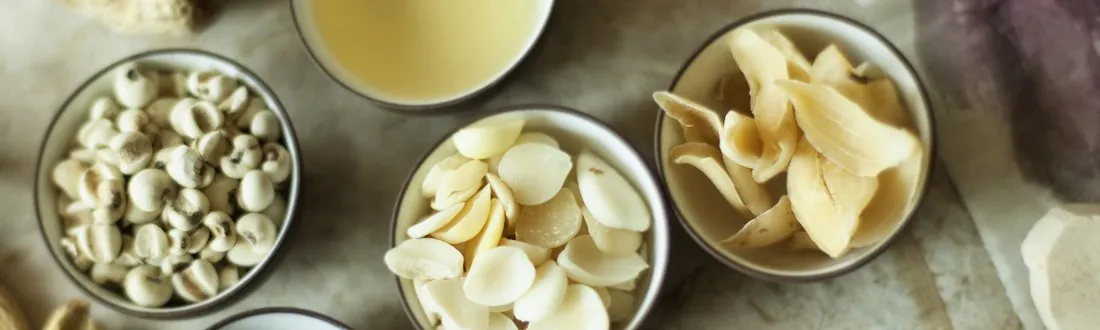
- Bai He (lily bulb, 3-30g) — the chief herb; nourishes Lung Yin, clears Lung Heat, stops cough
- Sheng Di Huang (raw rehmannia, 4-15g) — nourishes Yin, clears Heat, cools Blood
- Shu Di Huang (prepared rehmannia, 5-18g) — nourishes Kidney Yin and essence
- Mai Men Dong (Ophiopogon root, 3-15g) — nourishes Lung and Stomach Yin
- Xuan Shen (scrophularia, 2.4-15g) — clears deficiency Heat, nourishes Yin
- Dang Gui (Rx. Angelicae Sinensis, 3-12g) — nourishes Blood (paired with Yin tonics to support the Blood-Yin axis)
- Bai Shao (Rx. Paeoniae Alba, 3-12g) — nourishes Yin and Blood
- Jie Geng (Platycodon root, 2-10g) — opens the Lung and directs herbs upward
- Chuan Bei Mu (Fritillaria bulb, 3-10g) — clears Lung Heat, transforms Phlegm, stops cough
- Gan Cao (Rx. Glycyrrhizae, 1-6g) — harmonises and supplements Qi
Formula actions
- Nourishes Yin (Lung and Kidney) and moistens the Lung
- Clears deficiency Heat
- Transforms Phlegm and stops cough
- Cools Blood and stops bleeding (haemoptysis)
Conditions treated
- Chronic dry cough — particularly post-viral, post-COVID, or in the elderly
- Bronchiectasis with blood-tinged sputum
- Chronic obstructive pulmonary disease (COPD) with Yin deficiency
- Chronic laryngitis with hoarseness
- Pulmonary tuberculosis (adjunctive in historical use)
- Recurrent chest infections in Yin-deficient patients
- Smoker’s cough with dryness and irritation
Cautions
Contraindicated in cough from Wind-Cold or Phlegm-Damp patterns. Use cautiously in patients with diarrhoea or Spleen Qi deficiency (the formula is rich and cooling). Always consult a qualified Chinese herbalist registered with the RCHM. Online herbal consultations are available.
Prefer to be treated from home? Chinese herbal medicine online consultations are available throughout the UK and worldwide. After a full video consultation, Dr (TCM) Attilio D'Alberto formulates a bespoke herbal prescription and posts your Chinese herbs directly to your door.
Frequently asked questions about Bai He Gu Jin Tang
What is Bai He Gu Jin Tang used for?
Bai He Gu Jin Tang is used for chronic dry cough — particularly post-viral, post-covid, or in the elderly, bronchiectasis with blood-tinged sputum, chronic obstructive pulmonary disease (copd) with yin deficiency, chronic laryngitis with hoarseness, pulmonary tuberculosis (adjunctive in historical use). The formula targets the underlying TCM pattern producing these symptoms rather than the symptom in isolation, which is why pattern diagnosis by a qualified herbalist is essential.
How does Bai He Gu Jin Tang work?
The herbs in Bai He Gu Jin Tang work together: Bai He (lily bulb, 3 30g) — the chief herb; nourishes lung yin, clears lung heat, stops cough; Sheng Di Huang (raw rehmannia, 4 15g) — nourishes yin, clears heat, cools blood; Shu Di Huang (prepared rehmannia, 5 18g) — nourishes kidney yin and essence; Mai Men Dong (Ophiopogon root, 3 15g) — nourishes lung and stomach yin. The synergy of these actions addresses the underlying TCM pattern.
How long does Bai He Gu Jin Tang take to work?
For most patients, an improvement is typically noticed within 2–4 weeks of daily granule treatment. Full benefit usually requires 6–12 weeks, depending on how long-standing the underlying pattern is. Bai He Gu Jin Tang is typically prescribed as part of an individualised treatment plan that may include other herbs or adjustments over time.
Is Bai He Gu Jin Tang safe in pregnancy?
Use of Bai He Gu Jin Tang in pregnancy should only be considered under the supervision of a qualified RCHM herbalist with pregnancy training, and only when the TCM pattern specifically calls for it.
Who should not take Bai He Gu Jin Tang?
Contraindicated in cough from Wind-Cold or Phlegm-Damp patterns. Use cautiously in patients with diarrhoea or Spleen Qi deficiency (the formula is rich and cooling). Always consult a qualified Chinese herbalist registered with the RCHM. Online herbal consultations are available. Prefer to be treated from home? Chinese herbal medicine online consultations are available throughout the UK and worldwide. After a full video consultation, Dr (TCM) Attilio D'Alberto formulates a bespoke herbal prescription and posts your Chinese herbs directly to your door. Bai He Gu Jin Tang must be prescribed only after full pattern diagnosis by a qualified RCHM herbalist; self-prescription is not appropriate.
References
[10] Lee B, Kwon CY, Suh HW, Kim YJ, Kim KI, Lee BJ, Lee JH. Herbal medicine for the treatment of chronic cough: a systematic review and meta-analysis. Front Pharmacol. 2023 Oct 17;14:1230604. https://doi.org/10.3389/fphar.2023.1230604. PMID: 37920213.















