



Bai He Zhi Mu Tang (百合知母汤) — Lily Bulb & Anemarrhena Decoction
On this page
Overview
Bai He Zhi Mu Tang — the “Lily Bulb and Anemarrhena Decoction” — is also from Zhang Zhongjing’s Jin Gui Yao Lue and is the variant of Lily Bulb Disease (Bai He Bing) where residual Heat is more prominent. Where Bai He Di Huang Tang nourishes Yin and gently clears, Bai He Zhi Mu Tang adds Zhi Mu to clear Heat more actively. Used for patients whose post-illness convalescence has marked thirst, irritability, low-grade fever and prominent restlessness.
I prescribe Bai He Zhi Mu Tang as part of bespoke herbal formulas from pharmaceutical-grade granules sourced from Sun Ten in Taiwan.
TCM pattern
Bai He Zhi Mu Tang is prescribed for Lily Bulb Disease with prominent residual Heat:
- Restlessness, irritability
- Low-grade afternoon fever
- Marked thirst, dry mouth
- Insomnia[8] with vivid dreams
- Vague malaise after febrile illness
- Tongue — red, scant or peeled coat
- Pulse — rapid, slightly forceful
Key herbs
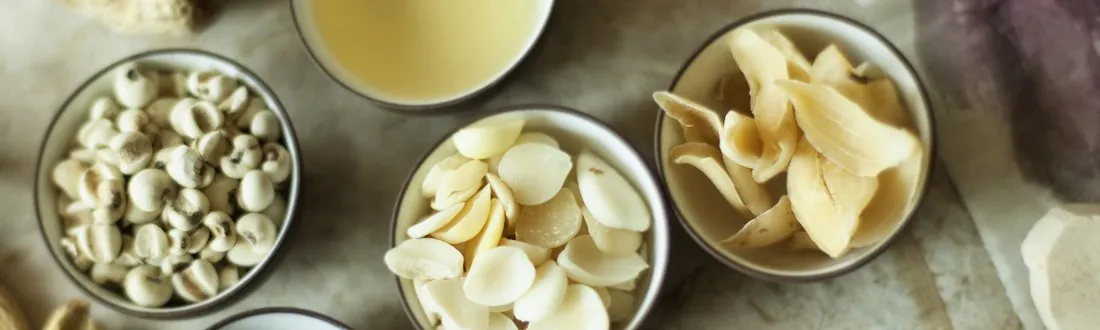
- Bai He (Bb. Lilii, 30–60g) — chief; nourishes Lung and Heart Yin; calms Shen
- Zhi Mu (Rx. Anemarrhenae, 6–15g) — clears Heat and nourishes Yin; specifically addresses lingering Heat
Formula actions
- Nourishes Lung and Heart Yin
- Clears residual Heat more actively
- Calms restlessness and irritability
Conditions treated
- Post-viral fatigue[9] with marked restlessness and low-grade fever
- Long COVID with persistent low-grade fever and restlessness
- Post-influenza convalescence with thirst and irritability
- Tuberculosis convalescence with low afternoon fever (alongside conventional care)
- Menopausal hot flushes[3] with mild Heat pattern
Cautions
Not appropriate for cold-deficient or severe Heat patterns.
Persistent low-grade fever needs medical investigation to exclude infection, TB, autoimmune or malignancy.
Always consult a qualified Chinese herbalist registered with the RCHM.
Prefer to be treated from home? Chinese herbal medicine online consultations are available throughout the UK and worldwide.
References
[3] Li M, Hung A, Lenon GB, Yang AWH. Chinese herbal formulae for the treatment of menopausal hot flushes: A systematic review and meta-analysis. PLoS One. 2019 Sep 19;14(9):e0222383. https://doi.org/10.1371/journal.pone.0222383. PMID: 31536531.
[8] Hu J, Teng J, Wang W, Yang N, Tian H, Zhang W, Peng X, Zhang J. Clinical efficacy and safety of traditional Chinese medicine Xiao Yao San in insomnia combined with anxiety. Medicine (Baltimore). 2021 Oct 29;100(43):e27608. https://doi.org/10.1097/MD.0000000000027608. PMID: 34713840.
[9] Wang YY, Li XX, Liu JP, Luo H, Ma LX, Alraek T. Traditional Chinese medicine for chronic fatigue syndrome: a systematic review of randomized clinical trials. Complement Ther Med. 2014 Aug;22(4):826-33. https://doi.org/10.1016/j.ctim.2014.06.004. PMID: 25146086.















