



Chinese yam (Huai Shan) chicken soup
By Dr (TCM) Attilio D’Alberto — registered Traditional Chinese Medicine practitioner (BAcC, RCHM) with over 25 years’ clinical experience.
On this page
1. About this recipe
Chinese yam — huai shan or shan yao, botanically Dioscorea opposita — is one of the most quietly useful ingredients in the Chinese kitchen. Sweet, neutral, and acting on the Spleen, Lung and Kidney channels, it builds qi without being heavy, supports digestion without being warming, and is unusually well-tolerated by patients who otherwise struggle with stronger tonics like ren shen (ginseng) or rich blood-builders like dang gui.
Cooked into a clear chicken broth with a small handful of supporting ingredients, this soup is the standard Chinese daily-cooking dish for low-grade chronic fatigue, loose stools, weak appetite, post-illness recovery and the kind of "just not quite right" that doesn't tip into any specific complaint. It is not a glamorous soup. It is a useful one.
2. Ingredients
Serves 4–6.
- 1 small chicken or 6–8 skin-on bone-in chicken thighs (about 1 kg total), preferably free-range
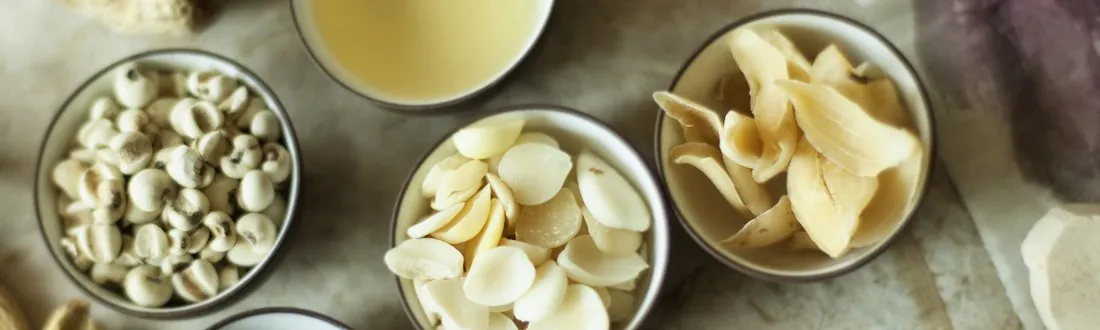
- 1/2 cup dried Chinese yam slices (huai shan), or one medium fresh Chinese yam, peeled and cubed
- 6–8 jujube (Chinese red dates), pitted and torn in half
- 1 tablespoon goji berries
- 2–3 slices fresh ginger
- 1 spring onion, white part only, lightly bruised
- 8 cups cold water
- Salt to taste, added at the end
- Optional: 1/4 cup dried lotus seeds, soaked
3. Method
- Rinse the chicken under cold water. Place in a heavy-based pot with 8 cups of cold water; do not add anything else yet.
- Bring slowly to the boil. As the chicken comes to temperature, a grey-pink foam will rise to the surface — skim this off carefully with a slotted spoon over the first 10 minutes. This keeps the broth clear.
- Reduce to a low simmer. Add the dried Chinese yam, red dates, ginger and spring onion (and soaked lotus seeds, if using). Cover and simmer gently for 1.5–2 hours.
- In the last 10 minutes, add the goji berries.
- Remove the ginger and spring onion. Salt to taste — the soup wants only a light hand of salt; it is the gentle natural sweetness of the dates and yam that does the work.
- Serve hot, broth and chicken together, in deep bowls.
4. Variations
- Vegetarian version — replace the chicken with a base of dried shiitake, kombu and fresh tofu; add an extra tablespoon of huang qi (astragalus) slices at the start for qi-tonification. Cook 1 hour instead of 2.
- With huang qi (astragalus) — add 4–5 dried astragalus slices at the start; deepens the qi-tonifying action, useful for chronic immune weakness and recurrent colds.
- Postpartum version — add 1 tablespoon dang gui and double the red dates; the soup shifts from Spleen-qi support to Spleen-and-blood support, appropriate in the first 6–8 weeks after childbirth.
- Convalescence congee — add 1/2 cup rice at the start and 2 extra cups of water; cook 2 hours; the soup becomes a richly nourishing chicken congee, the standard dish for recovery from illness or surgery.
- With fresh Chinese yam — if you can find fresh Chinese yam (long pale-skinned root, available at larger Asian supermarkets), use it instead of the dried slices. Peel, cube, add for the last 30 minutes. The texture is softer and silkier than the dried form.
5. When to eat it
The classical indications are Spleen qi deficiency: chronic low-grade fatigue, loose or unformed stools, weak appetite, soft pulse, pale tongue with a thin coating. I recommend this soup most often to patients recovering from a long illness, in the early weeks of fertility treatment, after surgery, in the run-up to and recovery from childbirth, and as a daily-cooking dish through the cooler months for anyone whose digestion runs cold and slow.
A bowl, two to three times a week, is the standard course. There is no upper limit — this is a soup designed to be eaten over months, not as a course of treatment, and patients often keep it in regular rotation indefinitely.
6. Cautions
This is one of the most broadly safe soups in the Chinese tradition. Patients with a strongly Heat-pattern presentation (red face, dry yellow tongue coating, hot flushes, marked irritability) may find it slightly warming; if so, halve the ginger and omit the dates. In acute infection with fever, hold off until the fever has resolved — tonifying soups feed both you and the pathogen in the early days. Pregnant women can eat this soup throughout, omitting any astragalus or dang gui additions unless specifically prescribed.















