


Autumn eating — Lung season
By Dr (TCM) Attilio D’Alberto — registered Traditional Chinese Medicine practitioner (BAcC, RCHM) with over 25 years’ clinical experience.
On this page
- When autumn begins and ends
- Overview
- Climate energy: dryness
- Five-element correspondences
- Common autumn patterns
- Dietary principles
- Foods to favour
- Foods to limit
- Cooking methods for autumn
- Traditional autumn dishes
- Lifestyle in autumn
- Frequently asked questions
- Related pages
1. When autumn begins and ends
Autumn runs from Li Qiu (Beginning of Autumn) to Li Dong (Beginning of Winter) — approximately 7 August to 6 November in the Western calendar.
| Solar term | Meaning | Approximate dates |
|---|---|---|
| Li Qiu (立秋) | Beginning of Autumn | ~7–22 August |
| Chu Shu (处暑) | End of Heat | ~23 August–6 September |
| Bai Lu (白露) | White Dew | ~7–22 September |
| Qiu Fen (秋分) | Autumn Equinox | ~23 September–7 October |
| Han Lu (寒露) | Cold Dew | ~8–22 October |
| Shuang Jiang (霜降) | Frost Descends | ~23 October–6 November |
Note that calendar autumn (from Li Qiu, ~7 August) overlaps with what most practitioners treat as late summer until about Bai Lu (White Dew, ~7 September). True autumn dryness sets in from mid-September onwards in the UK climate.
2. Overview
Autumn is the season of contraction, descent and gathering inward. In the five elements, autumn corresponds to the metal element, the Lung and Large Intestine, the white colour and the pungent flavour. Yang qi is now descending and the body is preparing for winter; the cooling air pulls moisture from the air, the soil and the body itself. Dryness is the dominant climate energy.
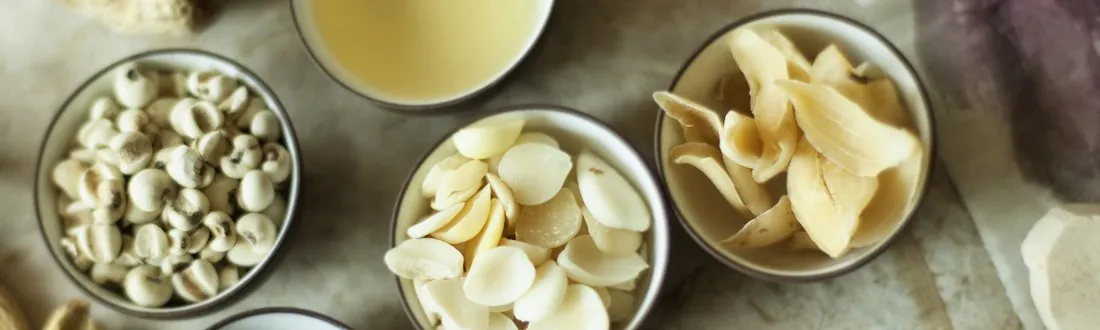
The dietary task of autumn is to moisten the Lungs and protect them from dryness. White, juicy, demulcent foods — pear, white fungus, lily bulb, lotus root, almond, walnut, pork — nourish Lung yin. A small amount of pungent flavour supports the Lung’s dispersing function but should be modest in dry autumn weather.
3. Climate energy: dryness
Autumn’s pathogenic factor is dryness (zao). Dryness in TCM consumes body fluids, particularly Lung yin. Symptoms of autumn dryness include dry cough (often unproductive or with very small amounts of sticky phlegm), dry skin and lips, dry hair, dry eyes, dry nasal passages, hoarseness, constipation with hard dry stools, and a tendency to nosebleeds and skin cracking.
Practical implications: drink plenty of fluids (warm water, herbal teas, broths), eat moistening foods, use a humidifier in heated rooms, protect the throat and nose, and reduce strongly drying foods (chilli, mustard, very hot spices, alcohol).
4. Five-element correspondences
- Element: Metal
- Yin organ: Lung
- Yang organ: Large Intestine
- Tissue: Skin and body hair
- Sense organ: Nose
- Colour: White
- Flavour: Pungent (acrid)
- Emotion: Grief and sadness (in excess); courage and acceptance (in balance)
- Climate energy: Dryness
- Direction: West
- Time of day: 3–7am (Lung at 3–5, Large Intestine at 5–7)
5. Common autumn patterns
- Lung yin deficiency: dry hacking cough (often worse at night), dry mouth and throat, dry skin, hoarseness, hot palms and soles in the late afternoon.
- Wind-cold or wind-heat colds: autumn is the second peak season for upper respiratory infections (winter being the first).
- Skin dryness, eczema flares: the skin (governed by the Lung) reacts to autumn dryness with itching, cracking, eczema worsening.
- Constipation with dry, pellet-like stools: Large Intestine dryness is the autumn presentation.
- Asthma flares: autumn is a peak season for asthma; dryness combined with the rapid temperature changes triggers attacks.
- Low mood, grief, melancholy: autumn’s emotion. SAD often begins in late autumn.
- Sluggish bowel and Large Intestine dryness: the Lung-Large Intestine pair is most challenged in autumn.
6. Dietary principles
- Moisten the Lungs with white, juicy, demulcent foods. White is the colour of metal element and the Lung.
- Reduce drying spices — chilli, mustard, dried ginger, curry powder. Use only modest amounts.
- Slow down food preparation. Soups, stews and slow-cooked dishes return; raw salad reduces.
- Slightly pungent flavour (small amounts) to support Lung dispersing — spring onion, ginger, garlic, white pepper.
- Begin to incorporate warmer, more nourishing foods as autumn deepens; the body needs to start building reserves for winter.
- Stay well hydrated with warm fluids: warm water, herbal teas, broths.
- Reduce alcohol and caffeine — both are drying.
7. Foods to favour
| Group | Examples |
|---|---|
| Moistening fruits | Pear (cooked or fresh), apple, grape, persimmon, fig, mulberry — pear is the autumn classic |
| White fungus and lily bulb | White fungus (yin er, silver tree fungus), lily bulb (bai he), lotus root, lotus seed |
| Lung-supporting nuts and seeds | Almonds (sweet, not bitter), walnuts, pine nuts, peanuts, sesame seeds |
| White vegetables | White cabbage, cauliflower, white radish (mooli), turnip, parsnip, daikon |
| Tofu and soya foods | Tofu, soya milk, fresh edamame |
| Yin-nourishing meats | Pork, duck, white fish |
| Sweet and moistening | Honey (small amounts), maltose (mai ya tang), rock sugar, sesame oil, congee |
| Mild pungent for Lung dispersing | Spring onion, leek, fresh ginger, garlic, white pepper, mustard greens, fresh chilli (modest) |
| Whole grains | Rice, oats, barley, millet |
8. Foods to limit
- Drying spices in excess — dried chilli, mustard powder, curry powder, hot horseradish, large quantities of dried ginger.
- Alcohol in excess — particularly spirits; very drying.
- Fried, charred and excessively roasted food — create internal dryness and heat.
- Cold and raw food — the Stomach now needs warmth; salads should be reduced and cooked.
- Excess caffeine — coffee in particular is drying.
- Smoking — particularly damaging in autumn (Lung season).
9. Cooking methods for autumn
- Slow-simmering and soup-making — the dominant autumn method. Long-cooked stews, broths and soups.
- Steaming — particularly for fish and white vegetables.
- Stewing — for fruits (stewed pear with rock sugar; stewed apple) and root vegetables.
- Slow roasting — for root vegetables and meats.
- Pressure cooking — for grains and beans.
- Reduce: grilling, BBQ, deep-frying, raw preparation.
10. Traditional autumn dishes
- Pear and rock sugar soup (xue li tang) — the classical autumn kitchen remedy. Pear simmered with rock sugar, optional white fungus and lily bulb. Moistens the Lungs, eases dry cough.
- White fungus dessert soup — soaked white fungus with red dates, lotus seed, rock sugar; deeply yin-nourishing.
- Lily bulb and lotus seed congee — gently calming and Lung-moistening.
- Almond and walnut paste — classic autumn breakfast; ground sweet almonds and walnuts, hot water, rock sugar.
- Pork and white radish soup — pork (yin-nourishing meat) with white radish; clears Lung phlegm and moistens.
- Steamed pear with honey — simple kitchen remedy for dry cough.
- Walnut and red date congee — warm, nourishing, suitable for late autumn into early winter.
11. Lifestyle in autumn
- Sleep: earlier than summer — aim for 10:30–11pm. The body wants more rest as the days shorten.
- Movement: reduce intensity from summer levels. Walking, qi gong, yoga, swimming. Avoid heavy sweating exercise that depletes Lung yin.
- Emotion: the autumn emotion is grief. This is the natural season for letting go — of relationships that no longer fit, of unfinished projects, of accumulated clutter. Embrace the season’s descending quality rather than fighting it.
- Skin: moisturise. Dry autumn air pulls moisture from the skin; a richer cream, sesame oil, or coconut oil applied after bathing protects.
- Lungs: autumn is the season for breathing exercises — qi gong, deep breathing, pranayama. Take walks in fresh air. Avoid smoke.
- Acupuncture: a session at the start of autumn (early September) supports Lung yin and prevents the typical autumn flares.
12. Frequently asked questions
Why am I getting recurrent dry coughs every autumn?
Recurrent dry autumn cough is the textbook presentation of Lung yin deficiency in TCM. Lifestyle factors that deplete Lung yin (smoking, dry indoor heating, prolonged speaking, dehydration, late nights) accumulate through summer and present in autumn. Daily pear and rock sugar soup, white fungus desserts, plenty of warm fluids, indoor humidifier, reduced caffeine and alcohol all help. Persistent or severe coughs need medical assessment.
Why does my eczema always flare in autumn?
The skin is governed by the Lung in TCM and reflects Lung-yin deficiency externally. Autumn dryness pulls moisture from skin already vulnerable. Internal moistening (white fungus, lily bulb, pear), external moisturising, reduced cleansing with hot water, and acupuncture/herbal medicine all help. Stress and grief (the autumn emotion) often worsen the flare.
Should I keep eating salads in early autumn?
Reduce gradually rather than stopping abruptly. From mid-September onwards, shift to lightly cooked vegetables (steamed, stir-fried, briefly blanched). By Cold Dew (~8 October), most of the diet should be cooked. Raw salads remain occasional rather than staple.
What about pumpkin and squash — are they autumn or late summer?
Botanically autumn, but in TCM these golden round root vegetables straddle late summer and autumn. They support both the Spleen (earth element of late summer) and the Lung (when prepared with white-coloured ingredients in autumn). Pumpkin soup with white miso and ginger is a perfect late-summer-into-autumn transitional dish.















