



Summer eating — Heart season
By Dr (TCM) Attilio D’Alberto — registered Traditional Chinese Medicine practitioner (BAcC, RCHM) with over 25 years’ clinical experience.
On this page
- When summer begins and ends
- Overview
- Climate energy: heat
- Five-element correspondences
- Common summer patterns
- Dietary principles
- Foods to favour
- Foods to limit
- Cooking methods for summer
- Traditional summer dishes
- Lifestyle in summer
- Frequently asked questions
- Related pages
1. When summer begins and ends
Summer runs from Li Xia (Beginning of Summer) to Li Qiu (Beginning of Autumn) — approximately 5 May to 6 August in the Western calendar.
| Solar term | Meaning | Approximate dates |
|---|---|---|
| Li Xia (立夏) | Beginning of Summer | ~5–20 May |
| Xiao Man (小滿) | Grain Buds (filling) | ~21 May–5 June |
| Mang Zhong (芒種) | Grain in Ear | ~6–20 June |
| Xia Zhi (夏至) | Summer Solstice | ~21 June–6 July |
| Xiao Shu (小暑) | Lesser Heat | ~7–22 July |
| Da Shu (大暑) | Greater Heat | ~23 July–6 August |
Note that Da Shu (Greater Heat) overlaps with the start of late summer in modern simplified TCM — from about 23 July, the climate energy begins to shift towards damp-heat as the harvest weeks approach. Many practitioners therefore treat early August as transitional between summer and late summer.
2. Overview
Summer is the season of maximum yang, expansion and outward energy. In the five elements, summer corresponds to the fire element, the Heart and Small Intestine, the red colour and the bitter flavour. Yang qi is at its peak; the body’s circulation is stronger, the pores are open and the Heart works hardest in the heat.
The dietary task of summer is to cool the body without chilling the digestion. This is the central paradox of summer eating: the body needs cooling foods, but the same Stomach that processes those foods does not want to be chilled. The classical solution is foods that are cooling in their thermal nature but served at room temperature or slightly above — watermelon, cucumber, mung bean soup, mint — rather than literally cold or iced.
3. Climate energy: heat
Summer’s pathogenic factor is heat (shu) — specifically summer-heat, a particular quality of high external temperature that combines with damp in the late season. Heat injures the qi (causing fatigue and sweating) and consumes the body fluids (causing thirst, dryness and concentrated urine). High summer-heat exposure (heatstroke) is the acute presentation; chronic mild heat-injury through poor summer eating is the slow-burn version.
Practical implications: stay hydrated with cool (not iced) water, herbal teas and broths; rest in the heat of the day; eat cooling foods at moderate temperatures; protect the back of the neck from harsh sun.
4. Five-element correspondences
- Element: Fire
- Yin organ: Heart
- Yang organ: Small Intestine
- Tissue: Blood vessels
- Sense organ: Tongue
- Colour: Red
- Flavour: Bitter
- Emotion: Joy / over-excitement (in excess); calm warmth (in balance)
- Climate energy: Heat
- Direction: South
- Time of day: 11am–3pm (Heart and Small Intestine hours)
5. Common summer patterns
- Heart fire: insomnia (especially difficulty falling asleep), agitation, mouth ulcers, red tip of the tongue, palpitations.
- Summer-heat injuring qi and yin: profound fatigue, profuse sweating, thirst, dry mouth, weakness, dizziness on standing.
- Damp-heat in the lower burner (late summer encroaching): urinary infections, vaginal infections, athlete’s foot, prickly heat rash.
- Stomach heat from BBQ and grilling: mouth ulcers, bad breath, gum inflammation, acid reflux flares.
- Spleen weakness from cold drinks: bloating, loose stools, fatigue (the consequence of chilling the digestion through ice).
- Insomnia from late summer evenings: particularly with difficulty falling asleep, vivid dreams.
6. Dietary principles
- Cool the body without chilling the digestion. Cooling thermal nature, not iced temperature.
- Eat in season. Summer is the season of fresh fruit, salads, lighter cooking, faster meals.
- Add a small amount of bitter to clear Heart fire: bitter melon, dandelion, asparagus tips, rocket, dark chocolate (small amounts).
- Stay hydrated with cool (not iced) water, herbal teas, soups, broths and water-rich fruits.
- Avoid building up internal heat. Reduce alcohol, BBQ, deep-fried food, very spicy food — all heating.
- Reduce portion sizes. The body wants less heavy food in summer.
- Don’t go too cold. Even in summer, the Stomach prefers warm to cold over the long term.
7. Foods to favour
| Group | Examples |
|---|---|
| Cooling fruits | Watermelon (the classical summer-heat clearer), melon, pear, peach, plum, apple, kiwi, strawberry |
| Cooling vegetables | Cucumber, lettuce, tomato, courgette, celery, asparagus, pak choi, lamb’s lettuce |
| Beans for summer | Mung bean (especially as soup), tofu, soya milk, edamame |
| Bitter foods (small amounts) | Bitter melon, dandelion greens, rocket, asparagus, mustard greens |
| Light proteins | White fish, prawns, chicken (cooked simply), tofu |
| Cooling herbs and spices | Mint, peppermint, chrysanthemum, hibiscus, lotus seed, lily bulb, lemon balm |
| Drinks | Cool (not iced) green tea, mung bean soup (cooled), barley water, mint tea, hibiscus tea |
| Grains | Rice, barley, oats — avoid heavy slow-cooked grains |
8. Foods to limit
- Iced drinks and ice cream — the single biggest summer dietary mistake; chills the Spleen and weakens digestion long-term.
- Excess BBQ, grilled and fried food — generate internal heat that worsens summer-heat patterns.
- Excess alcohol — particularly spirits and beer; creates damp-heat and dehydrates.
- Heavy slow-cooked stews and roasts — out of season; move to winter category.
- Excess lamb, chilli, deep-fried food — very heating; reserve for winter.
- Large heavy meals at the hottest part of the day — eat lightly at lunch, more at the cooler evening.
9. Cooking methods for summer
- Quick stir-frying — preserves freshness, suits summer’s pace.
- Steaming — particularly for fish and vegetables.
- Boiling and soup-making (served warm not hot) — mung bean soup, watermelon soup, light broths.
- Light grilling in moderation — finished with cooling sauces (mint yoghurt, lemon vinaigrette).
- Cold preparations served at room temperature — not refrigerated; cooling thermal nature without chilling temperature.
- Avoid: heavy roasting, deep-frying, slow-cooking.
10. Traditional summer dishes
- Mung bean soup (lu dou tang) — the classical Chinese summer drink. Mung beans simmered with rock sugar, served cool. The traditional remedy for heatstroke, prickly heat and summer rashes.
- Watermelon — eaten fresh; the most cooling fruit in TCM. Even the rind is medicinal (xi gua pi) for severe summer heat.
- Cold tofu — chilled silken tofu, soy sauce, sesame oil, spring onion, ginger.
- Cucumber salad — lightly salted, dressed with vinegar and sesame oil.
- Bitter melon stir-fry — with eggs or pork; the classical summer Heart-clearing dish.
- Mint and chrysanthemum tea — the everyday summer tea.
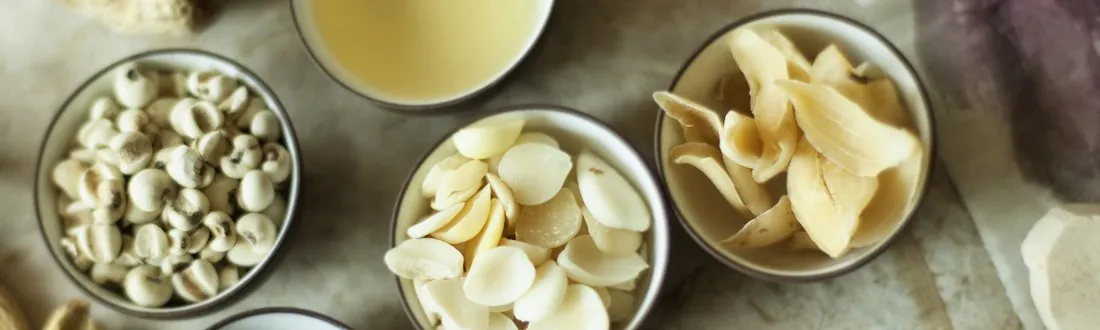
- Light congee with lily bulb and lotus seed — supports the Heart and calms agitation.
11. Lifestyle in summer
- Sleep: later than winter, but still aim for around 11pm. A short nap in the hottest part of the day (1–3pm) is the classical Chinese practice and matches the natural drop in alertness.
- Movement: exercise in the cooler hours of the day — early morning or evening. Avoid hard exertion in midday heat.
- Emotion: the Heart is most exposed in summer. Cultivate calm, joy, social connection. Avoid over-excitement, panic and over-stimulation.
- Sun: get sun exposure in the early morning and late afternoon; cover the back of the neck and head in midday sun.
- Water: stay well hydrated. Cool (not iced) water with a splash of lemon or mint is ideal.
- Air conditioning: avoid sitting directly in the cold draft. The combination of summer sweat with sudden chill is a classical cause of summer Bell’s palsy and stiff necks.
12. Frequently asked questions
What about cold drinks in really hot weather?
Cool (not iced) drinks are appropriate. The TCM caution is against very cold and iced drinks — the Stomach must warm them before digesting, and chronic chilling weakens the Spleen. Tepid herbal tea, room-temperature water with cucumber or mint, or even a bowl of cooled mung bean soup are far more effective at relieving summer heat than ice water, and don’t damage the digestion.
Should I avoid all hot food in summer?
No. Warm light cooked food is part of every summer meal in TCM. The advice is to avoid heavy slow-cooked food and very heating foods (lamb, chilli, BBQ in excess) — not all warm food. A bowl of warm light soup with cooling ingredients is the perfect summer first course.
Why does watermelon get so much attention?
Watermelon (xi gua) is recorded in the classical materia medica as the single most cooling fruit, and its high water content addresses both the heat and the dehydration of summer. The classical Chinese summer remedy for heatstroke is watermelon juice or cool watermelon flesh. Modern research confirms its hydration profile and citrulline content. Eat fresh, plain, ideally between meals.
What about salad?
Salad is the one season of the year when raw cold preparations make sense in TCM — summer is when the Stomach’s digestive fire can handle it. Make sure your salad is dressed with warming aromatics (ginger, garlic, spring onion, mustard) and contains some cooked elements (steamed prawns, blanched asparagus). Avoid icy cold salad straight from the fridge.















