

Xing Ren Hua Shi Tang (杏仁滑石汤) — Apricot Kernel & Talc Decoction
On this page
- Overview
- TCM pattern
- Key herbs
- Formula actions
- Conditions treated
- Comparisons with related formulas
- Cautions
Overview
Xing Ren Hua Shi Tang — Apricot Kernel and Talc Decoction — is a Wen Bing formula from Wu Jutong’s Wen Bing Tiao Bian (1798) for damp-warmth disease that has lodged in the lower burner. It addresses the picture where a damp-warmth pathogen has descended from the middle to the lower burner, producing persistent low-grade fever, abdominal heaviness, scanty dark urine and slight constipation[11], with a thick yellow tongue coat that doesn’t shift.
The formula combines aromatic Damp-resolving herbs (Xing Ren in the upper burner, Bai Dou Kou in the middle, Yi Yi Ren in the lower), Heat-clearing herbs (Huang Qin, Hua Shi, Tong Cao) and Phlegm-resolving herbs (Ban Xia, Yu Jin). The three burners are addressed simultaneously, with extra attention to the lower burner.
I prescribe Xing Ren Hua Shi Tang as part of bespoke herbal formulas from pharmaceutical-grade granules sourced from Sun Ten in Taiwan.
TCM pattern
Xing Ren Hua Shi Tang is prescribed for damp-warmth in the lower burner:
- Low-grade persistent fever — afternoon worse
- Heaviness of the body
- Abdominal fullness and heaviness
- Scanty, dark, possibly cloudy urine
- Loose, foul stools or alternating loose stools and constipation
- Reduced appetite, sticky mouth
- Mild thirst with no desire to drink
- Foggy head
- Tongue — thick yellow greasy coat
- Pulse — slippery, rapid, soft
Key herbs
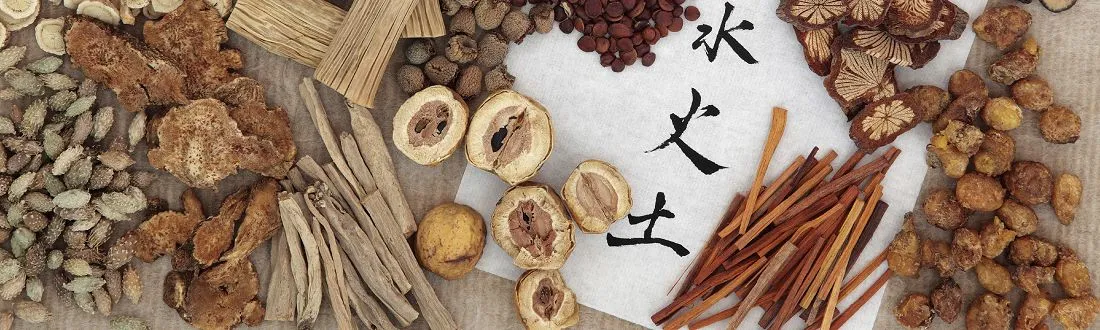
- Xing Ren (apricot kernel, 9g) — opens the Lung Qi in the upper burner
- Hua Shi (talc, 9g) — clears damp-heat
- Huang Qin (Rx. Scutellariae, 6g) — clears damp-heat
- Yu Jin (turmeric tuber, 6g) — moves Qi and Blood; opens the orifices
- Tong Cao (Med. Tetrapanacis, 3g) — drains damp through urine
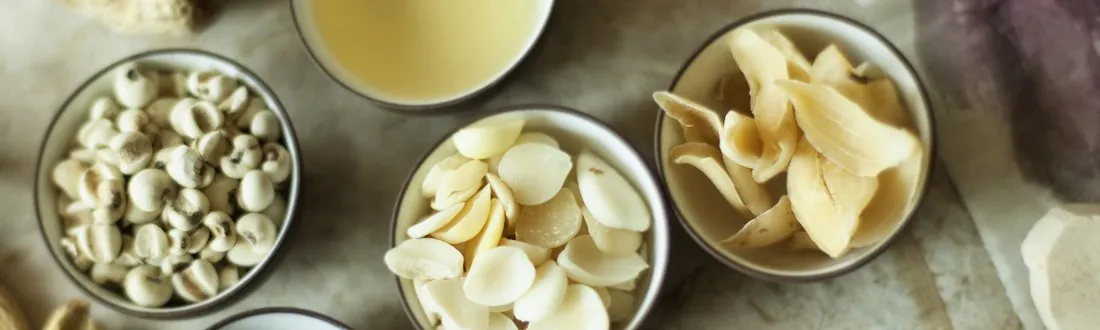
- Bai Dou Kou (cardamom) — aromatic; transforms Damp in the middle burner
- Ban Xia — transforms Phlegm and Damp
- Yi Yi Ren (coix seed) — drains damp from the lower burner
Formula actions
- Clears damp-warmth from all three burners, with focus on the lower burner
- Opens the Lung Qi
- Aromatic transformation of Damp in the middle burner
- Drains Damp through urination
Conditions treated
- Subacute/chronic urinary tract infection with damp-heat — see UTIs
- Chronic prostatitis with damp-heat pattern
- Pelvic inflammatory disease chronic phase (alongside conventional care)
- Chronic colitis with damp-heat
- Persistent post-viral low-grade fever
- Damp-warmth febrile illness in the late stage
- Chronic candidal infection with damp pattern
Comparisons with related formulas
- San Ren Tang — for damp-warmth in the upper and middle burners; similar approach, different focus.
- Ba Zheng San — for stronger lower-burner damp-heat UTI.
- Gan Lu Xiao Du Dan — for severe damp-warmth with throat and skin involvement.
Cautions
Not appropriate for cold-damp patterns (clear, profuse urination; cold lower abdomen).
Not appropriate for Yin-deficient patterns.
Persistent low-grade fever warrants medical assessment to exclude TB, autoimmune disease and chronic infections.
Always consult a qualified Chinese herbalist registered with the RCHM.
Prefer to be treated from home? Chinese herbal medicine online consultations are available throughout the UK and worldwide.
References
[11] Lyu Z, Fan Y, Bai Y, Liu T, Zhong LL, Liang HF. Outcome of the efficacy of Chinese herbal medicine for functional constipation: A systematic review and meta-analysis. World J Clin Cases. 2022 May 26;10(15):4856-4877. https://doi.org/10.12998/wjcc.v10.i15.4856. PMID: 35801027.















