



The Stomach in Chinese medicine
The Stomach (Wei, 胃) is the “Sea of Food and Fluid” in Chinese medicine — the first organ to receive everything we consume. Together with the Spleen, the Stomach drives the digestive transformation that sustains post-natal life. The Stomach receives and “rotten-ripens” food, then descends the turbid downward to the small intestine; the Spleen extracts the pure essence and ascends it. This Stomach-descending / Spleen-ascending pairing is the central axis of TCM digestion. The TCM concept of the Stomach overlaps with the Western stomach but is broader, encompassing oesophageal, gastric and proximal small-intestinal function. Paired with the Spleen; element Earth; season late summer; sense organ the mouth; emotion worry / overthinking; tissue muscles and flesh.
Functions of the Stomach
- Receives food and drink — the Stomach is the “Sea of Food and Fluid” (shui gu zhi hai); appetite, hunger and the urge to eat depend on Stomach Qi
- Rotten-ripens food (fu shu) — the initial transformation of ingested food; an essential first step before the Spleen can extract Gu Qi (Grain Qi)
- Controls the descent of turbid Qi — healthy Stomach Qi descends; rebellious Stomach Qi rising causes nausea, vomiting, hiccups, belching, acid reflux
- Origin of fluids — the Stomach is the source of bodily fluids; Stomach Yin and fluid deficiency manifests as dry mouth, dry stools, hunger without appetite
- Houses the Stomach Qi — in TCM diagnosis the strength of Stomach Qi is reflected in the pulse, the tongue coating and the complexion; preserving Stomach Qi is the first principle of treatment
Stomach and Spleen pair
The Stomach is paired with the Spleen as the Earth-element couple. The Stomach is the Fu (Yang) organ — hollow, receiving, descending; the Spleen is the Zang (Yin) organ — solid, transforming, ascending. They work as one digestive engine and their disharmony (Spleen-Stomach disharmony) is one of the most common patterns in clinical practice. Stomach pathologies tend toward Heat, Yin deficiency and rising rebellion; Spleen pathologies tend toward Cold, Qi deficiency and Dampness. Treatment usually addresses both.
Common patterns of Stomach disharmony
- Stomach Heat / Fire — burning epigastric pain, voracious appetite, foul breath, bleeding gums, dry mouth, constipation, thirst for cold drinks. Common in long-standing dietary excess, spicy food, alcohol
- Stomach Yin deficiency — dry mouth, hunger without appetite, dry retching, dry stools, glossy tongue with little coating; often follows febrile illness or chronic Stomach Heat
- Stomach Cold — epigastric cold pain better with warmth and pressure, clear vomit, watery diarrhoea, intolerance of cold food and drinks
- Stomach Qi deficiency — poor appetite, post-prandial fullness, fatigue after eating, sallow complexion, weak digestion
- Stomach Qi rebellion — nausea, vomiting, hiccups, belching, acid reflux, morning sickness; the cardinal sign of failed Stomach descent
- Food stagnation — epigastric distension and pain, foul belching, vomiting of undigested food, irregular stools; from overeating, irregular meals or hard-to-digest foods
- Damp-Heat in Stomach — epigastric heaviness, nausea, bitter or sticky mouth, jaundice, foul-smelling stools; from chronic dietary indiscretion
Conditions on this site relating to Stomach disharmony
Irritable bowel syndrome, acid reflux and GORD, nausea and vomiting, constipation, SIBO, gastritis, peptic ulcer, morning sickness in pregnancy, bad breath (halitosis) and post-chemotherapy nausea are all classically treated through the Stomach. Stomach Yin deficiency frequently underlies the dry-mouth and reduced-appetite presentations of menopause and post-radiotherapy.
Treatment principles for the Stomach
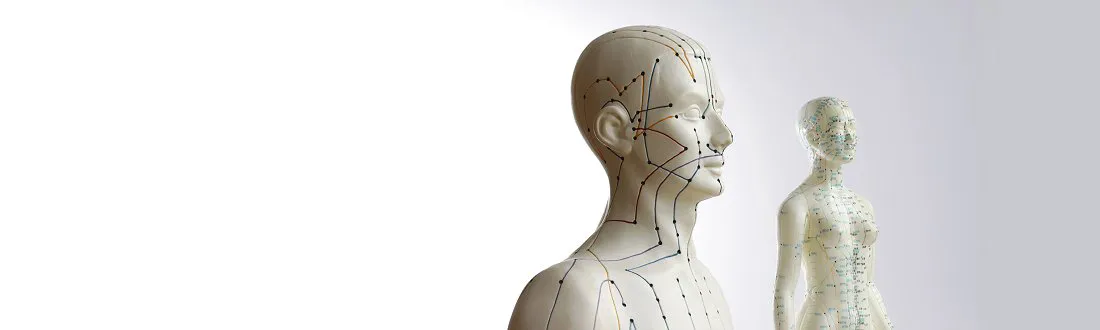
Core acupuncture points include ST 36 (Zusanli) — the master tonification point for both Stomach and the entire body; ST 25 (Tianshu) Front-Mu of the Large Intestine, regulates the intestines; ST 44 (Neiting) for Stomach Heat; ST 40 (Fenglong) for Phlegm and Damp; CV 12 (Zhongwan) Front-Mu of the Stomach (central point for all Stomach disharmonies); BL 21 (Weishu) as the Back-Shu of the Stomach; PC 6 (Neiguan) for nausea, vomiting and rebellious Stomach Qi. Foundational formulas include Bao He Wan (food stagnation), Ban Xia Xie Xin Tang (Stomach-intestinal Heat with Damp), Yu Nü Jian (Stomach Yin deficiency with Heat), and Li Zhong Wan (Stomach Cold with Spleen Yang deficiency). The classical Chinese principle “preserve Stomach Qi” underpins every TCM prescription — harsh treatment that damages digestion damages the foundation of recovery.
Return to Zang-Fu organ overview or read about the Spleen, Heart, Lung, Liver and Kidney.















