


White in Chinese Medicine
In Chinese medicine, white is the colour of the Metal element and the Lung, and it signifies cold, deficiency and emptiness. A pale-white complexion points to a shortage of Blood or Qi, while a bright, puffy white points to Yang deficiency and cold. White appears in a pale tongue, a white tongue coating and clear, watery secretions, and it is echoed in the white herbs that tonify and moisten the Lung and Spleen and the white foods that ease a dry cough. This page is part of the guide to colours in Chinese medicine.
On this page
- What white signifies
- A pale or white complexion
- Pale tongue, white coating and secretions
- The Metal element and the Lung
- White Chinese herbs
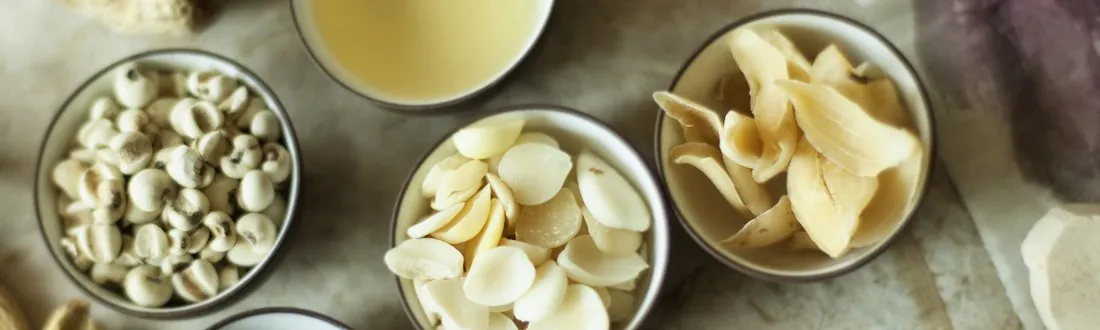
- White foods in Chinese food therapy
- When pallor needs a doctor
- Frequently asked questions
1. What white signifies
White is the colour of cold and of emptiness — a lack of the warmth, Qi or Blood that would otherwise give the body colour. The shade points to the type of deficiency:
- A pale, dull white suggests Blood deficiency — there is not enough Blood to bring colour to the face, lips and nails.
- A bright, shiny, slightly puffy white suggests Yang deficiency — not enough of the body's warming, activating energy, so cold and fluid accumulate.
- A sudden, stark pallor can accompany acute blood loss or collapse and needs urgent attention.
2. A pale or white complexion
A pale, lustreless complexion is one of the hallmark signs of Blood deficiency, typically alongside tiredness, dizziness, poor sleep and pale lips and nails. A bright white, puffy face that feels cold suggests Yang deficiency, often with cold hands and feet, low energy and a dislike of cold. Because women lose blood each month, a pale complexion from Blood deficiency is especially common in women.
3. Pale tongue, white coating and secretions
- Tongue body — a pale tongue indicates Qi, Blood or Yang deficiency, or cold.
- Tongue coating — a white coating generally indicates cold: a thin white coating with an exterior wind-cold (the early stage of a common cold), a thick, white, greasy coating with damp-cold.
- Phlegm and mucus — clear or white, watery phlegm indicates cold, in contrast to the yellow phlegm of heat.
- Discharge — a clear or white vaginal discharge suggests cold-damp.
- Lips and nails — pale lips and nail beds point to Blood deficiency.
4. The Metal element and the Lung
White is the colour of the Metal element, whose organs are the Lung and Large Intestine. Metal governs breathing, the boundary between inside and outside (including immunity and the skin), and the capacity to let go. Its season is autumn, its climate is dryness, its taste is pungent, and its emotion is grief or sadness — which is why prolonged grief is thought to affect the Lung. Dryness readily injures the Lung, which is why so many white, moistening foods and herbs are used to protect it.
5. White Chinese herbs
A striking number of white herbs tonify or moisten — particularly the Lung and Spleen:
- Bai Zhu (white atractylodes) — a key herb to tonify Spleen Qi and dry dampness.
- Bai He (lily bulb) — moistens the Lung, eases a dry cough and calms the mind.
- Bai Shao (white peony) — nourishes Blood and softens the Liver.
- Bai Zhi (angelica) — a warm, aromatic herb that expels wind-cold and opens the nose.
Their names literally begin with bai, the Chinese word for white. As always, herbs are combined into a matched formula by a qualified practitioner.
6. White foods in Chinese food therapy
White foods are traditionally said to benefit the Lung and moisten dryness — useful in autumn and for a dry throat or cough. Everyday examples include pear (a classic for a dry Lung), white radish (mooli), lily bulb, white fungus (tremella), tofu, almonds, cauliflower and Chinese leaf. Pungent white foods such as onion, garlic and white radish also support the Lung's dispersing function.
7. When pallor needs a doctor
Marked or sudden pallor should be checked medically. Persistent paleness with tiredness, breathlessness, a racing heart or dizziness can indicate anaemia and deserves a blood test. Sudden stark pallor with faintness, chest pain or heavy bleeding is an emergency. Blue-white, cold fingers or toes that change colour can indicate a circulation problem (such as Raynaud's) and are worth assessing. Chinese medicine can help build Qi and Blood alongside conventional care, but the cause of significant pallor should be diagnosed first.
8. Frequently asked questions
What does white mean in Chinese medicine?
White is the colour of the Metal element and the Lung, and it signifies cold, deficiency and emptiness. A pale, dull white complexion suggests Blood deficiency, a bright, shiny, puffy white suggests Yang deficiency and cold, and a sudden stark pallor can accompany acute blood loss. The theme is a lack of the warmth, Qi or Blood that gives the body colour.
What does a pale tongue mean in Chinese medicine?
A pale tongue body indicates deficiency of Qi, Blood or Yang, or the presence of cold. It is read together with the coating and the other signs: a pale tongue with a thin white coating suggests cold or early exterior illness, while a pale, swollen tongue with a thick white greasy coating suggests damp-cold and Yang deficiency.
What does a white tongue coating mean?
A white tongue coating generally indicates cold. A thin white coating is normal or suggests an early exterior wind-cold, such as the start of a common cold, while a thick, white, greasy coating suggests damp-cold accumulating internally. The coating is always interpreted alongside the colour of the tongue body itself.
Which Chinese herbs are white and what do they do?
Many white herbs tonify or moisten the Lung and Spleen, and their names begin with bai, meaning white. Bai Zhu (white atractylodes) tonifies Spleen Qi and dries damp, Bai He (lily bulb) moistens the Lung and eases a dry cough, Bai Shao (white peony) nourishes Blood, and Bai Zhi (angelica) expels wind-cold and opens the nose.
What do white foods do in Chinese medicine?
White foods are traditionally said to benefit the Lung and moisten dryness, which is useful in autumn and for a dry throat or cough. Examples include pear, white radish, lily bulb, white fungus, tofu, almonds and cauliflower. Pungent white foods such as onion and garlic support the Lung's dispersing function.
References
- Huang Di Nei Jing Su Wen (The Yellow Emperor's Classic of Internal Medicine). (~300 BCE). Beijing: People's Medical Publishing House.
- Maciocia, G. (2015). The Foundations of Chinese Medicine: A Comprehensive Text (3rd ed.). Edinburgh: Churchill Livingstone Elsevier.
- Maciocia, G. (2018). Diagnosis in Chinese Medicine: A Comprehensive Guide (2nd ed.). Edinburgh: Elsevier.
- Kaptchuk, T. J. (2000). The Web That Has No Weaver: Understanding Chinese Medicine (2nd ed.). New York: McGraw-Hill.
- Wiseman, N. & Ye, F. (1998). A Practical Dictionary of Chinese Medicine (2nd ed.). Brookline: Paradigm Publications.
- Bensky, D., Clavey, S., & Stöger, E. (2004). Chinese Herbal Medicine: Materia Medica (3rd ed.). Seattle: Eastland Press.















