



Colours in Chinese Medicine
Colour is one of the most immediate diagnostic signals in Chinese medicine. The colour of the complexion, tongue, eyes and bodily secretions tells a practitioner about heat and cold, dampness, deficiency and blood stasis. The five classical colours — green, red, yellow, white and black — each correspond to one of the Five Elements and its organ. Colour also runs through treatment: the colour of a herb or food often hints at what it does. This hub explains how colour is read and links to a dedicated page on each colour.
On this page
- Why colour matters in Chinese medicine
- How a practitioner reads colour
- The five colours and the Five Elements
- Colour in Chinese herbs
- Colour in Chinese food therapy
- The five colours in detail
- When colour is a medical warning sign
- Frequently asked questions
1. Why colour matters in Chinese medicine
Chinese medicine is built on careful observation, and colour is one of the first things a practitioner notices. Because the body's colours change with its internal state, they offer a window onto the patterns beneath — whether there is heat or damp-heat, cold, deficiency of Blood or Qi, or stagnation of Qi and Blood.
Colour works on two levels. First, as a diagnostic sign: the hue of the face, tongue, eyes, urine, phlegm and other secretions each carries meaning. Second, as part of the Five Element framework, in which each colour is paired with an element, a pair of organs, an emotion, a season and a taste. The two overlap and inform each other.
2. How a practitioner reads colour
Observation (looking) is one of the four classical examinations in Chinese medicine, alongside listening/smelling, questioning and palpation. Colour is read across several areas:
- The complexion — the overall colour and lustre of the face; see face diagnosis.
- The tongue — the colour of the tongue body and its coating; see tongue diagnosis.
- The eyes — redness, yellowing of the whites, dark shadows beneath.
- Secretions and excretions — the colour of urine, stool, phlegm, nasal mucus, vaginal discharge and sweat.
- Lips, nails and skin — pallor, redness, bluish or dark tinges.
No single colour is read in isolation. It is always weighed alongside the other signs and the full clinical picture.
3. The five colours and the Five Elements
In Five Element theory, each colour belongs to an element and its yin (solid) organ:
| Colour | Element | Organ | Commonly signifies | Emotion |
|---|---|---|---|---|
| Green / blue-green | Wood | Liver | Liver disharmony, cold, pain, stagnation | Anger |
| Red | Fire | Heart | Heat (full or deficient) | Joy / over-excitement |
| Yellow | Earth | Spleen | Damp, damp-heat, Spleen deficiency | Worry / pensiveness |
| White | Metal | Lung | Cold, deficiency, emptiness | Grief |
| Black / dark | Water | Kidney | Kidney deficiency, cold, blood stasis | Fear |
A greenish tinge points towards the Liver, a red flush towards Heart or heat, a sallow yellow towards the Spleen and damp, pallor towards the Lung or deficiency, and a dark, smoky complexion towards the Kidney.
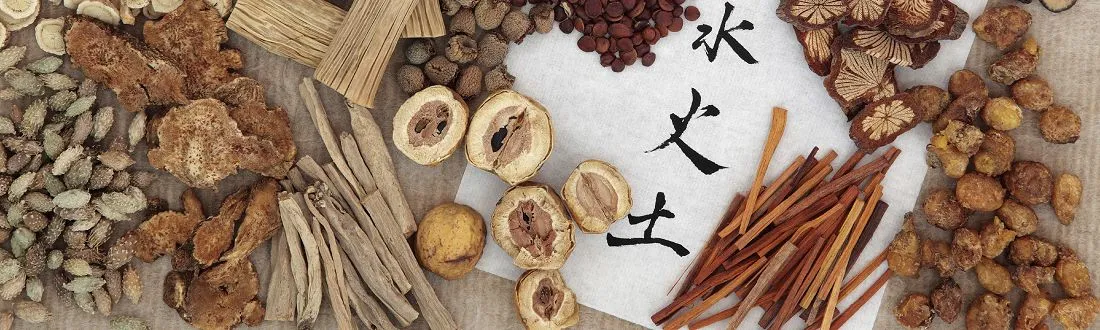
4. Colour in Chinese herbs
Colour often echoes what a herb does — a useful memory aid, though never an absolute rule:
- Yellow herbs frequently clear heat and damp-heat — the bitter, cold “three yellows” Huang Lian, Huang Qin and Huang Bai are the classic examples.
- Black and dark herbs often tonify the Kidney and nourish Blood — such as Shu Di Huang and He Shou Wu.
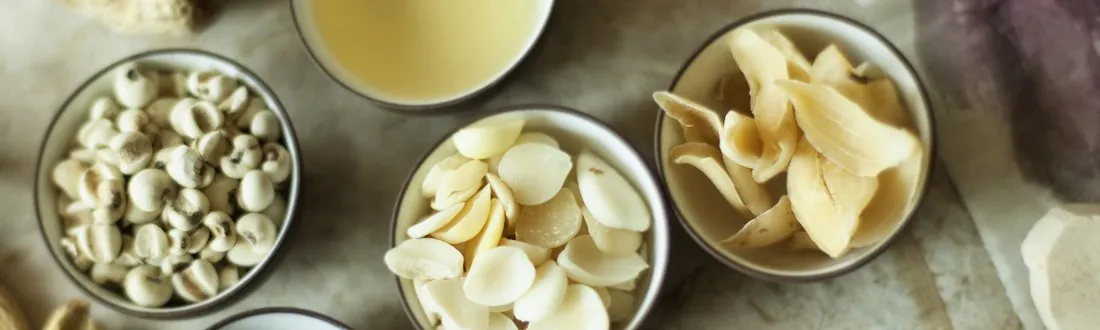
- White herbs often tonify or moisten the Lung and Spleen — such as Bai Zhu and Bai He (lily bulb).
- Red herbs often move or cool the Blood — such as Dan Shen and Hong Hua (safflower).
Each colour page below sets out its characteristic herbs in more detail. Chinese herbal medicine is a complementary therapy and should always be prescribed by a qualified practitioner.
5. Colour in Chinese food therapy
The same five colours guide Chinese food therapy. Eating a range of coloured foods is thought to nourish the corresponding organ — green foods the Liver, red foods the Heart and Blood, yellow and orange foods the Spleen, white foods the Lung, and black foods the Kidney. This is the basis of five-colour eating, a simple way to keep the diet balanced across the organ systems.
6. The five colours in detail
Each colour has its own dedicated page covering what it signifies, where it shows up in the body, its element and organ, and its characteristic herbs and foods:
- Green in Chinese medicine — the Liver, Wind, cold, pain and stagnation.
- Red in Chinese medicine — the Heart and heat, full and deficient.
- Yellow in Chinese medicine — the Spleen, damp and damp-heat.
- White in Chinese medicine — the Lung, cold and deficiency.
- Black in Chinese medicine — the Kidney, cold and blood stasis.
Purple is not one of the five classical colours but is clinically important: a purple tongue, lips or blood clots point to blood stasis (poor circulation of Blood), often with cold or long-standing Qi stagnation. It is noted on the red, green and black pages where relevant.
7. When colour is a medical warning sign
Some colour changes are important medical signs that need conventional assessment, not a Chinese medicine interpretation alone. See your doctor promptly if you notice:
- Yellow skin or yellowing of the whites of the eyes (jaundice) — this can indicate liver or gallbladder disease and should be checked urgently.
- Blood in the urine or stool, or black, tarry stools — these need prompt investigation.
- Blue or grey lips, tongue or fingertips (cyanosis) — a sign the blood may be short of oxygen; seek urgent help.
- Sudden marked pallor with dizziness or breathlessness.
- Any new, spreading or rapidly changing skin discolouration.
Chinese medicine observation is a complementary aid to understanding your constitution and patterns — it is not a substitute for medical diagnosis.
8. Frequently asked questions
What do colours mean in Chinese medicine?
In Chinese medicine, colours seen in the complexion, tongue, eyes and secretions reveal the body's internal state. Broadly, red signifies heat, white signifies cold or deficiency, yellow signifies damp or damp-heat, a dark or black colour signifies Kidney deficiency, cold or blood stasis, and a green or blue-green tinge signifies Liver disharmony, cold, pain or stagnation. Each also corresponds to one of the Five Elements and its organ.
What are the five colours in Chinese medicine?
The five classical colours are green (or blue-green), red, yellow, white and black, corresponding to the Five Elements Wood, Fire, Earth, Metal and Water and to the Liver, Heart, Spleen, Lung and Kidney respectively. Purple is not one of the five but is clinically important as a sign of blood stasis.
How is colour used in Chinese medicine diagnosis?
Observation is one of the four examinations in Chinese medicine, and colour is read across the complexion, the tongue body and its coating, the eyes, the lips, nails and skin, and the colour of urine, stool, phlegm and other secretions. No single colour is read alone; it is weighed with all the other signs and the full clinical picture.
Does the colour of a Chinese herb tell you what it does?
Often, as a memory aid rather than a rule. Yellow herbs such as Huang Lian frequently clear heat and damp-heat, black and dark herbs such as Shu Di Huang often tonify the Kidney and nourish Blood, white herbs often tonify or moisten the Lung and Spleen, and red herbs such as Dan Shen often move or cool the Blood. The actual action is determined by the herb's taste, nature and organ affinity, not colour alone.
When is a change in colour a medical warning sign?
See your doctor promptly for yellowing of the skin or the whites of the eyes (jaundice), blood in the urine or stool or black tarry stools, blue or grey lips, tongue or fingertips, sudden marked pallor with dizziness, or any new, spreading skin discolouration. These can indicate conditions that need conventional medical treatment, and Chinese medicine observation is not a substitute for medical diagnosis.
References
- Huang Di Nei Jing Su Wen (The Yellow Emperor's Classic of Internal Medicine). (~300 BCE). Beijing: People's Medical Publishing House.
- Maciocia, G. (2015). The Foundations of Chinese Medicine: A Comprehensive Text (3rd ed.). Edinburgh: Churchill Livingstone Elsevier.
- Maciocia, G. (2018). Diagnosis in Chinese Medicine: A Comprehensive Guide (2nd ed.). Edinburgh: Elsevier.
- Kaptchuk, T. J. (2000). The Web That Has No Weaver: Understanding Chinese Medicine (2nd ed.). New York: McGraw-Hill.
- Wiseman, N. & Ye, F. (1998). A Practical Dictionary of Chinese Medicine (2nd ed.). Brookline: Paradigm Publications.
- Bensky, D., Clavey, S., & Stöger, E. (2004). Chinese Herbal Medicine: Materia Medica (3rd ed.). Seattle: Eastland Press.















