



The Large Intestine in Chinese medicine
The Large Intestine (Da Chang, 大腸) is the “Transmitter of Refuse” in Chinese medicine — the final station of the digestive tract. It receives the turbid food residue passed down from the Small Intestine, reabsorbs the last useful fluids, and evacuates the solid waste. Healthy bowel function in TCM is the joint product of Stomach descent, Small Intestine separation of pure from impure, Spleen Qi support, Lung Qi descent and Liver Qi smoothing. The TCM Large Intestine corresponds closely to the Western anatomical colon and rectum. Paired with the Lung; element Metal; season autumn; sense organ the nose; emotion grief / letting go; tissue skin and body hair.
Functions of the Large Intestine
- Receives the turbid — takes the waste passed down from the Small Intestine after the “separation of pure and impure”
- Transmits and evacuates waste (chuan dao) — the “Transmitter of Refuse”; healthy peristalsis and a daily, formed, painless bowel motion are the markers of good Large Intestine function
- Reabsorbs fluids — recycles fluid from the chyme; deficiency of this function produces watery stools, excess produces dry, hard, difficult-to-pass stools
- Letting go — in the Five-Element framework the Large Intestine, paired with the Lung, governs the psychic capacity to release what is no longer needed — both physically (waste) and emotionally (grief, attachment, regret)
Large Intestine and Lung pair
The Large Intestine is paired with the Lung as the Metal-element couple. The Lung descends Qi and disseminates fluids downwards; this descent of Lung Qi is what allows the Large Intestine to receive turbid waste and move the bowels. When Lung Qi fails to descend (chronic cough, asthma, emphysema), constipation often follows; conversely, chronic constipation can impede the Lung’s descent and worsen respiratory symptoms. Treatment of stubborn constipation often involves the Lung, and treatment of chronic respiratory disease often involves the Large Intestine.
Common patterns of Large Intestine disharmony
- Large Intestine Heat (Excess Heat) — constipation with dry, hard stools, abdominal pain, foul-smelling stool, thirst, scanty dark urine. Common in dietary excess of spicy/fried food, alcohol or febrile illness
- Large Intestine Dryness — dry, pellet-like stools that are difficult to pass, often without abdominal pain or thirst; common in the elderly, post-partum, after febrile illness or in chronic Yin deficiency
- Cold-Damp in Large Intestine — watery diarrhoea, abdominal cold pain better with warmth, sticky stools; from chilled food, raw food or invasion of external cold
- Damp-Heat in Large Intestine — foul-smelling diarrhoea with mucus or blood, burning anus, urgency, abdominal pain. The TCM picture in acute bacterial enteritis, ulcerative colitis flares and traveller’s diarrhoea
- Large Intestine Deficiency (Cold) — chronic watery diarrhoea with undigested food, prolapse, incontinence; from chronic Spleen-Kidney Yang deficiency
- Collapse of Large Intestine — chronic diarrhoea ending in rectal prolapse or chronic haemorrhoids; from severe Spleen Qi sinking
Conditions on this site relating to Large Intestine disharmony
Constipation, diarrhoea, irritable bowel syndrome, ulcerative colitis, Crohn’s disease, SIBO, haemorrhoids, anal fissure, post-antibiotic dysbiosis. The same Metal-element treatment principles also apply to allergic rhinitis and eczema when the underlying pattern includes Lung-Large Intestine disharmony.
Treatment principles for the Large Intestine
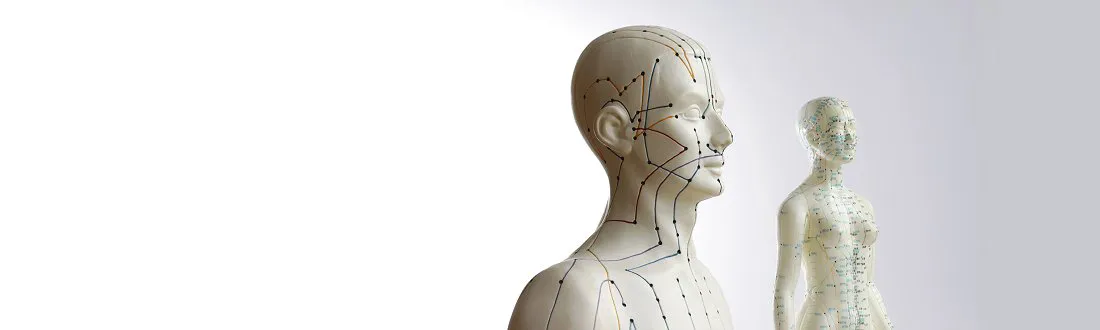
Core acupuncture points include LI 4 (Hegu) — one of the most clinically important points in the body, regulates the Large Intestine, expels Wind, releases the Exterior, calms pain; LI 11 (Quchi) for Heat in the channel and the bowel; ST 25 (Tianshu) the Front-Mu of the Large Intestine, the central point for all intestinal disorders; BL 25 (Dachangshu) the Back-Shu of the Large Intestine; SP 6 (Sanyinjiao) to harmonise the three Yin and support bowel function. Foundational formulas include Ma Zi Ren Wan (Large Intestine Dryness with constipation), Da Cheng Qi Tang (Large Intestine Heat with severe constipation), Ban Xia Xie Xin Tang (gastric and intestinal Damp-Heat), and Shen Ling Bai Zhu San (chronic Spleen-Large Intestine deficiency with loose stools).
For the full clinical article with pattern differentiation, classical citations and herbal treatment strategies, see Disorders of the Lung and Large Intestine.
Return to Zang-Fu organ overview. Paired with the Lung. Read about the other Fu organs: Stomach, Small Intestine, Bladder, Gallbladder, Triple Burner and the Pericardium; or the Zang organs: Heart, Spleen, Liver and Kidney.















