



The Small Intestine in Chinese medicine
The Small Intestine (Xiao Chang, 小腸) is the “Receiver of the Transformed” in Chinese medicine — the organ that receives partially digested food from the Stomach and carries out the critical “separation of pure and impure”. The pure essence is sent up to the Spleen for transformation into Qi and Blood; the impure fluid is sent to the Bladder for excretion; the impure solid is sent on to the Large Intestine. This separation function makes the Small Intestine central to digestion, fluid metabolism and the production of clear urine versus stool. Paired with the Heart as the Sovereign-Fire couple; element Fire; season summer; sense organ the tongue; emotion joy / shock; tissue the blood vessels.
Functions of the Small Intestine
- Receives the transformed — takes the partially digested food and fluid descended by the Stomach
- Separates pure from impure (fen bie qing zhuo) — extracts the pure essence (sent to the Spleen), pure fluid (sent to the Bladder via Kidney transformation), and discards the impure solid (sent to the Large Intestine). The most defining Small Intestine function
- Influences the quality of urine and stool — when Small Intestine separation fails, scanty dark urine accompanies loose stools (fluids going the wrong way), or watery diarrhoea accompanies normal urination; these “output mismatches” are clinical signs of Small Intestine dysfunction
- Receives Heart-Fire to discharge it as warmth and to clear it via urine — the Sovereign-Fire pair: when Heart Fire is excessive, it descends to the Small Intestine and is excreted through hot, scanty urine. Hence the TCM linkage between mouth ulcers (Heart Fire) and burning urination (Small Intestine Heat)
Small Intestine and Heart pair
The Small Intestine is paired with the Heart as the Sovereign-Fire couple. The pair is reciprocal: Heart Fire descends to support Small Intestine digestion; when Heart Fire is excessive (anxiety, anger, alcohol), it overflows into the Small Intestine and presents as urinary heat. Conversely, Small Intestine deficiency can fail to ground Heart Fire upward, producing irritability and insomnia. Treatment of conditions like mouth ulcers with burning urination, or anxiety-related urinary frequency, classically addresses both organs together.
Common patterns of Small Intestine disharmony
- Small Intestine Heat (Excess Heat) — scanty, burning, dark urine, possibly bloody; mouth ulcers (Heart Fire descended); irritability, restlessness. The TCM pattern in some UTIs and Heart-Fire mouth ulcers
- Small Intestine Qi pain — griping lower abdominal pain, distension, referral to the testis or groin; the TCM pattern in some hernias and intermittent abdominal pain syndromes
- Small Intestine Cold — lower abdominal cold pain better with warmth, watery diarrhoea with audible borborygmus, clear copious urine; chronic and constitutional
- Small Intestine failing to separate fluids — watery diarrhoea with scanty urine, the “wrong output” pattern; from Spleen-Kidney deficiency affecting Small Intestine transformation
- Small Intestine-channel obstruction — pain along the posterior arm, the lateral shoulder blade (the famous SI channel referred pain pattern), the side of the neck and the angle of the jaw; common in frozen shoulder, scapular pain and some TMJ patterns
Conditions on this site relating to Small Intestine disharmony
Irritable bowel syndrome with the “urine-and-stool output mismatch” pattern, UTIs with the Heart-Fire-descending pattern, recurrent mouth ulcers, frozen shoulder and scapular pain along the Small Intestine channel, posterior neck and angle-of-jaw pain, TMJ disorders when the SI channel is involved, and the lower-abdominal griping with hernia-type pain.
Treatment principles for the Small Intestine
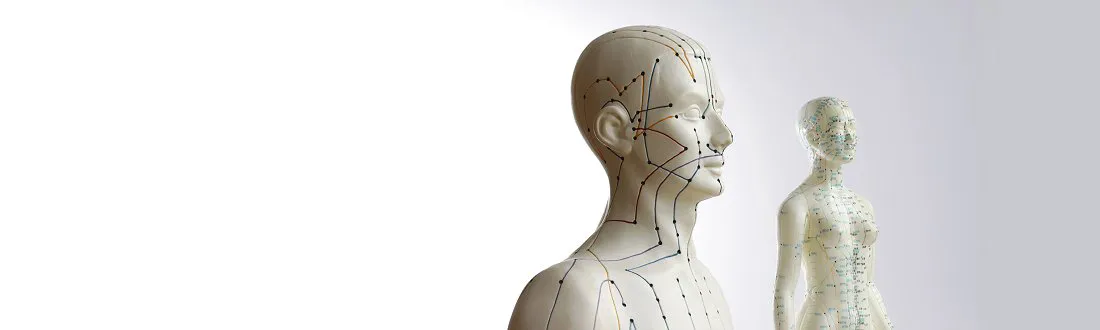
Core acupuncture points include SI 3 (Houxi) — the Stream point and Confluent (Master) of the Governing Vessel; for posterior neck pain, occipital headache, the spinal axis, and acute lumbar sprain; SI 4 (Wangu) the Yuan-source point; SI 9 (Jianzhen) and SI 10 (Naoshu) for shoulder disorders; SI 11 (Tianzong) over the scapula, a classical point for frozen shoulder; SI 19 (Tinggong) in front of the ear for tinnitus and ear disorders; CV 4 (Guanyuan) the Front-Mu of the Small Intestine; BL 27 (Xiaochangshu) the Back-Shu of the Small Intestine. Foundational formulas include Dao Chi San (Heart Fire descending to Small Intestine with mouth ulcers and burning urination), Wu Ling San (failure of fluid separation with watery diarrhoea and scanty urine), and modifications of Tian Tai Wu Yao San (Small Intestine Qi pain with hernia-type symptoms).
For the full clinical article with pattern differentiation, classical citations and herbal treatment strategies, see Disorders of the Heart and Small Intestine.
Return to Zang-Fu organ overview. Paired with the Heart. Read about the other Fu organs: Large Intestine, Stomach, Bladder, Gallbladder, Triple Burner and the Pericardium; or the Zang organs: Spleen, Lung and Kidney.















