



Chinese food therapy recipes
On this page
- About these recipes
- Recipes by therapeutic purpose
- How to cook them well
- Sourcing the unusual ingredients in the UK
- Recipe FAQs
- Related pages
1. About these recipes
These are practical recipes drawn from the Chinese food therapy (shi liao) tradition. Each one targets a specific TCM pattern — building qi and blood, nourishing Yin, warming the Kidneys, clearing damp, calming the Shen — using ingredients that are widely available in the UK. They are meant to be cooked and eaten, not just admired.
If you are new to Chinese food therapy, start at the main Chinese food therapy page for the principles (thermal natures, the five flavours, seasonal eating). This page is purely about cooking them.
2. Recipes by therapeutic purpose
Spleen and digestion — the base
- Congee (basic and variations) — the foundational Chinese rice porridge. The most-recommended dish for weak digestion, convalescence and post-illness recovery.
- Chinese yam (Huai Shan) chicken soup — quietly builds Spleen qi without being heavy or sweet. Good for chronic fatigue, loose stools and weak appetite.
Blood-building
- Four Things Soup (Si Wu Tang) — the classical blood-nourishing formula adapted as a soup. The foundation of women's tonification in Chinese cuisine.
- Dang Gui chicken soup — the most famous postnatal soup in Chinese cuisine. Strongly warming and blood-building.
- Eight Treasures rice (Ba Bao Fan) — a celebratory dessert with eight blood- and qi-tonifying ingredients.
Yin-nourishing — for dryness and depleted reserves
- Black sesame paste — Kidney-yin and Liver-blood tonic. Used for grey hair, dryness, constipation and depleted reserves.
- Pear and rock sugar soup — the autumn classic for dry cough and Lung dryness.
- Snow fungus and red date sweet soup — the classical Yin-nourishing dessert for skin, body fluids and chronic dryness.
Clearing Heat and damp
- Red bean and barley soup — the standard damp-clearing soup for puffiness, sluggish weight gain and bloating.
- Mung bean soup — the summer classic for clearing Heat, rehydrating after sun exposure and gentle daily detoxification.
Calming the Shen — for sleep and the mind
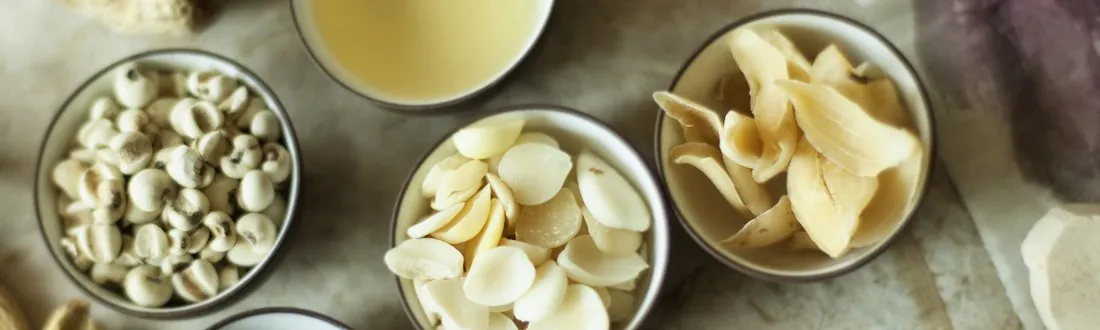
- Lotus seed and lily bulb sweet soup — the classical TCM dish for restless sleep, an unsettled mind and Heart yin deficiency. Gentle and quietly powerful.
Kidney essence (jing) — deep, long-term nourishment
- Chinese-style bone broth — the foundation of many Chinese soups; deeply nourishes Kidney-jing and the body's reserve.
3. How to cook them well
Most of these recipes are simple in ingredients but unforgiving in technique. A few rules carry across all of them.
- Choose the pot. A heavy-based stainless steel saucepan, an enamelled cast-iron casserole (Le Creuset and similar) or a Chinese clay pot all work well. Thin aluminium pans burn rice and break delicate ingredients before the broth has time to develop. A slow cooker is acceptable for soups and bone broth; congee is best on the stovetop.
- Simmer, never boil. The slow drawing-out of nutrients and flavour in TCM cookery happens at a low gentle simmer (small bubbles barely breaking the surface). A rolling boil hardens proteins, makes broth cloudy and destroys the delicate aromatics.
- Cold water start. For bone broth, soups and chicken-based dishes, always start the meat and bones in cold water and bring slowly to temperature. This draws out flavour and minerals; hot-water starts seal the surface and leave a flatter broth.
- Skim the foam. When meat or bones first come to temperature, a grey-pink foam rises — that is denatured protein and impurities. Skim it off in the first ten minutes. This is the single biggest difference between a clear, restaurant-quality broth and a cloudy home one.
- Congee technique. Rinse the rice until the water runs clear, use a generous 1:8 or 1:10 ratio of rice to water, and stir occasionally for the first half hour to prevent sticking. After that, leave it. The total cook is 1.5–2 hours at a low simmer; the rice will break down into a soft, creamy porridge with no grain definition left.
- Add aromatics late. Ginger, spring onion, sesame oil and toasted seeds are added in the final minutes — or at the table — not at the start. Their volatile oils evaporate within minutes of boiling.
- Freeze in portions. Bone broth, soups and congee all freeze well in single-serving containers. A weekend's cooking can supply a fortnight's worth of weeknight meals. Defrost in the fridge overnight, never in the microwave for a TCM-correct gentle reheat.
4. Sourcing the unusual ingredients in the UK
Most ingredients in these recipes are available in mainstream British supermarkets — rice, chicken, ginger, pears, walnuts, sesame, lentils, mung beans, barley. A handful are specifically Chinese and need either an Asian supermarket or an online source.
- Local Chinese supermarkets — for patients near my Wokingham clinic, the best in-person sources are the Asian supermarkets in Reading (the larger ones on Oxford Road and in the Broad Street Mall stock dang gui, goji berries, lily bulb, lotus seeds, red dates, snow fungus, Chinese yam and most herbal-medicine staples). London Chinatown's See Woo and Loon Fung are unmatched for variety; New Loon Moon is a particular favourite.
- Online — UK-based — Sous Chef (souschef.co.uk), Wing Yip (wingyipstore.co.uk) and Starry Mart all deliver authentic Chinese ingredients across the UK with reliable quality. For dried herbs specifically I order from a small number of trusted UK herbalist suppliers; if a patient asks I'll point them to a current source.
- Health food shops — Holland & Barrett and independent health-food shops typically stock organic goji berries, mung beans, adzuki/red beans, barley, sesame seeds and good-quality dried fruit at reasonable prices.
- Sensible substitutions — if a Chinese-specific ingredient is unavailable, the recipe still works with substitutions: pearl barley for Job's tears, dried unsweetened cranberries for goji, regular dates for jujube/red dates, dried longan for fresh longan. The therapeutic effect is reduced but the dish remains nourishing.
- A word on quality. Chinese herbal ingredients vary wildly in quality. For pieces that are eaten whole — goji, red dates, lily bulb, lotus seeds — pay for the higher grade. Cheap goji often comes sulphur-treated and tastes of nothing; good goji is plump, deep red and noticeably sweet on its own.
5. Recipe FAQs
Are these recipes safe alongside conventional medication?
For most patients, yes. None of these recipes contain medicinal-strength herbs — they use food-grade ingredients in culinary quantities. The one specific caution is for patients on warfarin or other anticoagulants, who should avoid large quantities of dang gui (Four Things Soup, Dang Gui chicken) without checking with their prescriber. If you are pregnant, on chemotherapy or being actively treated for a serious condition, please mention any new dietary additions to your medical team and to me.
Can vegetarians or vegans cook these?
Mostly yes. The chicken-based recipes (Dang Gui chicken, Huai Shan chicken, congee variations) can be cooked with vegetable stock or with a tofu-and-shiitake base — the warming, qi-tonifying quality is reduced but the dish is still nourishing. Sweet dessert soups (lotus seed and lily bulb, snow fungus, pear), congee and bean soups are all naturally plant-based. The one exception is bone broth, which depends fundamentally on bones for its Kidney-jing-tonifying action; there is no straight vegan equivalent (a kombu-shiitake dashi is excellent but functions differently).
How often should I eat these?
That depends on the recipe and the pattern. A bowl of congee every morning for a fortnight is the standard recommendation for Spleen qi deficiency. Dang Gui chicken soup is typically eaten once or twice a week through the cooler months by women rebuilding blood. Lotus seed and lily bulb sweet soup can be eaten daily in the run-up to bed for a fortnight when sleep is poor. Mung bean soup is for hot weather and best taken every other day during a heatwave. None of these are meant to be eaten constantly — they are tools to match a pattern, not lifestyle prescriptions.
Are these recipes safe for children?
Yes, with two adjustments. Reduce ginger and warming aromatics by about half for children under ten (their inherent yang is already strong). Keep portion sizes small, and introduce one new ingredient at a time so that food sensitivities are easier to spot. Congee in particular is the traditional Chinese first food after weaning and works beautifully as a gentle daily meal for a poorly child.
Some of these taste medicinal — is that normal?
Yes, particularly for the blood-building soups (Dang Gui chicken, Four Things). Dang gui has a strong, slightly bitter, distinctly herbal taste that is unfamiliar to British palates. The taste mellows after a few servings; the first bowl is often a small effort. Sweet dessert soups (lotus and lily, snow fungus, pear) are usually a pleasure from the first spoonful. If a recipe tastes overwhelmingly medicinal, halve the dang gui or other strong herb the next time — less is more in food therapy.
Can I freeze and batch cook?
Most of these freeze beautifully. Bone broth and soups freeze for up to three months without quality loss. Congee freezes for about a month — reheat with a splash of fresh water as it thickens on cooling. Sweet dessert soups (lotus and lily, snow fungus) lose a little texture in the freezer; eat them fresh where possible. Dry mixes (the ingredients for Four Things Soup, snow fungus + red dates) can be portioned dry into bags and kept indefinitely on the shelf.
6. Related pages
- Chinese food therapy — principles, thermal natures, the five flavours
- The nine TCM constitutions — choosing recipes to match your pattern
- Eating by season — which of these recipes belong to which season
- Therapeutic Chinese teas — the tea side of the same tradition
- TCM superfoods — the key ingredients used across these recipes
- Foods by therapeutic action
- Five-colour eating















