


Yi Wei Tang (益胃汤) — Benefit the Stomach Decoction
On this page
- Overview
- TCM pattern
- Key herbs
- Formula actions
- Conditions treated
- Comparisons with related formulas
- Modifications
- Cautions
- Frequently asked questions
Overview
Yi Wei Tang — Benefit the Stomach Decoction — is from Wu Jutong’s Wen Bing Tiao Bian (Systematic Differentiation of Warm Diseases, 1798), the foundational Qing-dynasty text on the warm-disease school. It was designed to restore Stomach Yin after a febrile illness has burned away the fluids of the middle burner.
The pattern Wu Jutong addressed — hunger but no appetite, dry mouth, dry retching, slight constipation[11], red tongue with little coat — remains exceptionally common today, particularly after viral illness, prolonged fevers, post-COVID recovery, the aftermath of antibiotics, in older adults, in Long COVID, and in patients on long-term medication. It is the cleanest classical formula for the gentle, focused task of nourishing Stomach Yin.
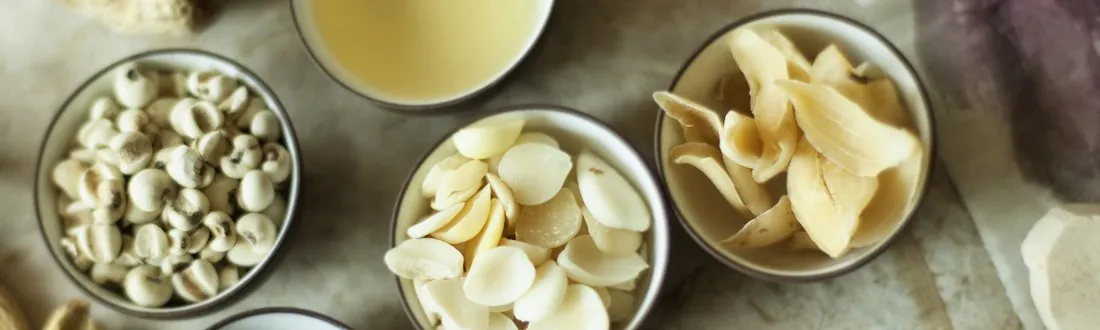
Yi Wei Tang is built from the “five Yin-nourishing” herbs: Sha Shen, Mai Men Dong, Sheng Di, Yu Zhu and Bing Tang (rock sugar). Each is sweet and cool, moistens dryness and gently nourishes fluid without burdening digestion or generating Damp.
I prescribe Yi Wei Tang as part of bespoke herbal formulas from pharmaceutical-grade granules sourced from Sun Ten in Taiwan.
TCM pattern
Yi Wei Tang is prescribed for Stomach Yin deficiency:
- Hunger but no appetite — the classical “Stomach Yin” sign; the Stomach is empty but the patient cannot eat
- Dry mouth and throat, especially after rising
- Mild dry retching or low-grade nausea[12] without vomit
- Slight constipation with dry, formed stool
- Mild low-grade fever or feeling of warmth in the afternoon
- Burning or empty sensation in the epigastrium
- Mouth ulcers in some cases
- Reduced thirst with desire for small sips (rather than large gulps)
- Tongue — red, dry, with little or peeled coat (a smooth, “mirror” tongue in chronic cases)
- Pulse — thin, slightly rapid, weak
The pattern is classically the aftermath of a warm-pathogen disease but in modern practice arises after any febrile illness, prolonged courses of antibiotics, chronic constipation, in dehydration, in older adults with naturally diminishing fluids, after chemotherapy or radiotherapy, in chronic gastritis, and as part of the picture in Long COVID.
Key herbs
- Sha Shen (Glehnia littoralis or Adenophora, 6-9g) — nourishes Stomach and Lung Yin; gently moistens dryness
- Mai Men Dong (Ophiopogon japonicus, 6-15g) — nourishes Stomach, Lung and Heart Yin; one of the most important Yin-nourishing herbs
- Sheng Di Huang (Rehmannia glutinosa fresh, 9-15g) — nourishes Yin and cools Blood
- Yu Zhu (Polygonatum odoratum, 4.5-9g) — gently nourishes Stomach and Lung Yin
- Bing Tang (rock sugar, 3g) — sweet, nourishes Stomach Yin, harmonises and pleasant for patients
Formula actions
- Nourishes Stomach Yin
- Generates fluids
- Resolves mild dryness and low-grade heat in the middle burner
- Restores appetite by replenishing fluids that the Stomach needs to receive food
Conditions treated
- Stomach Yin deficiency after febrile illness — the classical indication
- Post-viral fatigue[9] with reduced appetite — including Long COVID with appetite changes
- Recovery from gastroenteritis, food poisoning, antibiotics
- Chronic atrophic gastritis with dry stomach and decreased acid
- Recovery from chemotherapy with mouth dryness, mouth ulcers and reduced appetite
- Sjögren’s syndrome and dry-mouth conditions (alongside conventional management)
- Diabetes (xiao ke) with prominent thirst and dry mouth
- Functional dyspepsia with hunger but no appetite, dry retching — see acid reflux and digestive disorders
- Anorexia and recovery from eating disorders — supporting Stomach Yin in restored eating
- Constipation in elderly patients from Yin deficiency with dry stools
- Dry retching in pregnancy — see morning sickness
- Persistent nausea from Stomach Yin deficiency
Comparisons with related formulas
- Mai Men Dong Tang — for Lung and Stomach Yin deficiency with prominent cough[10]; closely related but emphasises Lung. Yi Wei Tang focuses on the middle burner.
- Sheng Mai San — for Qi and Yin deficiency from heat injury; better when fatigue and breathlessness are prominent.
- Sha Shen Mai Men Dong Tang — broader Yin-nourishing formula covering Lung and Stomach Yin together.
- Yu Nu Jian — for Stomach Yin deficiency with empty-Heat causing bleeding gums and ulceration.
- Zeng Ye Tang — for Yin deficiency with prominent dry constipation. Sometimes combined with Yi Wei Tang for both digestive and bowel symptoms.
Modifications
- For prominent dry constipation, combine with Zeng Ye Tang or add Xuan Shen and Sheng He Shou Wu
- For lingering low-grade heat, add Di Gu Pi and Yin Chai Hu
- For nausea, add small amounts of Zhu Ru and Pi Pa Ye
- For mouth ulcers, add Sheng Shi Gao and Huang Lian (small dose)
- For Qi deficiency overlay (chronic fatigue), add Tai Zi Shen and Huang Qi
- For very dry mouth and Sjögren’s pattern, add Shi Hu and Tian Hua Fen
- For chronic atrophic gastritis, add Bai Shao and Zhi Gan Cao to soften the Liver and pair Yin
Cautions
Not appropriate during damp-pattern digestive disorders — the sweet, moistening herbs will worsen Damp signs (thick tongue coat, bloating, loose stools, heavy head).
Not appropriate during acute infection or with thick yellow tongue coat.
Use with caution in diabetes if rock sugar (Bing Tang) is included — substitute with sugar-free preparations if needed.
Generally safe in pregnancy and in older adults — this is one of the gentler classical formulas.
Always consult a qualified Chinese herbalist registered with the Register of Chinese Herbal Medicine (RCHM). Online herbal consultations are available. See the prices page for costs.
Prefer to be treated from home? Chinese herbal medicine online consultations are available throughout the UK and worldwide. After a full video consultation, Dr (TCM) Attilio D'Alberto formulates a bespoke herbal prescription and posts your Chinese herbs directly to your door.
References
[9] Wang YY, Li XX, Liu JP, Luo H, Ma LX, Alraek T. Traditional Chinese medicine for chronic fatigue syndrome: a systematic review of randomized clinical trials. Complement Ther Med. 2014 Aug;22(4):826-33. https://doi.org/10.1016/j.ctim.2014.06.004. PMID: 25146086.
[10] Lee B, Kwon CY, Suh HW, Kim YJ, Kim KI, Lee BJ, Lee JH. Herbal medicine for the treatment of chronic cough: a systematic review and meta-analysis. Front Pharmacol. 2023 Oct 17;14:1230604. https://doi.org/10.3389/fphar.2023.1230604. PMID: 37920213.
[11] Lyu Z, Fan Y, Bai Y, Liu T, Zhong LL, Liang HF. Outcome of the efficacy of Chinese herbal medicine for functional constipation: A systematic review and meta-analysis. World J Clin Cases. 2022 May 26;10(15):4856-4877. https://doi.org/10.12998/wjcc.v10.i15.4856. PMID: 35801027.
[12] Zhai X, He Q, Chen M, Yu L, Tong C, Chen Y, et al. Pinellia ternata-containing traditional Chinese medicine combined with 5-HT3RAs for chemotherapy-induced nausea and vomiting: A PRISMA-compliant systematic review and meta-analysis of 22 RCTs. Phytomedicine. 2023 Jul;115:154823. https://doi.org/10.1016/j.phymed.2023.154823. PMID: 37099981.
Frequently asked questions
What is Yi Wei Tang used for?
Yi Wei Tang is the classical formula for Stomach Yin deficiency — a dry mouth and throat, hunger without any appetite, mild dry retching, a burning or empty feeling in the upper abdomen, slight dry constipation and a red tongue with little coat. In modern practice it is most often used during recovery after a feverish or viral illness, after antibiotics or chemotherapy, and in older adults whose fluids have thinned.
Can Yi Wei Tang help appetite loss after illness or Long COVID?
It may help when the appetite loss fits the Stomach Yin picture — feeling that you should eat but cannot face food, with a dry mouth and a peeled tongue — which is common after viral illness and in some Long COVID recovery. It is used as a complementary therapy alongside conventional care, and any significant or ongoing weight loss should be reviewed by your doctor.
What does “hunger but no appetite” mean?
It is the hallmark sign of Stomach Yin deficiency. The Stomach is empty and signalling hunger, but because it lacks the fluids (Yin) it needs to receive and process food, the person has no desire or ability to eat. Yi Wei Tang works by gently replenishing those Stomach fluids so normal appetite can return.
How is Yi Wei Tang different from Mai Men Dong Tang?
Both nourish Yin, but they aim at different organs. Mai Men Dong Tang emphasises Lung-and-Stomach Yin with a prominent dry cough, while Yi Wei Tang concentrates on the middle burner — the Stomach itself — for dryness, poor appetite and dry retching. A herbalist chooses between them, or combines related formulas, based on where the dryness sits.
Is Yi Wei Tang safe in pregnancy?
It is one of the gentler classical formulas and is generally considered safe in pregnancy and in older adults, which is why it is used for dry retching in early pregnancy within the right pattern. As with any herbal medicine in pregnancy, it should only be taken when prescribed by an RCHM-registered herbalist who knows you are pregnant.
Prefer to be treated from home? Chinese herbal medicine online consultations are available throughout the UK and worldwide.















