


TCM superfoods
On this page
- What are TCM superfoods?
- Medicine and food share the same origin
- The classical superior category
- How TCM superfoods differ from western "superfood" marketing
- Choosing the right superfood for your constitution
- Choosing by therapeutic action
- Choosing by season
- Combining superfoods
- How to use them daily
- Superfood directory
- General cautions
- Related pages
1. What are TCM superfoods?
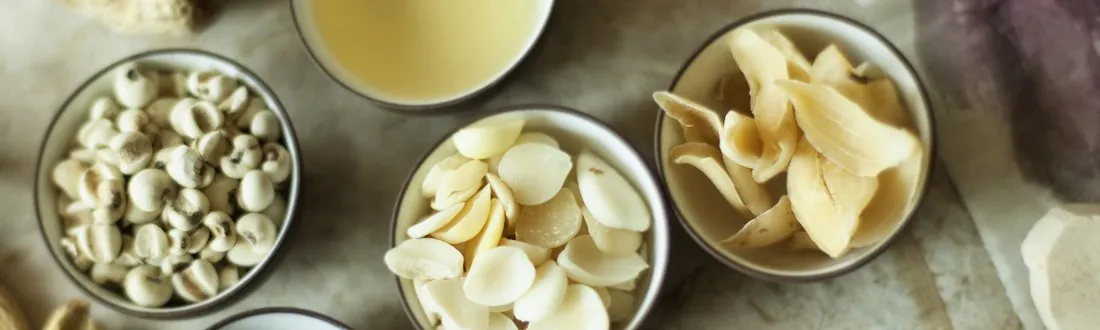
The Chinese tradition of yao shi tong yuan (药食同源) — medicine and food sharing the same origin — recognises a category of everyday foods that act as gentle, daily-use medicines. These “superfoods” have been used for centuries as both ingredients and tonic herbs and are recorded in classical Chinese materia medica. Each has a clearly defined therapeutic profile in Chinese food therapy, and each is used at quantities small enough to be food but consistent enough to act as medicine.
Unlike the western "superfood" marketing trend — where almost any nutrient-dense food can be branded a superfood — the TCM tradition recognises a specific, finite list of substances that have stood the test of two thousand years of clinical observation. The seven covered on this page are among the most extensively documented and widely used in modern Chinese homes and clinics. They are gentle enough for daily use, broad enough in action to suit varied constitutions and integrate easily into a Western kitchen.
2. Medicine and food share the same origin
The principle that food and medicine come from the same source is one of the foundational ideas of Chinese medicine. It means several things:
- Foods can be medicinal. When chosen correctly for the individual’s constitution and pattern, ordinary foods produce measurable therapeutic effects.
- Medicines can be foods. Many Chinese herbs (goji, jujube, walnut, sesame, lotus seed, Chinese yam, Job’s tears) appear in both the herbal materia medica and the cooking pot.
- Diet is the foundation of treatment. The classical Chinese physician Sun Simiao (581–682 AD) wrote: “A good physician first treats with diet; only if diet is insufficient does he turn to medicine.”
This integration of food and medicine is why every superfood on this page is also listed in the Chinese herbal materia medica. They blur the line deliberately.
3. The classical superior category
The first comprehensive Chinese materia medica, the Shennong Bencao Jing (Divine Farmer’s Classic of Materia Medica, c. 200 BCE), classified its 365 substances into three categories:
- Superior (shang pin): safe for daily long-term use to nourish life and promote longevity. No accumulation of side effects, no dependence, no toxicity.
- Middle (zhong pin): tonic and therapeutic substances; safe for periodic use under guidance.
- Inferior (xia pin): medicinal substances with significant action and side effects; for specific conditions only.
All seven superfoods on this page belong to the superior category. The superior classification is the strongest possible safety endorsement in classical Chinese medicine — substances that the human body benefits from across a lifetime of regular use. This is the standard the Chinese tradition holds its everyday tonic foods to.
4. How TCM superfoods differ from western "superfood" marketing
The word "superfood" has been overused in Western nutrition marketing. Almost any food rich in antioxidants, omega-3 or polyphenols can be branded a superfood. The TCM concept is more disciplined:
- Defined therapeutic profile. Each superfood has documented thermal nature, flavour, channel affinity and clinical actions — not just nutrition statistics.
- Constitutional matching. The same food is appropriate for one constitution and inappropriate for another. There is no universal "superfood for everyone."
- Long historical record. Centuries to millennia of documented use. Effects, indications and cautions all clinically observed.
- Modest portion size. 10–30 g daily, not large servings. The TCM principle is that small consistent inputs over time produce profound results.
- Combined with other foods. TCM superfoods are rarely used alone; they appear in soups, congees, teas and herbal formulas where their actions complement and harmonise.
5. Choosing the right superfood for your constitution
The right superfood depends on your TCM body constitution. The general matches:
| Constitution | Best superfoods | Use sparingly |
|---|---|---|
| Qi deficient | Red dates, Chinese yam, lotus seeds | Job’s tears (cooling) |
| Yang deficient | Walnuts, red dates, Chinese yam | Job’s tears (too cooling) |
| Yin deficient | Goji berries, black sesame, lotus seeds | Walnuts (too warming), red dates (warming) |
| Phlegm-damp | Job’s tears, Chinese yam | Black sesame (oily), red dates (sweet) in excess |
| Damp-heat | Job’s tears, lotus seed embryo | Walnuts, red dates, black sesame |
| Blood stasis | Black sesame, goji berries (with hawthorn) | Heavy oily tonics in excess |
| Qi stagnation | Lotus seed (calming), goji berries | Heavy stagnating foods in excess |
| Balanced | Any in moderation | Excess of any single one |
6. Choosing by therapeutic action
If you know what you want a superfood to do, this table indicates which to reach for:
| Therapeutic goal | Best superfood |
|---|---|
| Tonify Spleen qi (digestion, fatigue) | Red dates, Chinese yam, lotus seeds |
| Tonify Kidney yang (cold, low libido) | Walnuts, red dates |
| Tonify Kidney yin (night sweats, dryness) | Goji, black sesame, lotus seeds |
| Tonify Liver yin and blood (eyes, hair) | Goji, black sesame |
| Calm the Shen (anxiety, sleep) | Lotus seeds, red dates |
| Clear damp (puffiness, weight) | Job’s tears |
| Moisten Lungs (dry cough, autumn dryness) | Walnuts, black sesame |
| Moisten Intestines (constipation in older adults) | Black sesame, walnuts |
| Brighten the eyes | Goji |
| Skin clearing (acne, eczema) | Job’s tears |
| Build blood (post-menstrual, postpartum) | Red dates, goji, black sesame |
| Brain and cognitive support | Walnuts |
| Slow grey hair / hair loss | Black sesame |
7. Choosing by season
The TCM tradition matches food to season. The seasonal pairings:
- Spring (Liver season): light eating — goji for Liver yin, lotus seeds for emotional balance.
- Summer (Heart season): cooling foods — lotus seeds for Heart-clearing, Job’s tears for damp-heat.
- Late summer (Spleen season): sweet earth-element foods — Chinese yam, red dates, lotus seeds.
- Autumn (Lung season): moistening white foods — walnuts for Lung-moistening, black sesame for skin and Lung yin.
- Winter (Kidney season): deeply nourishing — walnuts, black sesame, red dates, goji.
8. Combining superfoods
Most TCM superfoods are used in pairs or trios where their actions complement each other. The classic combinations:
- Goji + chrysanthemum: Liver yin and eye-tonic tea — see goji-chrysanthemum tea.
- Walnut + black sesame: Kidney yang and yin combined — see black sesame paste.
- Red dates + ginger: warming blood-and-qi tonic — see red date and ginger tea.
- Goji + red dates + longan: Heart blood and Spleen qi together — the classic Eight Treasures tea base.
- Lotus seed + Chinese yam + red dates: universal Spleen-supporting trio for paediatric and elderly tonics.
- Black sesame + walnut + goji: the trio for Kidney essence and Liver-yin tonification — daily breakfast paste for adults over 40.
- Job’s tears + adzuki bean: the classical damp-clearing pair — see red bean and barley soup.
- Chinese yam + lotus seeds + red dates: the Spleen-supporting paediatric tonic.
- Eight Treasures combination: goji + red dates + lotus seeds + walnuts + longan + chrysanthemum + sesame + rock sugar — the comprehensive ceremonial blend.
9. How to use them daily
The most important principle is consistency at modest dose. Daily small servings over months produce more benefit than occasional large doses. Practical patterns:
- Add to congee or porridge: a spoonful of one or two superfoods stirred into morning congee or oats.
- Add to soups: red dates, goji, Chinese yam, lotus seeds and Job’s tears all integrate easily into Chinese, Western or fusion soups.
- Brew as tea: goji, red dates, ginger, chrysanthemum — daily caffeine-free tonic teas.
- Stir into yoghurt or kefir: ground sesame, chopped walnuts, soaked goji — modern western application.
- Toast and grind: sesame and walnuts must be ground for full nutrient absorption; do this in batches and store in the fridge.
- Snack: raw goji berries, walnut halves and pre-pitted red dates make convenient daily snacks.
10. Superfood directory
Click each for the full TCM and modern profile, with usage instructions, recipes and cautions:
- Goji berries (gou qi zi) — Liver and Kidney yin tonic, blood and eye tonic. Daily dose 10–20 g.
- Red dates / Jujube (hong zao / da zao) — classic Spleen qi tonic, calms the spirit, builds blood. Daily dose 3–6 dates.
- Black sesame (hei zhi ma) — Kidney essence, Liver blood, hair and skin nourishment. Daily dose 1–2 tbsp ground.
- Walnuts (hu tao ren) — Kidney yang tonic, brain food, Lung-moistening. Daily dose 30–50 g.
- Lotus seeds (lian zi) — Spleen and Kidney tonic, calms anxiety and supports sleep. Daily dose 10–30 g.
- Chinese yam (shan yao) — gentle three-organ tonic for Spleen, Lung and Kidney. Daily dose 30–60 g fresh.
- Job’s tears / Chinese pearl barley (yi yi ren) — clears damp, supports skin, eases joint stiffness. Daily dose 30–60 g.
11. General cautions
- Pregnancy: most TCM superfoods are safe in normal culinary amounts, but Job’s tears should be avoided. Discuss therapeutic doses with a practitioner.
- Acute infection or fever: deep tonifying superfoods are not appropriate during acute illness. Pause until recovered.
- Allergies: sesame, walnuts and goji can trigger allergic reactions. Test cautiously.
- Anticoagulants: goji and walnuts have mild blood-thinning interactions with warfarin.
- Diabetes: several superfoods (red dates, goji, lotus seeds) carry significant fruit sugar. Use in moderation if blood sugar is a concern.
- Match to constitution: the wrong superfood for your constitution can make things worse. Use the constitution-matching table above.
- Quality matters: sulphured goji, low-grade walnuts and dusty Job’s tears are widely sold. Prefer Chinese herbal pharmacies, organic suppliers or specialist Asian groceries.















