



Disorders of the Pericardium and Triple Burner
In Chinese medicine (TCM), the Pericardium (Xin Bao, 心包, the “Heart Protector”) is the sheath around the Heart that takes the impact of external pathogens before they reach the Emperor organ itself. The Triple Burner (San Jiao, 三焦) is the most unusual organ in TCM — a functional concept with no single anatomical equivalent, divided into the Upper, Middle and Lower Jiao regions, coordinating fluid metabolism, providing the avenue for the Yuan Qi (Source Qi) to reach the organs, and integrating the three regions of the torso as one functional unit. Together they form the Minister Fire pair (xiang huo), distinct from and complementary to the Sovereign Fire pair of Heart and Small Intestine. While the Heart-SI pair governs the spirit and the propulsion of blood, the Pericardium-Triple Burner pair governs the protective envelope around the Heart and the functional integration of body-wide fluid and qi distribution. Disorders of this pair cover the dramatic acute presentations of severe febrile illness (where the Pericardium is invaded by pathogenic Heat in the Wen Bing tradition), the Phlegm-misting presentations of impaired consciousness and dementia, the Shao Yang stage of half-exterior-half-interior disease, the chronic Triple Burner fluid disorders, the anxious chest-constraint presentations, and the lateral head, neck and ear disorders along the Triple Burner channel. This article presents the classical pattern differentiation and treatment strategies, drawing on the Nei Jing, Zhang Zhongjing’s Shang Han Lun on the Shao Yang stage, and the great Qing-dynasty synthesis of the Wen Bing school by Ye Tian-Shi (Wen Re Lun) and Wu Jutong (Wen Bing Tiao Bian).
Top Chinese herbs for the Pericardium and Triple Burner
The most clinically important Chinese herbs for the Pericardium-Triple Burner pair are:
- Chai Hu (Bupleurum) — the principal herb for the Shao Yang stage and for Triple Burner Qi obstruction; the imperial herb of Xiao Chai Hu Tang
- Huang Qin (Scutellaria root) — clears heat from the Shao Yang and Upper Jiao; pairs with Chai Hu in Xiao Chai Hu Tang
- Ban Xia (Prepared Pinellia) — transforms Phlegm in the chest and Middle Jiao; pairs with Chai Hu and Huang Qin
- Yu Jin (Curcuma tuber) — moves Liver qi and blood, clears Heart and Pericardium heat, opens the orifices for Phlegm-Heat misting
- Dan Shen (Salvia root) — moves Heart and Pericardium blood, calms the Shen, central to TCM cardiology
- Yuan Zhi (Polygala root) — opens the Heart orifices, resolves phlegm misting, restores Heart-Kidney communication
- Shi Chang Pu (Acorus rhizome) — opens the orifices and resolves phlegm; central to the Phlegm-misting formulas
- Zhu Ru (Bamboo shavings) — clears Phlegm-Heat from the Stomach and Gallbladder; central to Wen Dan Tang
- Zhi Shi (Immature Bitter Orange) — breaks up qi stagnation and dissolves phlegm in the chest; pairs with Zhu Ru in Wen Dan Tang
- Hou Po (Magnolia bark) — descends qi, transforms phlegm, opens the chest; central to Ban Xia Hou Po Tang for chest constraint and plum-stone throat
- Zi Su Ye (Perilla leaf) — releases the Exterior, opens the chest, regulates qi in the upper jiao
- Long Gu (Dragon Bone) — anchors the Shen, settles anxiety, central to Chai Hu Jia Long Gu Mu Li Tang
- Mu Li (Oyster shell) — pairs with Long Gu, anchors the Shen, softens hardness
- Sheng Di Huang (Raw Rehmannia) — cools the Ying level and the blood; central to Qing Ying Tang for Heat in the Pericardium
- Xuan Shen (Scrophularia root) — cools the Ying level and detoxifies; pairs with Sheng Di in Qing Ying Tang
These herbs are combined into the great Wen Bing-era and Shao Yang-stage formulas: Xiao Chai Hu Tang (Minor Bupleurum Decoction) for the Shao Yang stage; Chai Hu Jia Long Gu Mu Li Tang (Bupleurum plus Dragon Bone and Oyster Shell Decoction) for anxiety with palpitations and unsettled Shen; Wen Dan Tang (Warm the Gallbladder Decoction) for Phlegm-Heat harassing the Pericardium and Gallbladder; Qing Ying Tang (Clear the Ying-Level Decoction) for pathogenic Heat at the Ying level; An Gong Niu Huang Wan (Calm the Palace Pill with Cattle Bezoar, with plant-based substitutions in modern clinical practice) for severe Heat invading the Pericardium; Sheng Tie Luo Yin (Iron Filings Decoction) for Phlegm-Fire with mania; Wu Ling San (Five Ingredients Powder with Poria) for Triple Burner fluid disorder; Ban Xia Hou Po Tang (Pinellia and Magnolia Decoction) for chest constraint and plum-stone throat; and Zhen Wu Tang (True Warrior Decoction) for Yang deficiency with water overflow across the burners. A qualified Chinese herbalist selects and modifies these formulas based on each patient’s individual pattern.
The Pericardium: the Heart Protector
The Su Wen, Chapter 8, in the great organ-personality passages, names the Pericardium “the Official from whom joy and pleasure emerge” (shan zhong zhi guan, xi le chu yan) — though it is the Ling Shu that develops the Pericardium’s primary protective function. The Pericardium (Xin Bao Luo, 心包络) is the “envelope and connectors of the Heart”: in classical anatomy, it is the fibrous sheath that surrounds the Heart, and in TCM functional theory it is the protective organ that absorbs external pathogenic influence before it can reach the Heart-Sovereign itself.
Protecting the Heart from pathogenic invasion
The Pericardium’s defining function is protection of the Heart. In classical febrile-disease theory, the Pericardium is the first internal organ that pathogenic Heat reaches when invasion progresses beyond the Wei (defensive surface) level. The classical principle is direct: “Heat invades the Pericardium first, and protects the Heart-Sovereign from direct invasion”. When the Pericardium successfully absorbs the pathogenic impact, the patient may be very ill but consciousness is preserved; when the Pericardium is overwhelmed and the Heart itself is reached, consciousness collapses (delirium, coma, the loss of the patient’s “contact with the world” that classically precedes death in severe febrile illness).
This protective function is the foundation of the Wen Bing school’s four-level theory, codified by Ye Tian-Shi in Wen Re Lun (Discussion of Warm-Heat Diseases) and elaborated by Wu Jutong in Wen Bing Tiao Bian (Systematic Differentiation of Warm Diseases, 1798). The four levels — Wei, Qi, Ying, Xue — describe the progressive depth of pathogenic Heat invasion: Wei is the defensive surface; Qi is the level of the great Yang organs (Lung, Stomach); Ying is the “Nutritive” level reached when heat invades the Pericardium; Xue is the deepest blood-and-Yin level reached when the Heat damages the foundational substance.
Sharing Heart functions: blood and Shen
Beyond its protective role, the Pericardium shares the Heart’s functions of governing the blood and vessels and housing the Shen. Many of the chest-region pathologies that look as if they involve the Heart — chest pain, palpitations, Phlegm misting the consciousness, the chest constraint of anxiety — are formally Pericardium pathologies in classical TCM theory. The most famous practical example is the PC 6 (Neiguan) point: located on the inner wrist, it is one of the most clinically used points in TCM worldwide for nausea, chest pain, palpitations, anxiety and insomnia. PC 6 acts on the Pericardium-Triple Burner pair to regulate the entire upper jiao — the chest, the diaphragm, the upper abdomen.
The Pericardium channel
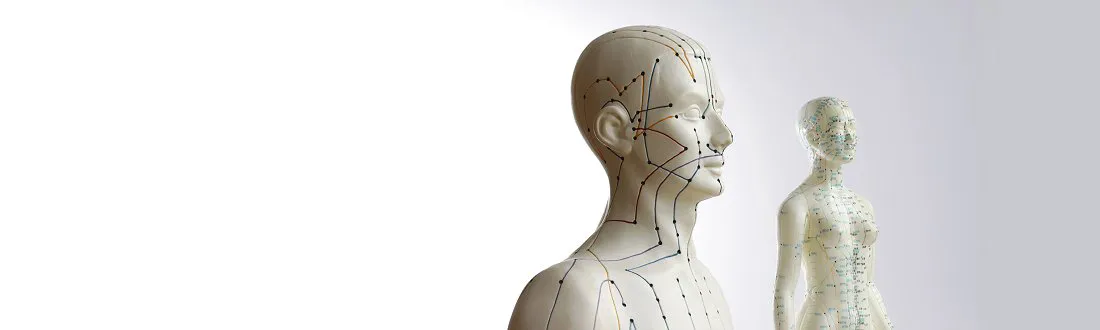
The Pericardium channel runs from the chest at PC 1 (Tianchi), along the inner arm to the middle finger at PC 9 (Zhongchong). It passes through the area of the heart and the upper abdomen, and connects to the Triple Burner through the Interior-Exterior pair. The Pericardium points — PC 3 (Quze) the He-Sea, PC 5 (Jianshi) the River point, PC 6 (Neiguan) the Luo-connecting point, PC 7 (Daling) the Yuan-source, PC 8 (Laogong) the Spring point, PC 9 (Zhongchong) the Well point — are extensively used in clinical practice for Heart, chest, mental and abdominal disorders.
The Triple Burner: the Official in Charge of Irrigation
The Triple Burner is the most unique and conceptually elusive organ in TCM. Classical texts describe it as “having a name but no form” (you ming wu xing) — recognising explicitly that it does not correspond to a single anatomical organ but to a functional system distributed across the body. The Su Wen, Chapter 8, names it “the Official in Charge of Irrigation, from whom the water passages emerge” (jue du zhi guan, shui dao chu yan).
The three Jiao regions
The Triple Burner divides the torso into three functional regions:
- Upper Jiao (shang jiao) — above the diaphragm, containing the Heart and Lung. Classical texts describe the Upper Jiao as “a mist” (shang jiao ru wu) — the region where qi vaporises, where breath enters, where the Heart distributes the blood.
- Middle Jiao (zhong jiao) — between the diaphragm and the navel, containing the Spleen and Stomach. Classical texts describe it as “a foam” (zhong jiao ru ou) — the region of digestive churning, where food is rotten-ripened and the Gu Qi is extracted.
- Lower Jiao (xia jiao) — below the navel, containing the Kidney, Bladder, Liver (positionally below the diaphragm but extending lower), the Intestines and the reproductive organs. Classical texts describe it as “a ditch” or “a swamp” (xia jiao ru du) — the region of filtering, excretion, and the storage of the deepest reserves.
The Triple Burner’s function is to coordinate these three regions as one integrated system — particularly the passage of fluids from above (Lung descent) through the middle (Spleen transformation) to below (Kidney transformation and Bladder excretion). When this coordination fails, fluid accumulates in one region while another runs dry; the body’s fluid balance becomes regional rather than systemic.
Avenue for the Yuan Qi
The Triple Burner is the avenue by which Yuan Qi (Source Qi), originating in the Kidney, reaches every organ and tissue. The Kidney holds the Yuan Qi as its constitutional reserve; the Triple Burner is the “piping” through which this Yuan Qi is distributed to power every other organ’s function. This explains why the Triple Burner’s function is intimately tied to the Kidney’s status — chronic Kidney depletion presents as Triple Burner Qi distribution failure across all three regions.
The Triple Burner channel
The Triple Burner channel runs from the ring finger at TB 1 (Guanchong), up the back of the arm, through the back of the shoulder, around the side of the neck, behind the ear, and to the outer corner of the eye. The Triple Burner points are clinically important for the lateral head, ear, and neck region: TB 3 (Zhongzhu) for headache and ear disorders; TB 5 (Waiguan) the Luo-connecting point and the Confluent of the Yang Wei Mai, for Shao Yang patterns, exterior release and ear disorders; TB 17 (Yifeng) behind the ear for tinnitus, facial paralysis, ear infections; TB 21 (Ermen) in front of the ear for tinnitus and hearing loss; TB 23 (Sizhukong) at the eye corner for temporal headache and eye disorders. TB 5 in particular is one of the most clinically used points in TCM practice worldwide.
Heat invading the Pericardium: the Ying level of warm disease
The Wen Bing school’s four-level theory describes the progression of pathogenic Heat from the surface into the body. The Ying level — the Pericardium level — is the third stage, reached when the Heat has overwhelmed the Lung and Stomach (the Qi level) and penetrated deeper. Heat invading the Pericardium (re xian xin bao) is the classical TCM picture of severe acute febrile illness with neurological involvement: high fever, marked agitation and restlessness, delirium with rambling speech or completely silent unconsciousness, dry red tongue, sometimes ulceration of the tongue and mouth, severe thirst, the eyes “wandering or staring without focus”, and in severe cases coma and convulsion. This is the TCM picture in severe bacterial meningitis, viral encephalitis, septic encephalopathy, severe sepsis with neurological involvement, and heat stroke.
Treatment strategy: Clear the Ying level and open the orifices (qing ying kai qiao). The defining formula is Qing Ying Tang (Clear the Ying-Level Decoction) from Wu Jutong’s Wen Bing Tiao Bian. The formula combines Sheng Di Huang + Xuan Shen + Mai Men Dong to cool and nourish the Ying; Jin Yin Hua + Lian Qiao + Dan Zhu Ye to clear residual surface heat; Dan Shen to move blood; Huang Lian to clear Heart-Stomach heat. Used in TCM hospital practice for severe febrile illness, often alongside conventional antibiotics and antiviral treatment.
For the most severe presentation with frank Heat invading the Pericardium with delirium or coma, the classical “three treasures” (liang bao) are deployed:
- An Gong Niu Huang Wan (Calm the Palace Pill with Cattle Bezoar) — the most cooling and the principal formula for severe heat-induced coma. The classical formula contains Niu Huang (cattle gallstones), Xi Jiao (rhinoceros horn — universally substituted now with Shui Niu Jiao, water buffalo horn), She Xiang (musk — my clinic uses plant-based substitutes for animal-welfare reasons), Huang Qin, Huang Lian, Zhi Zi, Bing Pian (Borneol), Yu Jin, Zhu Sha (cinnabar — substituted with plant equivalents for safety), Xiong Huang (realgar — substituted). With ethical substitutions, the formula remains highly effective.
- Zi Xue Dan (Purple Snow Special Pill) — cooling and orifice-opening with focus on tremor and convulsion; uses minerals (Magnetite, Hua Shi, Han Shui Shi) plus aromatic herbs.
- Zhi Bao Dan (Greatest Treasure Special Pill) — balanced cooling-and-opening for the intermediate presentation between An Gong and Zi Xue.
The acupuncture combination for acute Pericardium-Heat involvement is precise and dramatic: PC 9 (Zhongchong) bled at the fingertip; GV 26 (Renzhong) the principal acute-revival point; GV 20 (Baihui); the “ten declines” (shi xuan) at the fingertips. These are emergency techniques used in TCM resuscitation protocols.
Phlegm misting the Pericardium
Phlegm misting the Pericardium / orifices (tan mi xin qiao) is the classical TCM pattern for impaired consciousness from Phlegm rather than Heat. It is the picture in stroke (particularly the cold-and-phlegm stroke pattern, the “tense stroke” biao zhong with sudden coma), in some forms of dementia, in post-stroke cognitive impairment, in severe depression with cognitive dulling, in some psychotic presentations, in vegetative-state coma, in vascular cognitive impairment. The mechanism is that Phlegm, generated by Spleen failure or by chronic Liver Qi stagnation, has risen and obstructed the “orifices” through which consciousness is illuminated.
Symptoms include impaired consciousness ranging from mental dulling and slow thinking, through confusion and disorientation, to frank coma; emotional flatness or paradoxical agitation; slurred or rambling speech; gurgling sound in the throat (the audible phlegm); excessive drooling; vivid disturbing dreams or hallucinations; and in severe cases the catatonic-vegetative state. The tongue has a thick greasy white or yellow coating; the pulse is slippery and wiry.
Treatment strategy: Open the orifices, dissolve phlegm (kai qiao hua tan). The differentiation between Cold-Phlegm and Hot-Phlegm misting determines the formula choice:
- Cold-Phlegm misting (the dementia, post-stroke, comatose patient with cold features, pale or dusky face, white greasy coating): the classical formula is Su He Xiang Wan (Liquid Styrax Pill), which contains She Xiang (musk — substituted in my clinic), traditional cinnabar (Zhu Sha — not stocked, plant-based substitutes used), Su He Xiang (storax), Bing Pian (borneol), An Xi Xiang (benzoin) and other aromatic warming substances. With ethical substitutions, the formula remains useful for cold-phlegm misting of the orifices.
- Hot-Phlegm misting (acute febrile delirium, severe psychiatric agitation with heat features): An Gong Niu Huang Wan as above.
For chronic Phlegm misting (the chronic dementia, post-stroke cognitive impairment, chronic schizophrenia presentations), the formula Di Tan Tang (Wash Away Phlegm Decoction) by Yan Yong-He is the foundational treatment: Ban Xia + Chen Pi + Fu Ling + Gan Cao (Er Chen Tang base); Zhi Shi + Zhu Ru break up Phlegm; Dan Nan Xing (Bile-Prepared Pinellia) for stubborn phlegm; Shi Chang Pu + Yuan Zhi open the orifices; Ren Shen and Sheng Jiang support the Spleen Qi.
The acupuncture combination PC 5 (Jianshi) for Phlegm misting; PC 6 (Neiguan); GV 26 (Renzhong) for acute revival; GV 20 (Baihui) for cognitive enhancement; ST 40 (Fenglong) the principal Phlegm point; and the “13 Ghost points” described by Sun Si-Miao for severe psychiatric presentations.
Phlegm-Heat harassing the Heart and Pericardium
Phlegm-Heat harassing the Pericardium (tan re rao xin) is the most clinically common compound pattern of the Pericardium and is the foundational TCM picture in many anxiety, insomnia, panic and milder psychiatric presentations. The mechanism is that Phlegm-Damp has accumulated (typically from Spleen Qi deficiency, poor diet with rich greasy or sweet food, or chronic Liver Qi stagnation) and the Phlegm has generated Heat from its long obstruction. The Heat-laced Phlegm then harasses the Pericardium and Heart producing the distinctive symptom cluster.
Symptoms include severe insomnia with vivid disturbing dreams (often recurring dreams of being chased, pursued, attacked or unable to find a way out); palpitations particularly at night; chronic anxiety with chest tightness; irritability; sometimes mild paranoia or persecutory thinking; nausea or vague chest fullness; bitter taste in the mouth; sticky mouth; dizziness; mild cognitive dulling; sometimes mild agitation. The tongue is red with a yellow greasy coating; the pulse is slippery and wiry, often rapid.
Treatment strategy: Clear Phlegm-Heat, calm the Shen (qing tan an shen). The defining formula is Wen Dan Tang (Warm the Gallbladder Decoction) — despite its name (which derives from the formula restoring the Gallbladder to its proper “warming” function within the body, not from a thermal effect), Wen Dan Tang is a Phlegm-clearing, mildly cooling formula. Ban Xia + Chen Pi + Fu Ling + Gan Cao (Er Chen Tang base) + Zhi Shi + Zhu Ru. For more severe Phlegm-Heat with greater agitation, add Huang Lian + Zhi Zi to create Huang Lian Wen Dan Tang. For chronic Phlegm-Heat with prominent anxiety and palpitations, add Long Gu + Mu Li + Zhen Zhu Mu to anchor the Shen.
An alternative foundational formula is Chai Hu Jia Long Gu Mu Li Tang (Bupleurum plus Dragon Bone and Oyster Shell Decoction) from the Shang Han Lun. This formula combines the Shao Yang-stage Bupleurum-Pinellia-Huang Qin core with anchoring minerals (Long Gu, Mu Li) and is one of the most clinically reliable formulas in TCM practice for anxiety with prominent palpitations, sleep disturbance, irritability and chest tightness — the picture of generalised anxiety disorder, panic attacks with somatic features, and chronic stress with mixed mental-physical symptoms.
For severe Phlegm-Heat with frank mania (the bipolar manic episode, severe psychotic agitation, acute psychotic reactions), the classical formula is Sheng Tie Luo Yin (Iron Filings Decoction). The formula uses Sheng Tie Luo (iron filings) as the emperor herb — its great mass and anchoring weight subdue the rebellious Phlegm-Heat. Tian Men Dong + Mai Men Dong nourish the consumed yin; Bei Mu + Dan Nan Xing transform the phlegm; Lian Qiao + Dan Shen + Fu Ling + Yuan Zhi + Shi Chang Pu open the orifices and clear residual heat. Modern Chinese inpatient psychiatry uses Sheng Tie Luo Yin alongside conventional antipsychotics for acute manic and psychotic states.
The Shao Yang stage: half-exterior, half-interior
The Shao Yang stage is one of the six stages of febrile disease in Zhang Zhongjing’s Shang Han Lun, and is the stage where the pathogen has progressed beyond the surface (Tai Yang) but has not yet reached the interior (Yang Ming or the three Yin levels). The Shao Yang involves the Gallbladder and Triple Burner channels. The classical symptom set is distinctive: alternating chills and fever (the patient cannot quite get cold and cannot quite get hot), fullness in the chest and hypochondrium, bitter taste, dry throat, blurred vision, dizziness, irritability, nausea, no appetite, and a wiry pulse. The tongue has a thin white or thin yellow coating.
Treatment strategy: Harmonise the Shao Yang (he jie shao yang). The defining formula is Xiao Chai Hu Tang (Minor Bupleurum Decoction) from Zhang Zhongjing — one of the most clinically important formulas in all of Chinese medicine. Chai Hu + Huang Qin as the emperor pair (one releases the Shao Yang from the surface, one clears the Shao Yang heat from the interior); Ban Xia + Sheng Jiang descend the rebellious Stomach Qi and address the nausea; Ren Shen (or Dang Shen) + Da Zao + Gan Cao support the Spleen-Stomach Qi against the Shao Yang attack.
Xiao Chai Hu Tang is one of the most clinically reliable formulas in TCM practice for the half-exterior-half-interior presentation: persistent low-grade febrile illness; the “not quite getting better and not quite ill” post-viral state; chronic Lyme-like presentations with intermittent fever, nausea and hypochondriac fullness; long COVID with this pattern picture; chronic fatigue with intermittent fever; chronic hepatitis (the Shao Yang involvement of the Gallbladder); chronic biliary disease with intermittent pain. Modern Chinese clinical practice has extensively documented Xiao Chai Hu Tang’s use in hepatobiliary disease, chronic fatigue states, and the post-infectious presentations.
The formula has many derivatives based on the additional features present:
- Da Chai Hu Tang (Major Bupleurum Decoction) — adds Da Huang and Zhi Shi for Shao Yang with constipation and severe abdominal fullness; used for acute cholecystitis and gallstone disease
- Chai Hu Jia Long Gu Mu Li Tang — covered above; Shao Yang plus anxiety and unsettled Shen
- Chai Hu Gui Zhi Tang — combines Xiao Chai Hu Tang with Gui Zhi Tang for combined Tai Yang-Shao Yang presentation
- Hao Qin Qing Dan Tang — Qing Hao + Huang Qin + Zhu Ru + Ban Xia + Chen Pi + Fu Ling + Bi Yu San; for Shao Yang with prominent damp-heat features (the classical formula for malaria-pattern alternating fever)
The acupuncture combination TB 5 (Waiguan) — the Confluent of the Yang Wei Mai, opens the lateral channels, releases the Shao Yang; GB 41 (Zulinqi) — the Confluent of the Dai Mai, pairs with TB 5; GB 34 (Yanglingquan) for the Shao Yang; PC 6 (Neiguan) for nausea; SP 6 (Sanyinjiao) for general harmonisation.
Triple Burner Qi obstruction and fluid disorders
Triple Burner Qi obstruction (san jiao qi bi) is the pattern where the integrated function of the three jiao regions has failed. Fluids accumulate in one region while another runs dry; qi cannot pass freely between organs; the body’s fluid balance becomes regional and uncoordinated rather than systemic and balanced. This is the TCM picture in idiopathic generalised oedema crossing multiple body regions, in lymphoedema (alongside lymphatic specialist care), in some forms of chronic fluid retention syndrome, in nephrotic syndrome with refractory oedema, and in the “wandering” fluid problems that move between body regions without obvious cause.
Treatment strategy: Regulate the Triple Burner, restore fluid passage (tiao li san jiao). The classical formulas include:
- Wu Ling San (Five Ingredients Powder with Poria) from the Shang Han Lun — the foundational Triple Burner fluid formula. Fu Ling + Zhu Ling + Ze Xie drain water through the urinary route; Bai Zhu strengthens the Spleen; Gui Zhi warms and assists yang transformation. Used in modern Chinese practice for idiopathic oedema, premenstrual fluid retention, post-operative fluid retention, and as adjunctive treatment in CHF and renal disease.
- Zhen Wu Tang (True Warrior Decoction) for Yang deficiency with water overflow throughout the burners — covered in the Kidney-Bladder article; particularly indicated when oedema is combined with cold features, fatigue and low back ache.
- Wu Pi San (Five Peels Powder) for skin and limb oedema with abdominal distension — Sang Bai Pi, Sheng Jiang Pi, Da Fu Pi, Chen Pi, Fu Ling Pi.
Chest constraint and plum-stone throat
Chest constraint with plum-stone throat sensation (mei he qi) is one of the most clinically distinctive patterns described in TCM and is the picture of the somatic-anxiety-with-throat-sensation that virtually any modern Western practitioner will have seen. The patient describes a sensation as of something lodged in the throat — like a small plum stone — that cannot be swallowed and cannot be coughed up. Investigation (ENT examination, oesophagoscopy) finds nothing structural. The sensation worsens with emotion, with stress, with sustained tension; it improves when the patient is relaxed and engaged in pleasant activity. Often accompanied by chest tightness, frequent sighing, chest fullness, sometimes mild dysphagia.
The classical TCM mechanism: Liver Qi stagnation has produced Phlegm-Qi accumulation in the chest and throat region. The formula Ban Xia Hou Po Tang (Pinellia and Magnolia Decoction) from Zhang Zhongjing’s Jin Gui Yao Lue is the defining treatment. The classical text describes the indication poetically: “the woman who feels as if roasted meat is lodged in her throat”. Ban Xia dissolves the phlegm; Hou Po descends the qi and opens the chest; Fu Ling calms the Shen and drains damp; Zi Su Ye opens the upper jiao; Sheng Jiang assists Ban Xia. The formula is small, elegant and reliably effective; most patients experience meaningful improvement within 4–6 weeks.
Where the chest constraint coexists with severe anxiety and unsettled Shen, combine Ban Xia Hou Po Tang with Gan Mai Da Zao Tang (Licorice, Wheat and Jujube Decoction) for “visceral agitation” (zang zao) — the classical TCM picture of the woman with the “hundred sorrows”, frequent crying, restless agitation, no apparent external cause. The combination is one of the most useful in TCM practice for somatic anxiety with chest and throat features.
Pericardium-Triple Burner channel pathologies
Beyond the internal organ patterns, the Pericardium and Triple Burner channels run through important regions of the body and disorders of these channels produce clinically recognisable presentations:
Pericardium channel: Pain along the inner arm; the channel runs through the area of the heart and the upper abdomen. Use Pericardium channel points (PC 3 He-Sea, PC 5 River, PC 6 Luo, PC 7 Yuan) for inner-arm and elbow pain, for the carpal tunnel pattern in the wrist, and for chest pain referred through the channel.
Triple Burner channel: Pain along the back of the arm, the side of the shoulder, the side of the neck, the side of the head, the ear region. Tinnitus and ear disorders are the most clinically common Triple Burner channel pathologies. TB 17 (Yifeng) behind the ear is the principal point for tinnitus and is one of the most clinically reliable acupuncture points for ear-region disorders. TB 21 (Ermen) in front of the ear treats hearing loss and tinnitus. TB 5 (Waiguan) distally treats temporal headache, side-of-the-head dizziness, and the lateral neck pain that radiates from the cervical spine through the trapezius region.
Differentiating yin and yang patterns of the Pericardium
The Pericardium, sharing Heart functions, expresses similar yin-yang differentiation but in a less dramatic and less commonly named form than the Heart patterns. The Pericardium pathologies that involve substance depletion (Pericardium Yin deficiency, Pericardium Blood deficiency) are usually subsumed clinically under the Heart equivalents (Heart Yin deficiency, Heart Blood deficiency) covered in the Heart-Small Intestine article. The Pericardium-specific patterns are typically excess (Heat invasion, Phlegm misting, channel obstruction) rather than deficiency.
Differentiating Wei, Qi, Ying, Xue levels
The four-level framework of warm disease is the Wen Bing school’s great contribution and is essential for understanding Pericardium pathology in the febrile-disease context. Briefly:
Wei (Defensive) level: The early surface stage. Fever, slight chills, headache, sore throat, sometimes cough. The Lung is the principal organ. Treatment uses Yin Qiao San, Sang Ju Yin.
Qi (Energetic) level: The pathogen has entered the interior but is at the level of qi rather than substance. High fever, marked thirst, sweating, restlessness. The Lung and Stomach are the principal organs. Treatment uses Bai Hu Tang (Tiger Decoction), Ma Xing Shi Gan Tang.
Ying (Nutritive) level: Heat has entered the Pericardium. High fever (often worse at night), delirium, vivid dreams, rash on the skin, dry red tongue. Treatment uses Qing Ying Tang and the three treasures (An Gong Niu Huang Wan etc.) as discussed above.
Xue (Blood) level: The deepest level. The Heat damages blood and yin substantially. High fever with the addition of haemorrhagic features (bleeding from any orifice, purpura, frank bleeding), convulsion, coma. The Heart, Liver and Kidney are all involved. Treatment uses Xi Jiao Di Huang Tang (Rhinoceros Horn and Rehmannia Decoction — with Shui Niu Jiao, water buffalo horn, substituted for the protected rhinoceros horn).
Frequently asked questions about the Pericardium and Triple Burner
Why is PC 6 (Neiguan) such an important acupuncture point?
PC 6 (Neiguan) is the Luo-connecting point of the Pericardium and the Confluent (Master) point of the Yin Wei Mai. Its clinical applications cover the entire upper jiao: nausea, vomiting (the most-researched application, used widely in pregnancy, chemotherapy and post-operative nausea); palpitations, chest pain, the somatic anxiety of chest tightness; the panic attack with chest oppression; insomnia. Modern controlled trials have demonstrated PC 6’s efficacy in post-operative and chemotherapy-induced nausea, and acupressure bands worn at PC 6 are now standard adjunctive treatment for motion sickness and morning sickness. The point sits at one of the most regulatable locations on the body and is often the first or second point chosen in any treatment involving anxiety, nausea or chest discomfort.
What is the Shao Yang stage in Chinese medicine, and how is it recognised clinically?
The Shao Yang stage is the “half-exterior, half-interior” stage of febrile disease — the pathogen has progressed beyond the surface but has not yet reached the deep interior. It involves the Gallbladder and Triple Burner channels. The classical symptom set is distinctive: alternating chills and fever (the patient cannot quite get cold and cannot quite get hot), fullness in the chest and hypochondrium, bitter taste, dry throat, blurred vision, dizziness, irritability, nausea, no appetite, and a wiry pulse. Clinically it presents as the “not quite better and not quite ill” post-viral state, chronic fatigue with intermittent fever, chronic Lyme-like presentations, long COVID with hypochondriac fullness and intermittent fever, and chronic hepatitis. The defining treatment is Xiao Chai Hu Tang (Minor Bupleurum Decoction) — one of the most clinically reliable formulas in TCM practice.
Why does anxiety often present with throat and chest sensations in Chinese medicine?
The Pericardium and Triple Burner channels run through the chest, diaphragm and throat area; chronic Liver Qi stagnation produces Phlegm-Qi accumulation in this region, which the patient experiences as the “plum-stone throat” sensation (a feeling as of a lump in the throat that cannot be swallowed or coughed up), the “chest tightness” of anxiety, the “something stuck” feeling between the breasts. The defining formula is Ban Xia Hou Po Tang from Zhang Zhongjing’s Jin Gui Yao Lue: Ban Xia dissolves phlegm, Hou Po descends qi, plus Fu Ling, Zi Su Ye, Sheng Jiang. Acupuncture at CV 17 (Shanzhong), PC 6, CV 22 (Tiantu) and LV 3 opens the chest and throat region. Most patients experience meaningful improvement within 4–6 weeks. This is a clinically prescient TCM observation — modern Western somatic-symptom and globus pharyngeus presentations map directly onto this two-thousand-year-old pattern.
Can Chinese medicine help with tinnitus and ear disorders through the Triple Burner?
Yes. The Triple Burner channel runs around the ear, and many ear-region disorders involve the Triple Burner as the channel pathway. Acupuncture at TB 17 (Yifeng) behind the ear, TB 21 (Ermen) in front of the ear, plus distal points TB 3 and TB 5 — combined with the underlying pattern-based herbal treatment (Kidney Yin deficiency formulas for high-pitched ringing tinnitus, Kidney Yang formulas for low-soft hum, Liver-Gallbladder Fire formulas for acute roaring tinnitus) — produces meaningful improvement in most chronic tinnitus presentations. Treatment is more effective for tinnitus that is less than 5 years old; long-standing tinnitus is harder to reverse but typically still improves to some degree. See the companion article on Disorders of the Kidney and Bladder for the deeper Kidney-Essence framework underlying chronic tinnitus.
How does Chinese medicine treat impaired consciousness and coma?
The treatment is differentiated by the underlying pattern. Heat invading the Pericardium (high fever, delirium, agitation) uses the “three treasures” (An Gong Niu Huang Wan, Zi Xue Dan, Zhi Bao Dan) with appropriate ethical substitutions for protected and toxic ingredients. Phlegm misting the orifices (cold variant, with pale duskiness and slow pulse) uses Su He Xiang Wan (with substitutions) or Di Tan Tang. Yang collapse with cold-sweating and faint pulse uses Si Ni Tang or Shen Fu Tang. The acupuncture treatment is precise: GV 26 (Renzhong) is the first-line emergency revival point and is one of the points used in TCM-trained emergency staff; PC 9 bled at the fingertip; the “ten declines” (Shi Xuan) bled at the tips of all fingers. All of this is administered alongside conventional resuscitation and critical care — the modern TCM approach is rigorously integrative in critical illness.
What is the practical clinical meaning of the “three jiao” division of the body?
The three-jiao division provides a clinical framework for understanding which symptoms cluster together, which organs are involved, and what treatment strategies are appropriate. Upper Jiao disorders (Heart, Lung) cluster around chest, breathing, throat, voice, complexion, palpitations. Middle Jiao disorders (Spleen, Stomach) cluster around appetite, digestion, energy, weight, bowel function. Lower Jiao disorders (Kidney, Bladder, Liver, Intestines, reproductive organs) cluster around urinary, reproductive, lower back, lower abdomen, hormonal function. When symptoms span multiple jiao regions (the patient with palpitations + digestive disturbance + urinary frequency), the Triple Burner-coordinating treatment is appropriate (Wu Ling San, Xiao Chai Hu Tang, Wen Dan Tang as differentiated). When symptoms cluster in one jiao, the specific organ-level treatment for that jiao is appropriate. The three-jiao framework remains one of the most clinically useful diagnostic tools in TCM practice.
Conclusion
The Pericardium and Triple Burner pair, the Minister Fire couple, occupies a unique position in classical TCM theory. The Pericardium is the protective envelope of the Heart, the absorber of pathogenic invasion, the channel host for some of the most clinically used points in the body; the Triple Burner is the functional concept that integrates the three regions of the torso into a coordinated fluid-and-qi-distribution system. Together they govern the boundary between internal and external in febrile illness, the integrated function of the body’s three regions, the protective screen around the Sovereign organ, and the lateral channel pathways of the upper body that produce so many of the head, neck and ear presentations. The key clinical principles, summarised across the classical literature, are:
- The Pericardium protects the Heart — severe febrile illness reaches the Pericardium before the Heart; clearing heat at this level prevents progression to fatal cardiovascular involvement
- The Triple Burner has “a name but no form” — the functional integration of fluid and qi distribution across the three jiao regions
- The Shao Yang stage of febrile disease is half-exterior, half-interior — the harmonising treatment with Xiao Chai Hu Tang restores the balance without forcing the pathogen deeper or pushing it back to the surface
- The Wen Bing four-level framework (Wei, Qi, Ying, Xue) is essential for understanding severe febrile illness and the Pericardium’s role at the Ying level
- Phlegm misting the orifices presents along a spectrum from mild cognitive dulling to frank coma — treatment differs by cold versus hot phlegm with corresponding formula selection
- The Pericardium-Triple Burner channels treat the lateral head, neck, ear and chest region — the most clinically reached channels for tinnitus, lateral migraine, and ear-region disorders
- PC 6 (Neiguan) is one of the most clinically important acupuncture points in the world — effective for nausea, anxiety, palpitations, chest pain and insomnia across multiple controlled-trial demonstrations
- Ban Xia Hou Po Tang remains the principal classical treatment for somatic anxiety with throat and chest features — the “plum-stone throat” observation has not been improved upon in 1,800 years
The classical scholarship on this pair runs from the Nei Jing’s foundational organ-personality passages, through Zhang Zhongjing’s Han-dynasty Shao Yang chapters in the Shang Han Lun, through Sun Si-Miao’s Tang-dynasty work on the Pericardium-Shen interface, through Yan Yong-He’s Song-dynasty contributions on Phlegm misting, to the great Qing-dynasty synthesis of the Wen Bing school by Ye Tian-Shi and Wu Jutong which placed the Pericardium at the centre of the warm-disease theory that remains foundational in modern Chinese hospital infectious-disease practice.
Further reading on this site
Return to the Zang-Fu organ overview. Read the related organ hub pages for the Pericardium and Triple Burner. See the companion deep-dive articles on Disorders of the Spleen and Stomach (Earth), Disorders of the Liver and Gallbladder (Wood), Disorders of the Heart and Small Intestine (Sovereign Fire), Disorders of the Kidney and Bladder (Water) and Disorders of the Lung and Large Intestine (Metal) — the complete six-pair set of organ-disorder deep dives. For specific conditions discussed in this article, see anxiety, insomnia, tinnitus, morning sickness and the FAQs on the PC 6 (Neiguan) and TB 5 (Waiguan) point pages.















